

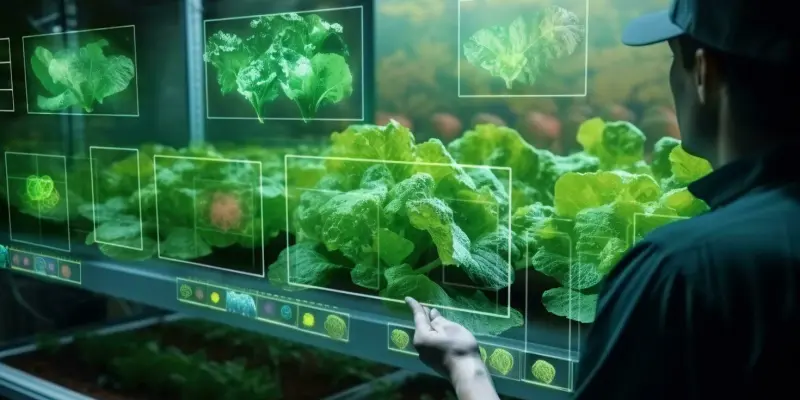
Artificial Intelligence (AI) has emerged as a pivotal force in reshaping agricultural practices, spearheading advancements that promise to revolutionize traditional farming methods. This technological transformation is not merely about mechanizing procedures but rather about integrating intelligence into every facet of agriculture. Farmers across the globe are increasingly adopting AI-driven technologies to optimize efficiency, sustainability, and productivity. From enhancing crop monitoring with aerial drones to deploying sophisticated predictive models, AI is paving the path toward smart farming. These innovations enable the meticulous analysis of data, offering insights that help manage resources more effectively. The advent of AI is fostering an era where farming decisions rely heavily on data-driven insights, and adaptability is paramount to overcoming environmental challenges. A deeper exploration into specific applications of AI highlights its critical role in redefining agricultural practices, emphasizing the synergy between technology and nature.
Precision Farming and Crop Monitoring
AI-powered drones have become indispensable in precision farming, offering a groundbreaking approach to crop and soil monitoring. These drones utilize advanced imaging technologies, including multispectral and computer vision techniques, to capture real-time, high-resolution images of fields. Unlike traditional methods, this innovation provides farmers with pinpoint data on crop health, stress levels, diseases, and nutrient deficiencies. Deep learning models embedded within these systems convert vast datasets into actionable insights, enhancing decision-making precision. The ability to rapidly cover extensive areas ensures that crop conditions are monitored continuously, minimizing the reliance on manual scouting. This shift toward data-centric farming fosters resource optimization, guaranteeing improved yields while sustaining the environment. Drones, thus, embody a fundamental change in agricultural monitoring, showcasing the power of AI in facilitating smarter resource use and bolstering field management efficiency.
Smart Soil Analytics and Resource Optimization
AI-driven soil analytics mark a significant advancement, integrating Internet of Things (IoT) networks to redefine soil monitoring. Intelligent sensors are deployed across farms, measuring moisture levels, pH balance, and nutrient content. This data acquisition is powered by LoRaWAN technology, known for its minimal power consumption and extended range, allowing information transmission across large agricultural landscapes. Edge computing systems play a vital role by processing data locally, reducing dependency on constant cloud connectivity. Consequently, real-time irrigation and fertilization adjustments become feasible, optimizing resource utilization while curbing environmental impacts. This smart approach to soil management not only preserves resources but also serves as a cornerstone in the pursuit of sustainable farming. By harnessing AI, these innovations drive efficiency, underscoring the importance of intelligent resource management in contemporary agriculture. This developmental stride signals a paradigm shift toward greater ecological consciousness within the farming sector.
Weather Forecasting and Risk Management
AI in weather forecasting is reshaping agricultural practices by offering unparalleled precision in climate predictions. Leveraging Long Short-Term Memory (LSTM) networks and gradient boosting algorithms, AI-driven models comprehensively analyze historical climate data to anticipate adverse weather events such as droughts, frost, and storms. Bayesian neural networks further reinforce these predictions, quantifying uncertainties to enable informed farming decisions based on risk assessment. This capability to forecast weather patterns equips farmers with the foresight needed to implement preventive measures for crop protection against unpredictable climatic events. By proactively managing risks, farmers are better positioned to safeguard their yields, align strategies, and enhance resilience against environmental challenges. Such tailored solutions foster innovative agricultural risk mitigation, highlighting AI’s pivotal role in bolstering farm management amid shifting climatic conditions. This proactive stance signifies a substantial advancement in the cultivation of an agile agricultural sector.
Decision Support Systems and Sustainability
AI-driven decision support systems have emerged as linchpins in the evolution of precision farming, integrating diverse data sources to optimize farming processes. Utilizing satellite imagery, soil health analytics, and deep learning models, these systems refine predictions for planting schedules, irrigation cycles, and fertilization strategies. Incorporating real-time field data enhances accuracy, enabling farmers to maximize crop yields while minimizing resource waste. This comprehensive analysis fosters smart farming practices characterized by lower costs and reduced environmental footprints. By embracing advanced analytics, the agricultural sector can transition toward more sustainable methods, enhancing productivity and resilience. The ability to leverage AI for informed decision-making epitomizes a shift toward functionality and ecological balance, underscoring the transformative potential of technology in agriculture. As sustainability becomes a focal point, AI proves instrumental in aligning farming practices with environmental stewardship goals.
Intelligent Irrigation and Pest Management
The role of AI in irrigation systems underscores its commitment to fostering sustainable agricultural practices. AI-powered models dynamically adjust watering schedules based on soil moisture data, weather forecasts, and specific crop water needs, ensuring efficient water use and conservation. This precision prevents over-irrigation, reducing water waste and operational costs while maintaining crop health. Concurrently, AI-driven pest and disease management systems enhance crop protection by predicting infestations before they occur. Advanced machine learning models identify plant diseases early, allowing targeted interventions that minimize pesticide use and ecological disruption. The integration of AI into pest management highlights a strategic shift toward environmental protection, promoting a symbiotic relationship between agriculture and nature. This forward-thinking approach not only supports ecological sustainability but also exemplifies the holistic benefits AI brings to modern farming.
Future Considerations and Technological Evolution
Artificial Intelligence (AI) has become a transformative force in agriculture, reshaping how farming is done by integrating intelligent systems into traditional practices. This evolution goes beyond mere mechanization, focusing on embedding smart technology into every aspect of agriculture. Globally, farmers are increasingly embracing AI-driven tools to enhance efficiency and yields while promoting sustainability. Technologies like aerial drones for crop monitoring and advanced predictive models are leading the charge toward smart farming. These innovations allow in-depth data analysis, providing insights that significantly improve resource management. As AI advances, farming decisions are increasingly reliant on data-driven insights, becoming crucial to navigating environmental challenges. Exploring AI applications in the agricultural sector reveals its essential role in evolving farming methods and fostering a harmonious relationship between technology and nature, underscoring a new era where adaptiveness in agriculture is key.