

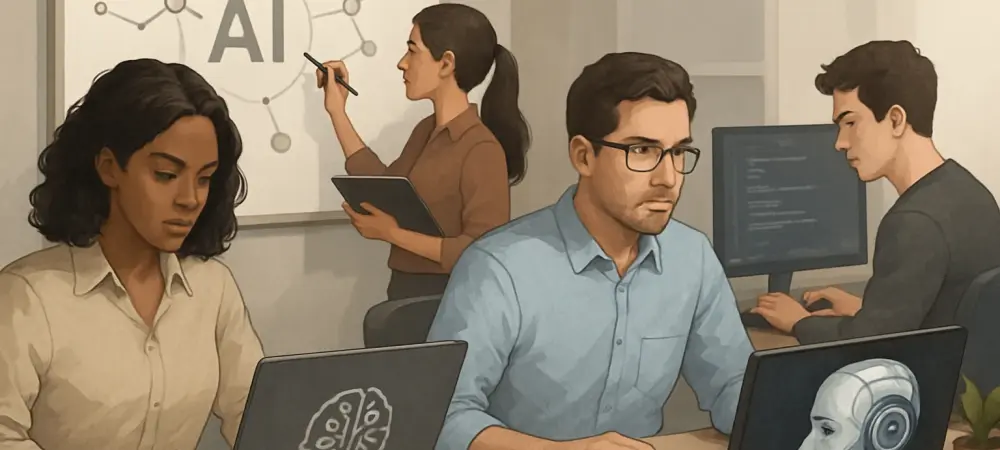
In the bustling world of small businesses today, a quiet revolution is unfolding—one powered by Artificial Intelligence (AI). Picture a local retail shop where the owner, once buried in inventory spreadsheets, now relies on an AI tool to track stock in real time, freeing up hours for customer engagement. Across industries, from cafes to consultancies, AI is no longer a distant concept but a daily reality that’s reshaping how work gets done. This transformation isn’t just about flashy tech; it’s about the people behind the scenes whose roles are evolving in unexpected ways. Dive into this exploration of how AI is altering job landscapes for small and medium-sized enterprises (SMEs), revealing both the promise and the challenges of this new era.
Why AI Feels So Personal for Small Businesses
For small-business owners and employees, AI’s impact hits close to home. Unlike in large corporations where technology might seem detached, in smaller firms, every change directly affects the tight-knit teams that keep operations running. A single AI tool managing customer inquiries or automating payroll can shift an employee’s entire day, turning routine drudgery into opportunities for meaningful work. These personal stakes are palpable—staff aren’t just adapting to tech; they’re redefining their purpose within the company.
The emotional weight of this shift varies. Some workers embrace the chance to focus on creative problem-solving, while others grapple with uncertainty about their value in an AI-augmented workplace. Data from a recent OECD survey shows that 83% of SME adopters report no major staffing changes, easing fears of replacement. Yet, the intimacy of small teams means every tweak in responsibility feels magnified, making AI adoption as much a human story as a technological one.
The High Stakes of AI for Lean Operations
Small businesses often operate on razor-thin margins, with limited budgets and lean staff compared to corporate giants. Staying competitive in a market where customer demands grow and labor costs climb is a constant battle. AI emerges as a critical lifeline, offering efficiency gains that can mean the difference between thriving and merely surviving. With 31% of SMEs already using generative AI, as per recent global studies, the technology is proving essential for leveling the playing field.
However, the stakes are uniquely high for these firms. Unlike larger entities that can absorb the costs of tech overhauls or layoffs, SMEs must integrate AI with precision, ensuring it enhances rather than disrupts their operations. The focus isn’t on slashing jobs—only 9% of adopters report reduced headcount—but on redefining roles to boost productivity. This delicate balance underscores why AI’s role in small firms is a story of adaptation under pressure.
How AI Is Reshaping Everyday Roles
AI’s influence on small-business job roles unfolds across multiple layers, each transforming work in distinct ways. Routine tasks like drafting emails or updating social media are increasingly handled by AI, allowing staff to pivot toward strategic oversight. For example, a customer service rep might now focus on resolving unique complaints while AI fields standard queries, elevating the role’s impact. Data reveals that 65% of SMEs using AI note improved employee performance, highlighting the power of this shift.
Beyond task automation, hybrid roles are emerging within existing teams. Instead of hiring specialized AI staff, small firms are creating positions like AI Operations Lead, tasked with managing automation tools, or prompt curators ensuring output quality. Additionally, labor market trends show a 56% wage premium for AI-skilled workers, with high-demand abilities like data analysis driving triple the revenue growth per employee in AI-exposed sectors. Yet, challenges persist—issues like output inaccuracy or compliance risks around data usage demand human oversight, slowing full adoption.
Real Stories from the AI Frontlines
Hearing directly from those navigating this change brings AI’s impact into sharp focus. A small retail owner shared, “With AI managing inventory updates and basic chats, my team can prioritize personalized service—that’s what keeps customers coming back.” This sentiment reflects a broader trend: AI as a tool to enhance, not erase, human connection. The OECD data backs this up, with most SMEs seeing AI as a performance booster rather than a staff reducer.
Tech consultants, however, point to hurdles in this journey. Many small firms underinvest in training, despite recognizing AI’s potential, leading to uneven adoption. Larger SMEs tend to integrate faster, benefiting from slightly bigger budgets, while smaller players struggle with the learning curve. These firsthand accounts paint a nuanced picture—AI offers transformative possibilities, but only for those ready to tackle the practical barriers head-on.
Actionable Strategies for Small Firms to Adapt
Navigating AI-driven role changes requires a practical approach tailored to small-business realities. Start by mapping out repetitive tasks—think invoicing or scheduling—that AI can streamline, freeing up time for higher-value work. Redesign workflows with intent, ensuring human oversight for critical decisions to prevent costly errors. These initial steps lay a foundation for meaningful integration without overwhelming limited resources.
Further, invest in cross-training current staff rather than seeking external hires, capitalizing on the 56% wage premium for AI skills through affordable online courses or vendor tutorials. Develop a simple governance framework—a one-page policy on approved tools and data rules—to address compliance concerns like privacy or copyright. Finally, measure AI’s impact locally, tracking metrics such as reduced error rates or faster task completion, to gauge success beyond vague financial hopes. These strategies equip SMEs to balance tech adoption with their human core.
Reflecting on AI’s Transformative Path
Looking back, the journey of AI in small businesses reveals a profound shift in how roles are perceived and performed. Automation has lifted the burden of mundane tasks, allowing employees to channel their energy into strategy and creativity, while hybrid positions emerged as a pragmatic response to evolving needs. The data speaks clearly—augmentation, not replacement, defines this era, with most firms reporting enhanced performance over slashed headcounts.
Yet, the path forward demands proactive steps. Small businesses need to commit to ongoing training, ensuring staff keep pace with AI’s rapid advancements. Workflow redesign and governance must remain priorities to mitigate risks and maximize gains. As this chapter closes, the focus turns to building resilience—equipping teams to adapt to whatever technological leaps lie ahead, ensuring that human ingenuity always complements machine efficiency.