

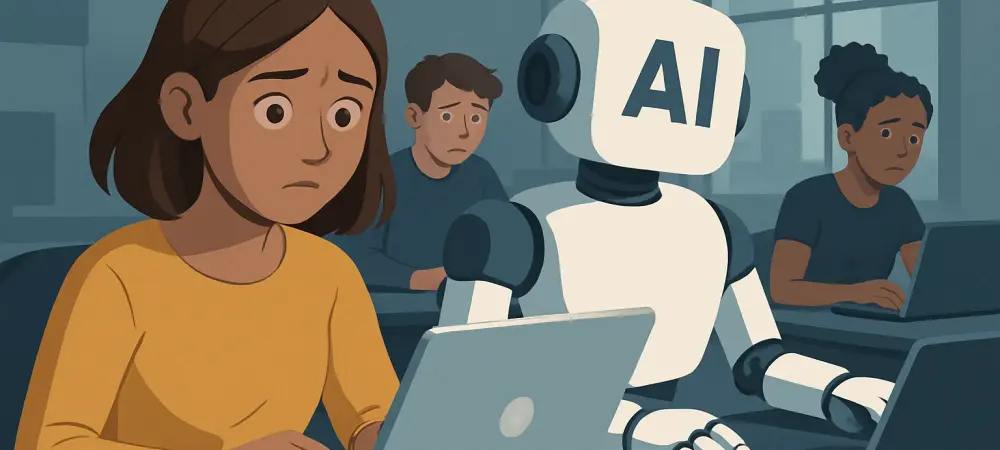
As artificial intelligence continues to reshape industries across the United States, a pressing concern emerges for the younger workforce, particularly those just stepping into their careers, with recent research from Stanford University revealing a stark reality. Entry-level workers, especially aged 22-25, are bearing the brunt of AI-driven job displacement in sectors heavily exposed to automation. This shift, fueled by the rapid adoption of generative AI tools, raises questions about the future of work for the next generation. While overall employment may show signs of growth, the decline in opportunities for young professionals in fields like software development and customer service paints a troubling picture. The challenge lies in understanding whether AI will continue to erode these foundational roles or if it can be harnessed to create new pathways. This evolving landscape demands a closer look at how technology is altering job prospects and what it means for those entering the labor market today.
The Scale of AI-Driven Job Displacement
The impact of AI on employment for young workers is both measurable and significant, with data highlighting a disproportionate effect on early-career individuals. A comprehensive Stanford University study, analyzing payroll data from millions of workers across thousands of U.S. companies, found a 13% relative drop in employment for young professionals in AI-exposed occupations since the rise of generative AI tools. Fields such as customer service and software development, often entry points for recent graduates, have seen the sharpest declines. This trend, which became noticeable after the public release of advanced AI systems, contrasts with broader labor market growth, underscoring how specific demographics are more vulnerable. The erosion of these roles not only limits immediate job opportunities but also threatens the long-term career progression of an entire generation, as foundational experience becomes harder to gain.
Beyond the numbers, the implications of this displacement are profound for workforce development. Industry experts warn that the loss of entry-level positions could disrupt the pipeline for future leaders, as young workers miss out on critical skills and experience needed for advancement. Roles that once served as stepping stones are increasingly automated, leaving fewer chances for hands-on learning. This creates a ripple effect, potentially stunting the growth of managerial and leadership talent in the coming years. Moreover, the psychological toll on young workers cannot be ignored, as job insecurity and limited prospects may deter them from pursuing certain career paths altogether. The urgency to address this issue lies in balancing technological advancement with the need to preserve pathways for professional growth among the youth.
Automation Versus Augmentation in the Workplace
A critical factor in AI’s impact on young workers is how the technology is applied—whether it automates tasks entirely or augments human capabilities. In occupations where AI replaces repetitive, rule-based work, job losses are stark, particularly for entry-level roles that rely on structured processes. The Stanford research highlights that such automation has led to significant declines in employment for younger employees in these fields. However, in contrast, positions where AI serves as a supportive tool rather than a replacement show stability or even growth. This dichotomy reveals that the design of AI integration plays a pivotal role in determining job outcomes. For young workers, the challenge is navigating a landscape where their roles could either disappear or evolve depending on how employers choose to implement these technologies.
Further exploration into this divide shows varying effects across industries and skill sets. In sectors where AI enhances productivity, such as creative or analytical roles, young workers may find their positions strengthened, as technology amplifies their contributions without displacing them. Notably, some industry leaders have observed that non-technical backgrounds, like liberal arts, can offer an edge in leveraging AI through nuanced communication and context-driven tasks. This suggests that adaptability and diverse skills could be key for young professionals to thrive. On the other hand, lower-end jobs tied to codified knowledge remain at high risk, with little room for human input once automation takes hold. The lesson here is that fostering collaboration between AI and human effort could safeguard employment while still driving innovation.
The Rapid Evolution of AI Capabilities
The pace at which AI is advancing adds another layer of complexity to its impact on young workers. Benchmarks cited in recent studies show a dramatic leap in AI’s problem-solving abilities, particularly in coding, where proficiency has surged over a short period. This rapid progress indicates that even roles currently considered safe from automation may soon face disruption. For young workers, this means that job security is increasingly uncertain, as skills deemed valuable today could become obsolete in a matter of years. The relentless improvement of AI systems underscores the need for continuous learning and adaptation, as static skill sets may no longer suffice in a tech-driven economy.
Equally important is recognizing which roles remain less vulnerable to AI’s reach, at least for now. Jobs involving caregiving, physical labor, interpersonal communication, or creative expression are harder for AI to replicate due to their reliance on human nuance. For young workers entering the labor market, these areas may offer more stable opportunities compared to highly automatable fields. However, industry voices caution against overconfidence, as technological breakthroughs could eventually encroach on even these domains. The takeaway for the younger workforce is clear: staying ahead requires a proactive approach to skill development, focusing on areas where human judgment and empathy still hold irreplaceable value.
Shaping a Future with AI Collaboration
Reflecting on the challenges faced by young workers, it has become evident over recent years that AI has reshaped the U.S. labor market with a dual-edged impact. While it has eroded entry-level roles in automatable fields, leaving many early-career individuals grappling with a 13% employment decline, it has also preserved or enhanced jobs where human-AI collaboration thrives. The rapid strides in AI capabilities have signaled that no sector is entirely immune, yet roles rooted in human interaction or physical tasks hold ground against automation. Looking ahead, the path forward hinges on strategic adaptation. Young workers must prioritize upskilling in areas that complement AI, such as creative problem-solving or emotional intelligence, to remain relevant. Employers, too, should focus on integrating technology in ways that augment rather than replace human effort. By fostering a synergy between innovation and workforce development, the potential exists to transform this disruption into an opportunity for growth and resilience.