

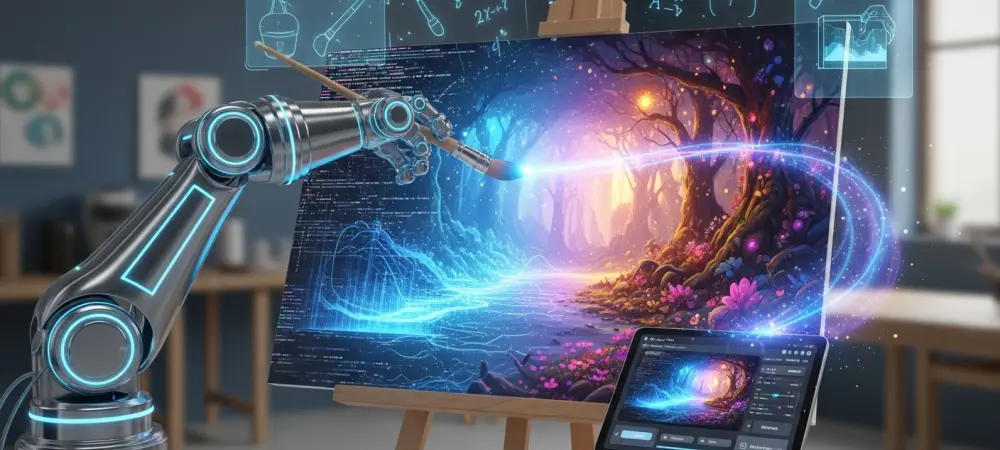
The traditional barrier between a creative concept and its visual realization has dissolved into a fluid stream of instantaneous digital generation, where complex imagery is birthed from mere descriptions rather than weeks of manual labor. This paradigm shift represents a fundamental departure from the legacy models of production that once dictated the pace of marketing, design, and entertainment industries. By the start of 2026, the integration of sophisticated generative models into professional pipelines has moved beyond the experimental phase to become a foundational requirement for staying competitive in a saturated attention economy. While the technology was once viewed with a mixture of curiosity and skepticism, its current role is one of immense utility, serving as an engine that powers everything from localized social media assets to high-fidelity product prototypes. The speed at which an idea can now be prototyped, iterated upon, and finalized has effectively shortened the distance between imagination and reality, allowing creative professionals to explore thousands of variations in the time it previously took to sketch a single draft. Consequently, the focus of the modern designer has pivoted away from the technical execution of pixels and toward the higher-level orchestration of brand vision and strategic impact.
1. The Evolution Of Visual Production
Visual production has undergone a seismic shift, moving away from the traditional, labor-intensive studio model toward a streamlined, high-speed digital ecosystem. In the past, creating high-quality marketing assets required a logistical dance involving photographers, set designers, lighting technicians, and extensive post-production editing. This process was inherently slow and expensive, often taking weeks or months to move from a conceptual mood board to a finalized campaign ready for distribution. Today, in 2026, this bottleneck has been largely eliminated through the widespread adoption of AI-driven imagery, which enables the near-instant generation of photorealistic or highly stylized visuals. The transition from physical sets to virtual environments has democratized high-end production, allowing smaller firms to compete with global agencies in terms of visual quality. This evolution is characterized by a move toward scalability, where a single creative director can oversee the production of thousands of unique assets that would have formerly required an entire department. The shift is not just technical but cultural, as businesses now expect visual content to be as agile and responsive as the data that drives their marketing strategies.
As generative technologies matured, AI-generated imagery transitioned from a niche curiosity to a standardized component of the modern corporate toolkit. Companies across diverse industries, from retail to finance, have integrated these tools directly into their design systems to maintain a constant flow of fresh visual material. This standardization has led to a more integrated approach to brand storytelling, where AI assists in everything from internal presentations to external advertising campaigns. The ability to produce high-fidelity visuals without the need for traditional stock photo subscriptions or expensive one-off shoots has redirected significant portions of creative budgets toward strategy and audience research. Moreover, the scalability provided by AI means that visual content is no longer a static asset but a dynamic resource that can be updated in real-time to reflect changing market conditions or seasonal trends. By making visual production a core digital competency, organizations have gained a level of creative independence that allows them to pivot their brand messaging with unprecedented speed. This widespread professionalization of generative tools has solidified their place in the industry, making them as essential to the modern office as word processors or spreadsheet software.
2. Key Drivers Of AI Adoption
The rapid migration toward automated visual production is primarily driven by the escalating demand for massive volumes of content across an ever-growing number of digital platforms. In 2026, a single marketing campaign must often encompass hundreds of variations tailored for specific social media channels, email newsletters, and interactive web experiences. Traditional production methods simply cannot keep pace with this need for variety without incurring astronomical costs. Furthermore, there is a growing realization that audiences are becoming increasingly desensitized to generic stock photography, which often feels disconnected from the specific brand narrative or cultural context. To combat this decreased focus, organizations are using AI to create unique, tailored images that are specifically designed to capture the attention of niche demographics. These visuals are more engaging because they can be customized to reflect the specific aesthetic preferences and values of the target audience, providing a level of relevance that pre-packaged assets cannot match. The need for this visual specificity at scale has made AI adoption an operational necessity for brands that want to remain visible in a crowded marketplace.
Beyond the need for volume and relevance, the push for AI adoption is heavily influenced by persistent financial constraints within corporate creative departments. Marketing budgets are under constant scrutiny, and there is immense pressure on creative leaders to produce more impactful content without a corresponding increase in departmental spending or headcount. AI-generated imagery provides a solution to this dilemma by drastically lowering the marginal cost of producing each additional visual asset. By automating the most time-consuming aspects of the creative process, such as background removal, lighting adjustments, and basic composition, teams can reallocate their human resources toward high-value activities like brand positioning and creative direction. This financial efficiency is particularly crucial for mid-sized enterprises that may not have the resources for large-scale photo shoots but still require a high-end visual presence to build trust with their customers. The ability to generate professional-grade visuals on demand has leveled the playing field, allowing organizations of all sizes to maintain a sophisticated brand image while staying within tight budgetary limits. Consequently, the adoption of AI is often viewed as a strategic investment in long-term operational sustainability.
3. Primary Areas Of Productivity Gains
One of the most significant impacts of AI on the creative workflow is the dramatic acceleration of campaign development cycles. In the current landscape, the time required to move from an initial conceptual idea to a final approved visual has been compressed from weeks into hours. This rapid development is made possible by AI’s ability to generate multiple high-fidelity options based on a single brief, allowing stakeholders to see a variety of creative directions immediately. Instead of waiting for a designer to mock up several distinct versions manually, marketing teams can use generative tools to visualize different themes, color palettes, and compositions in real-time during brainstorming sessions. This immediacy facilitates a more iterative and collaborative process, as feedback can be incorporated instantly and the results viewed on the spot. By shortening the feedback loop, organizations can respond to real-world events or trending topics with professional-grade imagery before the window of relevance closes. This agility has transformed visual communication into a proactive tool rather than a reactive one, enabling brands to participate in cultural conversations as they happen.
Productivity gains are also highly visible in the areas of mass customization and fast design testing, which allow for a more data-driven approach to creativity. Businesses can now create localized visuals for different geographic regions or customer segments without the prohibitive costs traditionally associated with regional shoots. For example, a global apparel brand can use AI to swap backgrounds, lighting, and even the stylistic elements of a product shot to better align with local cultural aesthetics across dozens of markets simultaneously. In addition to localization, AI tools enable designers to test product concepts and advertising layouts instantly before committing significant resources to production. By generating photorealistic prototypes of new packaging or retail displays, teams can gather consumer feedback or conduct internal reviews much earlier in the development process. This capability reduces the risk of project failure and ensures that only the most effective designs move forward to the final stages of implementation. This combination of mass customization and rapid prototyping ensures that every visual asset is optimized for its specific audience and purpose, maximizing the overall impact of the creative investment.
4. Maintaining Brand Uniformity
Preserving a consistent brand identity is a primary challenge when using generative tools, but it is achievable through the development of a curated collection of approved visual anchors. These anchors serve as a library of reference images that have already been vetted for brand alignment, color accuracy, and stylistic tone. By providing these references to the AI as a guiding framework, creative teams can ensure that every generated image feels like a natural extension of the existing brand ecosystem. This prevents the “hallucination” of elements that do not fit the established aesthetic and provides a reliable baseline for all automated output. Furthermore, organizations must document and record specific command formulas—the precise text patterns and technical parameters that consistently produce the brand’s signature style. These formulas act as a standardized recipe that any team member can follow to maintain visual cohesion across different projects and platforms. This systematic approach to prompt engineering turns what could be a chaotic process into a disciplined and repeatable professional workflow, ensuring that the brand’s visual voice remains clear and recognizable regardless of the volume of content produced.
In addition to technical guides, maintaining brand uniformity requires a strict human oversight phase for all materials that will eventually be seen by customers. While AI can handle the heavy lifting of generation, human reviewers are essential for catching subtle inconsistencies, ethical nuances, or aesthetic deviations that an algorithm might overlook. This review step ensures that every piece of content meets the brand’s quality standards and aligns with its strategic messaging. To further support this consistency, teams should normalize file dimensions and formats at the end of the generation process, ensuring that all downstream users receive assets that are ready for immediate use. By standardizing the technical delivery of these files, organizations can prevent compatibility issues and ensure that the visual quality remains high across different media channels. This combination of visual anchors, documented formulas, human review, and technical normalization creates a robust framework for managing AI-generated content at scale. This structured approach allows companies to reap the benefits of generative speed while protecting the integrity of their brand identity in a crowded and competitive digital landscape.
5. The Role Of Image Modification
The true power of AI in creative workflows often lies as much in its modification capabilities as it does in its initial generation functions. Modern platforms allow for sophisticated editing tasks, such as removing unwanted objects, changing lighting conditions, or extending backgrounds to fit different aspect ratios, all with a few simple commands. This level of control is vital for refining generated images to meet exact professional standards, as it allows designers to fix small errors or adjust compositions without starting the generation process from scratch. Background extension, or “outpainting,” has become particularly valuable for adapting assets across varied social media formats, enabling a single square image to be seamlessly transformed into a vertical story or a horizontal banner. These modification tools significantly reduce the time spent on tedious manual retouching, allowing designers to focus on the more nuanced aspects of the visual narrative. By treating the initial AI output as a flexible foundation rather than a finished product, creative teams can achieve a level of precision that was once the exclusive domain of master photo editors.
Furthermore, the integration of both creation and refinement tools into a single platform has streamlined the creative process and reduced operational friction. When designers can generate an image and then immediately apply complex modifications within the same interface, the workflow becomes more cohesive and efficient. This unified approach eliminates the need to jump between multiple software applications, which often involves time-consuming file exports and imports that can degrade image quality or lead to version control issues. Modern all-in-one platforms provide a seamless environment where the transition from a text-based prompt to a finely tuned, pixel-perfect asset is nearly instantaneous. This benefit is especially evident in high-pressure environments where deadlines are tight and the need for quick iterations is constant. By combining these capabilities, organizations empower their creative staff to experiment more freely and reach the final approved version of a visual asset in record time. This synergy between generation and modification is a cornerstone of contemporary digital design, offering a level of versatility that has redefined the boundaries of visual content creation.
6. Strategies For Implementation
To successfully integrate AI visuals into a business environment, organizations must begin with a single, recurring project type to build a reliable and repeatable process. By picking a steady, manageable need—such as social media graphics or internal blog headers—teams can experiment with generative tools without the pressure of a high-stakes campaign. This targeted start allows for the development of a specific guide for successful text commands, where designers can log the phrases, styles, and settings that yield the best results for their brand. Building this internal knowledge base is crucial for long-term success, as it reduces the learning curve for new team members and ensures a consistent level of quality across all generated output. During this phase, it is also important to combine creation and modification tools right away, utilizing software that allows for both generating and editing images to minimize technical friction. This integrated approach ensures that the workflow remains fluid and that the creative team can move quickly from the initial idea to a refined, professional asset without unnecessary delays or complex software transitions.
As the process matures, organizations should establish a clear standard for final approval to determine which types of images require human review and which can be published immediately. For instance, high-profile advertising assets might require multiple rounds of executive sign-off, while routine internal communications might follow a more automated path. Parallel to this, it is essential to track efficiency improvements and hours gained to justify the ongoing expansion of the technology’s use within the company. Recording the time saved on manual tasks provides concrete data that demonstrates the value of AI adoption to senior leadership and helps in resource planning for future projects. Ultimately, the goal of these strategies is to ensure that team members can focus on high-level planning and creative direction rather than manual labor. By letting the AI handle the repetitive aspects of asset production, humans are freed to concentrate on the strategy, brand taste, and emotional impact of their work. This shift not only improves the quality of the final output but also enhances job satisfaction by allowing creative professionals to engage in more meaningful, high-value activities.
7. The Future Of Creative Work
The evolution of visual production pointed toward a future characterized by “conversational” design, where imagery was treated as a flexible and editable object rather than a static file. In this environment, the interaction between the designer and the machine resembled a continuous dialogue, with visuals evolving through a series of refinements and contextual adjustments. This approach allowed for a highly dynamic creative process where the boundaries between different media types became increasingly blurred. Organizations that embraced this shift found that their creative output became more responsive to real-time data and cultural trends, enabling them to maintain a more authentic connection with their audiences. The technology served as a catalyst for a more experimental culture, where the cost of exploring a new idea was virtually zero, leading to a surge in visual innovation across the industry. This transition highlighted the importance of a brand’s unique visual DNA, as the ease of creation made the underlying creative strategy and artistic vision more important than ever before.
The transition toward a fully integrated AI workflow suggested a future where creative professionals spent less time on technical execution and more on curation and strategic oversight. Organizations that prioritized the development of robust prompt libraries and standardized approval processes found themselves better positioned to capitalize on the speed of generative tools. It became clear that the most successful implementations involved a balanced approach, where machine efficiency was directed by human taste and ethical considerations. Moving forward, the focus remained on refining the interaction between human designers and generative systems to ensure that visual output remained authentic to the brand’s core identity. Teams that embraced this shift transformed their creative departments into agile hubs of innovation that could respond to market changes in hours rather than weeks. This evolution ultimately underscored the enduring value of human creativity, even as the tools used to express that creativity underwent a radical transformation. The era of manual asset creation had largely concluded, giving way to a more dynamic and intelligent form of visual communication.