

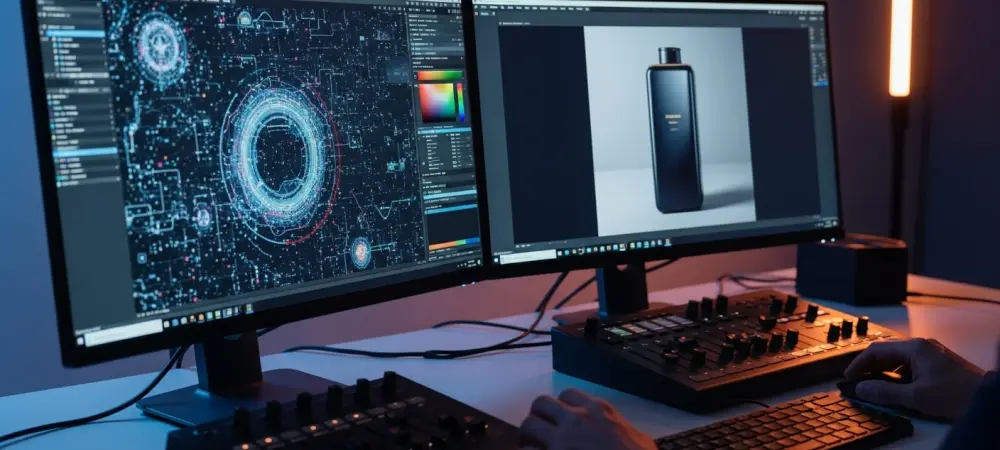
The professional creative economy has reached a pivotal juncture where the distinction between algorithmic precision and human artistic intuition is no longer a matter of conflict but one of deep integration. As the current industry landscape settles into a mature phase of adoption, the initial skepticism that once defined the relationship between artists and machines has largely dissipated, replaced by a sophisticated understanding of how generative tools function as high-fidelity instruments. This analysis explores the transition of artificial intelligence from a technical curiosity into a foundational pillar of modern design, architecture, and marketing. Today, these tools are not merely additive features; they are catalysts fundamentally altering the workflow, expectations, and ethical boundaries of every creative profession.
The Paradigm Shift in Visual Expression
The landscape of professional creativity is undergoing its most significant transformation since the invention of digital photography, moving beyond the simple automation of tasks toward the synthesis of entire visual concepts. In the current market, artificial intelligence image generation has transitioned into a necessary component for high-fidelity commercial output, offering a level of speed and scalability that traditional methods cannot match. This shift matters because it has forced a reassessment of what constitutes “creative labor,” moving the value of a professional away from the manual execution of pixels and toward the intellectual curation of ideas.
Moreover, the widespread integration of these systems has created a new baseline for visual literacy in the corporate world. Clients now expect a rapid iterative process where multiple high-quality concepts are presented within hours rather than weeks. This acceleration is not just about productivity; it represents a fundamental change in the creative dialogue, allowing for a more experimental and inclusive design process. As businesses continue to adapt, the ability to navigate this high-speed environment has become the primary differentiator for successful agencies and independent creators.
From Digital Novelty to Industry Standard
To understand the current impact of generative technology, one must analyze the rapid progression that occurred as models moved away from producing surreal, distorted imagery. Just a short time ago, generative AI was often viewed as a “party trick”—capable of generating interesting visuals but plagued by anatomical errors, illegible text, and a lack of spatial logic. These early iterations served as proofs of concept that fascinated the public but offered little utility for professional-grade projects. However, the foundational research conducted during this period paved the way for the architectural breakthroughs currently dominating the market. The shift toward professional adoption was driven by the necessity for speed and the rising cost of traditional digital asset creation. As foundational models improved, they began to bridge the gap between abstract concepts and usable, high-resolution pixels. This transition moved AI out of the realm of social media memes and into the boardrooms of global architectural firms and advertising giants. The history of this development is a testament to how quickly a disruptive technology can move from the periphery to the center of a global industry when it addresses specific, pain-driven market needs.
The Technological Leap: Precision and Control
Solving the Challenge: Visual Consistency
One of the primary hurdles for early adopters was the inability to maintain a consistent visual identity across multiple generations, which made character or brand continuity nearly impossible. Today, innovations such as persistent identity embeddings and scene-aware attention mechanisms have effectively solved this problem. These technical advancements allow the software to “remember” specific assets and styles, ensuring that a brand mascot or a film protagonist remains identical throughout an entire campaign or storyboard. This level of reliability has transformed the technology from a random inspiration generator into a precise tool for professional execution.
Granular Editing: Specialized Market Solutions
The market has moved away from a “one-size-fits-all” approach toward extreme specialization, with platforms now tailored to specific industrial needs. Professionals no longer rely on a single, broad prompt to deliver a finished product; instead, they utilize specialized systems for photorealistic marketing, detailed architectural rendering, or stylized concept art. The introduction of granular editing capabilities—such as inpainting for modifying specific elements and outpainting for expanding canvases—has given designers the creative control they previously lacked. This shift allows for the manipulation of specific light sources or textures without the need to regenerate the entire composition, mimicking the layer-based workflows of legacy design software.
Expanding Applications: Beyond Traditional Design
The utility of generative imagery has permeated sectors far beyond the visual arts, addressing complex data gaps in highly technical fields. In architecture, designers use these systems to present dozens of interior variations to clients in real-time, while in the medical field, synthetic imagery is being used to train diagnostic algorithms for rare conditions that lack sufficient real-world documentation. Even the education sector has adopted these tools to create custom, curriculum-specific illustrations at a fraction of the traditional cost. These diverse applications address the misconception that AI is only for “shortcuts,” proving its worth as a tool for solving communication barriers and data shortages.
Emerging Trends: The Future of Real-Time Synthesis
Looking toward the period from 2026 to 2028, the trajectory of generative technology points toward real-time synthesis and the blurring of boundaries between static and moving images. The industry is entering an era where the gap between a conceptual thought and a high-resolution visual rendering is narrowing toward zero. As temporal coherence improves, the same tools used for stills are being adapted for seamless video generation, allowing for interactive storyboarding and immersive virtual environments. This evolution suggests a future where “content” is not a static file but a dynamic, generative experience that can adapt to user input in real-time. Furthermore, the industry is bracing for a more regulated landscape, with content provenance standards and metadata requirements becoming the norm. This shift is essential for ensuring transparency and protecting intellectual property in an age where the origin of a visual asset can be difficult to discern. As legislative bodies refine their approach to copyright and training data, the market is likely to consolidate around “artist-aware” platforms that offer clear legal frameworks. This maturation of the regulatory environment will provide the stability needed for even larger-scale institutional investment in generative workflows.
Navigating the Landscape: Strategies for Success
For professionals and businesses to thrive in this redefined environment, they must adopt strategies that prioritize human direction over technical labor. The most successful creators are those who view these tools as a “digital brush”—a sophisticated instrument that handles time-consuming rendering tasks, allowing the human mind to focus on high-level curation and original vision. Best practices now involve staying informed on platforms that respect copyright and utilizing generative tools to explore a wider range of concepts during the initial ideation phase. By integrating these tools into existing workflows rather than resisting them, professionals can unlock new levels of productivity. Education and continuous upskilling have become the most critical investments for those in the creative sector. Understanding the underlying logic of prompt engineering, latent space manipulation, and hybrid workflows is no longer optional; it is a core competency. Businesses should focus on creating internal guidelines that balance the efficiency of automation with the necessity of human oversight. This approach ensures that the final output maintains a unique brand voice and meets the rigorous quality standards required for commercial success.
The Enduring Value: Reflecting on Human Direction
The rise of sophisticated image generation did not signal the end of the human creator; instead, it marked a definitive evolution in the creator’s role within the global economy. As the technology matured, the industry recognized that while machines could handle the nuances of lighting, texture, and perspective, the original spark of an idea remained uniquely human. The most significant takeaway from this transition was the successful movement from the role of a “maker” to that of a “director.” This change allowed professionals to amplify the reach of their own imagination through the power of the machine, creating a more vibrant and diverse visual world.
Actionable strategies emerged as creators focused on developing proprietary style models and focusing on complex, multi-layered storytelling that algorithms could not replicate. The focus shifted toward the mastery of “intent-based” design, where the human ability to understand cultural context and emotional resonance became the ultimate competitive advantage. Ultimately, the integration of generative tools proved that the future of creativity belongs to those who leverage technology to expand the boundaries of what is possible. The era solidified the fact that while the tools of the trade changed, the necessity for human vision remained the most valuable skill in the creative marketplace.