

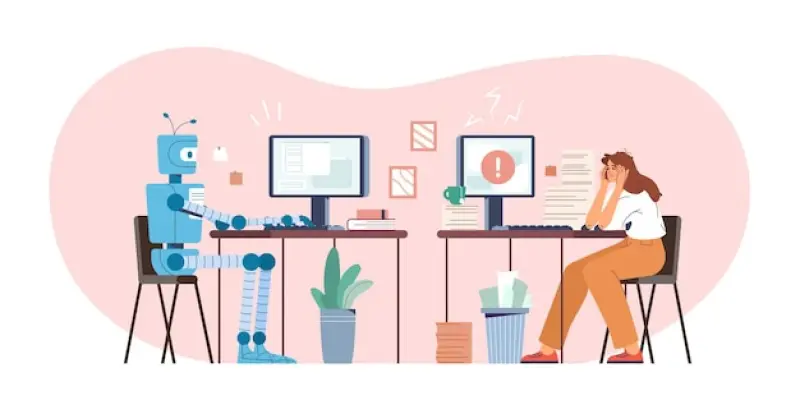
Artificial intelligence (AI) is revolutionizing the modern workplace, but contrary to popular belief, it is not leading to widespread job displacement. Instead, AI is primarily being used to augment human tasks, enhancing productivity and efficiency across various industries. This article delves into the ways AI is being integrated into the workplace, the industries and roles most affected, and the economic implications of this technological shift.
AI as an Augmentative Tool
AI’s role in the workplace is predominantly augmentative, assisting workers with tasks rather than replacing them. This includes activities such as brainstorming, refining ideas, and ensuring work accuracy. The findings of the Anthropic Economic Index report reveal that 57% of AI usage falls into this augmentation category, while the remaining 43% involves direct automation. This delineation underscores the evolving partnership between AI and human workers, highlighting the collaborative nature of current AI applications.
The use of AI for augmentation is evident in a variety of tasks where it helps improve decision-making and offload repetitive work. For instance, AI can assist in drafting and refining text, conducting research, and generating ideas, particularly in creative and editorial roles. This collaborative dynamic is crucial for understanding how AI will reshape work in the future, fostering a more integrated and supportive relationship between AI and human workers.
Industries Leading AI Adoption
The report identifies software development as the field with the highest AI adoption, accounting for 37.2% of the analyzed interactions. These interactions typically encompass tasks like debugging code, modifying software, and troubleshooting networks. The second-highest category of AI use is in creative and editorial work, which includes media, marketing, and content production roles. In these fields, AI is frequently utilized to draft and refine text, conduct research, and generate ideas.
However, AI usage is significantly lower in industries requiring physical labor, such as healthcare, transportation, and agriculture. This disparity highlights the current limitations of AI, which excels at text-based and analytical tasks but struggles with roles that require hands-on work, manual dexterity, or complex interpersonal interactions. This trend suggests that while AI is transforming numerous tasks across different sectors, its capabilities remain bounded by the fundamental requirements of certain job types.
AI Across Job Roles
Approximately 4% of occupations show AI usage for at least 75% of their tasks, indicating deep task-level integration in specific roles. More broadly, around 36% of occupations use AI for at least 25% of their tasks, demonstrating that AI is increasingly incorporated into the workflows of a substantial portion of the workforce. This selective adoption pattern reflects a nuanced understanding of AI’s capabilities, where its deployment is tailored to augment human skills and expertise rather than replace them.
Wage Correlation with AI Adoption
The report presents an intriguing finding regarding the correlation between AI usage and wages. AI adoption is most prevalent in mid-to-high salary range jobs, peaking in the upper quartile of wages but declining at both the very high and low ends of the wage spectrum. This trend suggests that AI is primarily adopted in roles requiring analytical and technical skills but not necessarily the highest levels of specialized expertise.
Current Limitations of AI
The disparity in AI adoption among different types of jobs highlights the current limitations of AI. It excels at text-based and analytical tasks but struggles with roles that require hands-on work, manual dexterity, or complex interpersonal interactions. For instance, only 0.1% of the analyzed conversations were related to farming, fishing, and forestry tasks, underscoring the constraints of AI in physical labor-intensive fields.
Economic Implications and Future Considerations
As AI continues to expand its role, there is a critical need to address potential economic inequalities that might arise from differing levels of access to AI tools between high- and low-wage workers. The findings also serve as a cautionary note for policymakers, indicating that while AI is not yet replacing entire jobs at scale, its increasing presence in high-value tasks could profoundly impact workforce dynamics. Furthermore, there is a need for ongoing training and education initiatives to help workers adapt to AI-enhanced roles and ensure that the workforce is equipped with the necessary skills to thrive in an AI-augmented environment.
Anthropic’s Methodology
Unlike previous studies that rely on expert predictions or self-reported surveys, Anthropic’s research is grounded in direct analysis of actual AI usage. Leveraging its privacy-preserving analysis tool, Clio, Anthropic analyzed over four million user conversations with Claude. These interactions were mapped to occupational categories from the U.S. Department of Labor’s O*NET database, providing a realistic and detailed portrayal of AI adoption in the workplace.
Final Analysis
Artificial intelligence (AI) is transforming the modern workplace in profound ways. Contrary to fears about massive job losses, AI is not eliminating jobs en masse. Instead, it is being deployed to augment human tasks, boosting productivity and efficiency across numerous sectors. This technological integration is reshaping how businesses operate, offering tools that support employees rather than replace them. The economic effects of AI adoption are widespread, leading to the creation of new roles and opportunities for workers to upskill and adapt to changing job requirements. As AI continues to evolve, its role in complementing and enhancing human labor will likely expand, further defining the future workplace.