

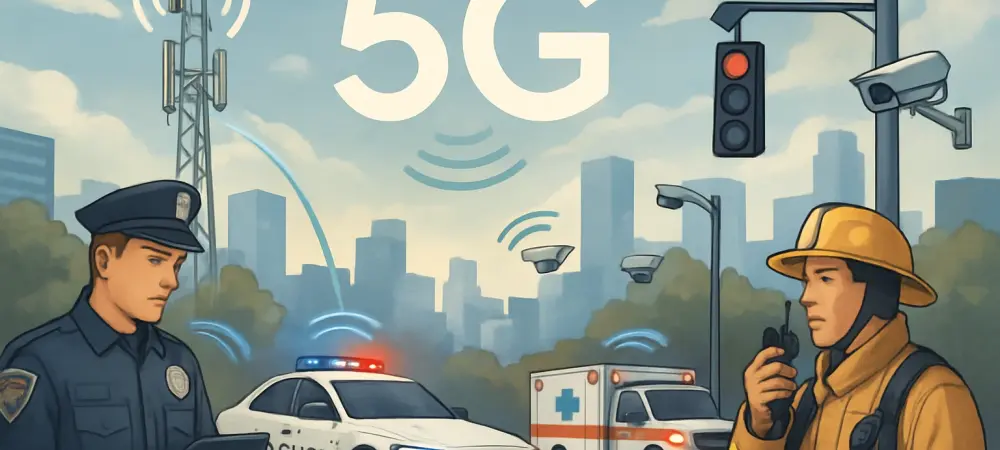
Sirens cut through downtown noise while a drone hovers overhead, and the buffer wheel that once stalled life-or-death video feeds finally disappears as 5G turns patchy links into real-time lifelines for crews and command. This roundup gathers perspectives from practitioners, researchers, and city technologists on how 5G is reshaping public safety and smart city operations, where it falls short, and what a pragmatic playbook looks like when seconds matter. The goal is to compare grounded viewpoints—not hype—to help agencies decide where to start, what to buy, and how to measure impact.
From Patchy Links to Real-Time Lifelines: Why 5G Matters Now
Operational leaders consistently point to the same pain: lag, dropouts, and congestion that once crippled body cam streams, drone telepresence, and command links during major incidents. Field commanders emphasize that the combination of low latency, high bandwidth, and higher capacity changes the character of operations, not just the speed. In their view, 5G restores confidence in mobile video and sensor flows, particularly when units are moving fast through dense or radio-hostile environments.
Healthcare responders and NG911 planners echo that reliability is the hinge. They argue that drones, robots, wearables, next-gen call handling, and telemedicine only achieve design intent under stress when the network is deterministic at the edge. According to this group, 5G’s stability transforms “best effort” aids into dependable tools—a shift that 4G and Wi‑Fi rarely sustained at scale. However, several voices caution that coverage remains uneven and disaster damage can level towers; hybrid strategies and staged deployments are still essential.
Across the interviews, the discussion settled on a map of the shift: measurable performance gains, the rise of private 5G for control, the convergence of edge computing with AI analytics, deeper integration with smart city platforms, and real-world constraints such as rural gaps or airport-adjacent rollouts. Instead of treating these as separate issues, agencies describe them as parts of a new operating model that blends transport, compute, and policy into one fabric.
Inside the 5G Shift: Capabilities, Use Cases, and the New Operating Model
The Performance TrifectLow Latency, High Bandwidth, Massive Capacity in the Field
Network engineers across public safety teams describe sub‑20 ms latency and multi‑gig throughput as the practical threshold that stabilizes HD video from body cams and drones, keeps robot control loops tight, and supports multi-stream incident command feeds without starving one stream to keep another alive. Fire chiefs cite wildfire mapping and search-and-rescue as emblematic, where command depends on simultaneous aerial views, thermal imagery, and unit telemetry flowing smoothly, not in fits. NG911 leaders add that richer multimedia calls now land in the center without crashing ancillary systems.
Market analysts underscore that the momentum appears structural rather than cyclical. They point to public safety and security technology projected to expand from $581.9 billion in 2025 to $1.63 trillion by 2034, a 12.2% CAGR, with 5G often flagged as the enabler of data-heavy, automated operations. Practitioners read this as validation that iterative upgrades are giving way to platform change, where bandwidth and latency unlock new staffing models and workflows rather than marginal gains.
Critics in rural and disaster-prone regions counter that gaps persist and that towers fall. They push for hardening sites with backup power and portable cells, and they back satellite backhaul for continuity when terrestrial links are impaired. Aviation stakeholders also note that airport-adjacent activations required caution due to spectrum and altimeter concerns, an example of how deployment must weigh safety alongside performance. The consensus is not that 5G solves everything, but that it gives agencies a reliable baseline to build from—provided contingencies are engineered in.
Private 5G as the Command Fabric: Determinism, Priority, and Preemption in Practice
Agency CIOs and radio system managers increasingly describe private 5G as the “command fabric” for critical venues. With on‑premises control, they can enforce QoS, carve network slices for incident severity, and apply preemption so first responders stay online when public networks saturate. Mission‑critical push‑to‑x rides on that same fabric, tying voice, video, and data into resilient dispatch workflows that endure even when the surrounding macro network struggles.
Case reports from stadiums, ports, campuses, and underground facilities describe seamless mobility across radio‑unfriendly zones, where handoffs do not tear video feeds and sensor telemetry does not stall in steel-dense corridors. Operations leaders stress that private 5G reduced interference problems that plagued Wi‑Fi in crowded events and eliminated congestion spikes common on shared public LTE during citywide gatherings. The result, they argue, is a more predictable environment for both people and machines.
That said, these teams do not romanticize the build. Spectrum access—CBRS or licensed—demands planning, and the cost and skill set to operate private cores are non-trivial. Roaming between private and public domains still requires policies, testing, and sometimes custom integration. Compared with 4G and Wi‑Fi, though, proponents judge the trade-offs favorable because interference and congestion were operational liabilities, not minor inconveniences.
Edge + AI on 5G: Turning Streams into Split-Second Decisions
Analytics specialists agree that the most striking change appears when data is processed at the edge. MEC nodes in vehicles, trailers, or micro sites now run video analytics, license plate and object detection, hazard recognition, and patient telemetry triage close to the source. Paramedics describe ambulance telemedicine that sends live vitals and high-quality imaging to hospitals, allowing clinicians to advise earlier and prepare beds and resources with better precision.
Disaster teams recount flood and wildfire scenarios where drones fuse with fixed sensors to paint a live picture for command. Robot operators emphasize that real-time guidance—made possible by low latency plus edge inference—keeps machines safe and effective in hazardous scenes such as chemical spills or unstable structures. In their telling, 5G is the circulatory system while AI is the reflex, and the edge is where reflex turns into action.
Governance leaders add a necessary brake. They warn about model drift, bias, and cyber exposure at the edge, arguing for validation pipelines, drift monitoring, stringent audit trails, and zero‑trust controls. Even so, they see upside in autonomous dispatch assists, predictive staging of resources before conditions worsen, and shared situational awareness across agencies. The message is clear: benefits flow when AI is treated as an operational discipline, not a bolt‑on.
City-Scale Safety: Synchronizing Streets, Sensors, and Responders
City CTOs position 5G as the backbone for smart corridors that clear emergency routes with adaptive signals while citywide CCTV and environmental monitors feed live operations centers. Traffic engineers say coordinated signals trimmed crucial minutes for ambulances, particularly when congestion flared during events. Combined with pavement sensors and transit data, the system adjusts in near real time rather than on fixed timers.
Regional differences remain central to planning. Dense urban cores lean on mmWave for deep capacity, while suburban and rural areas depend more on mid‑band for reach. Emergency managers in hurricane or wildfire zones prioritize hardened, power‑backed sites and satellite failover to handle grid outages and infrastructure damage. These choices, they argue, determine whether the network holds in the moments it matters most.
Even the strongest advocates caution that connectivity alone yields limited value. The gain emerges when 5G transport fuses with AI decisioning and interoperable data standards so that feeds are not just fast but intelligible across systems. In other words, the citywide nervous system works when its signals are understandable and actionable, regardless of vendor or agency boundary.
From Vision to Playbook: How Agencies Can Act Now
Program directors recommend starting with mission threads: map latency‑critical workloads—video analytics, robotics, NG911 multimedia—to current and planned coverage, then pilot where impact is immediate. They advise quick wins like stabilizing body cam offload or enabling ambulance telemedicine on priority slices. From there, build a portfolio of use cases that stretches across fire, EMS, law enforcement, and traffic operations, with shared KPIs to align budgets.
Resilience architects urge a deliberate network mix. Private 5G provides determinism, public networks extend reach, and satellite backstops disasters or remote terrain. The guiding idea is graceful degradation rather than binary failure: if a tower fails, MEC still runs analytics; if terrestrial links degrade, satellite carries critical flows; if power drops, hardened sites ride batteries and generators. These teams emphasize practicing failover during multi‑agency exercises, not just writing about it.
Security and AI governance leaders close the loop with controls and measurement. They recommend enforcing zero‑trust end to end, binding QoS, slicing, and preemption to incident severity, and testing under load with real traffic and adversarial conditions. For outcomes, they track time‑to‑insight, video reliability, dispatch accuracy, responder safety metrics, and patient results. Those numbers, not slide decks, guide scaling decisions and funding.
The Road Ahead: 5G as the Backbone of Safer, Smarter Cities
Across the spectrum of viewpoints, one throughline stands out: 5G is not a speed bump but a platform shift that allows reliable, real‑time operations at a scale and mobility level that 4G and Wi‑Fi did not sustain. The strongest gains appear when edge compute and AI ride the same transport, turning raw streams into immediate decisions that align people, robots, and infrastructure. This convergence is changing how agencies plan, staff, and stage resources.
Most experts expect deeper integration among 5G, edge, and AI, accelerating autonomous assists, predictive response, and continuous coordination across agencies and city systems. The advice is to invest in private 5G where determinism matters most, design hybrid continuity with satellite, and commit to interoperable data and ethical AI so that lifesaving decisions arrive in time. Market signals reinforce this direction, with public safety and security technology projected from $581.9 billion in 2025 to $1.63 trillion by 2034 at a 12.2% CAGR.
This roundup closed with three actionable pivots: treat network, compute, and AI as one operating platform; exercise priority and preemption policies under real load; and score deployments against outcome metrics that matter to the field. For readers seeking more depth, agency after‑action reports on wildfire and flood responses, NG911 modernization guides, and municipal playbooks for traffic signal preemption provided practical roadmaps and lessons learned that extended far beyond technology selection.