

The convergence of physical hardware and enterprise intelligence represents the next frontier of industrial efficiency. Dominic Jainy, an IT professional specializing in artificial intelligence and blockchain, has dedicated his career to bridging the gap between raw data and actionable business insights. With a deep understanding of how autonomous systems interact with complex corporate architectures, Jainy provides a roadmap for integrating robotic assets into the very fabric of enterprise resource planning.
This discussion explores the mechanics of reducing operational latency through automated reporting and the technical infrastructure required to support autonomous agents in rugged environments. We delve into the security protocols necessary for mobile hardware nodes, the importance of data filtering through middleware, and the critical human element of retraining a workforce to transition from manual labor to data-driven oversight.
How does connecting quadruped robots directly to enterprise software reduce reporting lag? Could you walk through the steps the system takes—from detecting an irregular motor frequency to checking spare parts—and how this changes the speed of decision-making compared to manual logging?
In a traditional setting, a technician might notice a subtle high-frequency whine in a compressor, but by the time they finish their shift and log the observation, hours have passed. By integrating ANYbotics robots directly with SAP, we reduce this window from hours to milliseconds. When the robot’s acoustic sensors detect an irregular frequency, the onboard AI immediately identifies the deviation and triggers an API call to the SAP asset management module. The system doesn’t just alert a human; it autonomously checks inventory for the specific 25mm bearing required, calculates the financial impact of a 4-hour shutdown, and places the work order on an engineer’s schedule. This shift from subjective human opinion to hard, consistent numbers ensures that a machine is repaired long before a catastrophic failure occurs.
Industrial sites often have poor connectivity due to thick concrete and metal scaffolding. How do edge computing and private 5G networks solve these bandwidth issues, and what specific data remains on the robot’s onboard processors versus what gets transmitted to the backend?
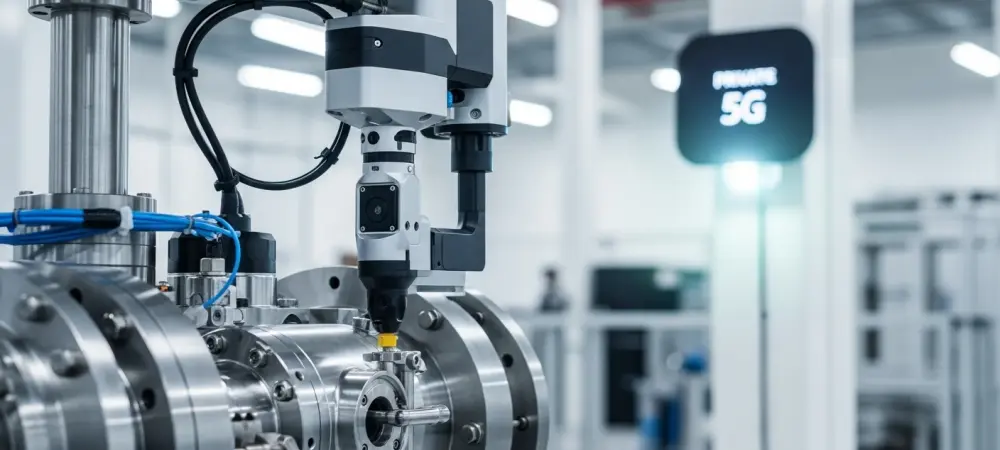
The physical environment of a chemical plant or offshore rig is a nightmare for standard Wi-Fi because of electromagnetic interference and dense metal structures. We solve this by utilizing edge computing, where the robot acts as its own localized data center to process heavy lidar and high-definition thermal video. The robot’s onboard processors crunch the raw data to determine if a pump is simply warm or dangerously overheating, meaning only the critical “fault event” and its GPS coordinates are transmitted. To ensure this small but vital data packet reaches the ERP, many facilities deploy private 5G networks. This provides a dedicated, high-penetration signal that keeps the robot connected in zones where traditional networks would fail, ensuring the backend always has a real-time pulse on the facility.
A roaming robot equipped with visual and thermal sensors presents unique security risks. What specific zero-trust network protocols are necessary to verify a robot’s identity, and how do you prevent attackers from moving laterally into the corporate network if a hardware node is compromised?
A mobile robot is essentially a roaming camera and sensor suite, which makes it a high-value target for digital intrusion. We implement zero-trust protocols where the robot must constantly re-authenticate its identity at every network jump, treating the hardware as a potentially hostile node. We use micro-segmentation to strictly limit the robot’s access to only the specific SAP modules required for maintenance logging, effectively “jailbreaking” its permissions from the rest of the corporate network. If the system detects any unauthorized communication or an anomaly in the robot’s data signature, it can instantly sever the connection. This isolation prevents a compromised robot from being used as a gateway to access sensitive financial data or HR records elsewhere in the enterprise.
Raw acoustic and thermal data can easily clutter a dashboard with hundreds of useless warnings. How should companies use middleware to filter this noise, and what specific thresholds or rules help distinguish a minor vibration from a critical maintenance emergency?
Without a robust filtering layer, a maintenance team will quickly experience “alert fatigue” and start ignoring the SAP dashboard entirely. We use middleware as a sophisticated translator that converts thousands of raw data points into structured, actionable tables that the ERP can understand. This software is programmed with specific thresholds—for example, a 15% increase in vibration over a 10-minute rolling average—to distinguish between a harmless transient spike and a genuine mechanical failure. The middleware discards the 99% of “normal” data, ensuring that only verified anomalies trigger a high-priority ticket. This organized data is then stored in a data lake, which serves as a clean repository for future machine learning models aimed at predictive maintenance.
Moving personnel from high-voltage or toxic zones to data analysis roles requires a significant shift in trust. What steps are involved in retraining workers to manage automated tickets, and how do you ensure they feel comfortable overriding the system during an unexpected event?
The transition is less about replacing workers and more about moving them from “doing” the inspection to “managing” the results. Retraining involves teaching veteran plant operators how to interpret SAP dashboards and manage the automated ticket flow that the robots generate. We emphasize that the robot’s role is to handle the dangerous, high-voltage, or toxic perimeter walks, while the human remains the final decision-maker. It is vital to establish protocols where an operator can manually override any automated decision, such as pausing an autonomous part-ordering sequence if they suspect a sensor error. This collaborative approach builds trust, as workers see the robot as a tool that removes them from harm’s way rather than a replacement for their expertise.
Large-scale rollouts often fail if the initial integration is too broad. How should a company structure a pilot program in a controlled hazard zone, and what metrics are used to audit the accuracy of the data pipeline before adding more robots?
A successful rollout must begin with a small, targeted pilot in a single high-risk area where the infrastructure, specifically the private 5G network, is already rock-solid. During this phase, the primary metric is data fidelity: we conduct daily audits to ensure that the physical state detected by the robot perfectly matches the records generated in SAP. We look for a 100% correlation between detected anomalies and actual field conditions before we even consider adding a second or third robot. Once this pipeline is verified as accurate, we can then scale the operation to include more complex integrations, such as automated parts ordering and multi-robot coordination across the entire facility.
What is your forecast for the adoption of physical AI in heavy industry?
I believe we are entering an era where autonomous inspectors will be treated not as separate gadgets, but as a standard extension of a company’s corporate data architecture. Within the next decade, the presence of quadruped robots in hazardous zones will be as common as having a desktop computer in an office. As these systems move from simple reactive reporting to true predictive failure analysis, companies will see a dramatic reduction in downtime and a total transformation of the industrial workforce. My advice for leaders is to stop viewing robotics as a hardware purchase and start viewing it as a data strategy; the real value isn’t in the robot’s legs, but in the intelligence it feeds into your business.