

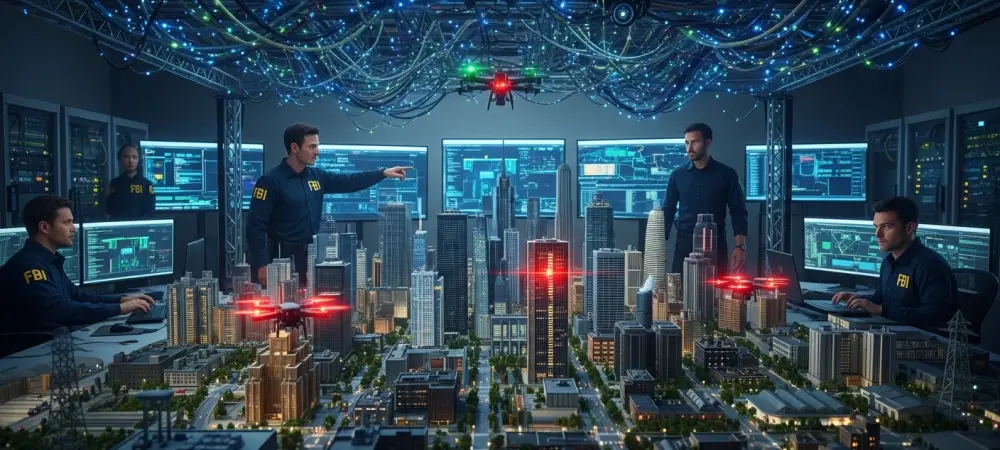
Tucked away in the high-tech corridor of Huntsville, Alabama, a sprawling industrial complex has been transformed into a meticulous replica of a modern urban neighborhood known as the Kinetic Cyber Range. This 2,000-square-meter facility is not merely a training ground for traditional law enforcement tactics; instead, it represents a sophisticated intersection where physical investigation meets high-stakes digital warfare. By stepping inside this simulated environment, federal agents move beyond the abstract nature of code and computer screens to engage with the tangible consequences of cyber-enabled crimes. The facility serves as a vital bridge, allowing personnel to navigate a world where a smart refrigerator or a hospital’s central server is just as likely to hold critical evidence as a physical file cabinet. This immersive approach ensures that law enforcement stays ahead of increasingly complex threats by grounding digital training in the visceral reality of a real-world urban setting.
The Structural Blueprint: Integrating Physical and Digital Realities
To achieve such high levels of immersion, the physical layout of the Kinetic Cyber Range was designed to mirror a functioning contemporary community, complete with residential houses, hotel rooms, and a fully operational hospital. There is even a gas station and a utility company, all furnished with standard decor and internal wiring to make the environment feel authentic. This attention to detail is crucial because it allows agents to practice the physical logistics of a raid while accounting for the digital footprint of their surroundings. For instance, when investigators enter a mock home, they must identify which devices are collecting data, ranging from security cameras to smart appliances. This environment forces trainees to consider how physical space impacts digital evidence preservation, ensuring that they do not inadvertently corrupt data while securing a scene during a fast-moving tactical operation that requires both physical and technical precision.
Beneath the surface of these realistic facades lies a complex technical infrastructure that rivals the digital architecture of a small city or a major corporate headquarters. A centralized data center powers the entire range, housing more than 200 operational servers that run a wide variety of operating systems to reflect the diverse IT environments found in the public and private sectors. Every piece of hardware within the mock city, from specialized industrial control systems to consumer-grade internet-of-things devices, is programmed to behave exactly like its real-world counterpart. This technical fidelity ensures that when a trainee encounters a software barrier or a networking issue, the challenge is identical to what they would face in the field. By creating this high-fidelity simulation, the bureau provides its agents with a playground where they can explore the intricacies of modern networks without the risk of impacting actual public services.
Transforming Educational Paradigms: The Kinetic Training Model
The development of this facility signals a fundamental shift in how law enforcement agencies approach the education of their cyber-focused personnel by prioritizing applied learning under intense pressure. In the past, technical training was often limited to sterile classroom settings or isolated computer laboratories that failed to capture the chaotic nature of real-world crime scenes. Now, the emphasis is placed on developing a comprehensive skill set that includes technical proficiency, sound judgment, and clear communication. By operating within this sandbox environment, students are encouraged to push their boundaries and even make critical errors, which serve as powerful teaching moments in a controlled setting. This hands-on methodology ensures that when agents transition from the range to the field, they possess the confidence to handle unpredictable variables that cannot be replicated through theory alone, making them far more resilient and capable in the face of sophisticated digital adversaries.
A key objective of this immersive training philosophy is the cultivation of muscle memory and the ability to act decisively during a real-time cyberattack or a digital forensics recovery mission. Since the entire facility is completely isolated from the open internet, instructors have the freedom to simulate devastating scenarios, such as complete network failures or massive data breaches, that would be far too dangerous to attempt in a live environment. This fail-safe approach allows agents to refine their investigative tactics and experiment with diverse response strategies until their actions become second nature. The focus remains steadily on the human element of technology, teaching personnel when to use technical tools and when to exercise restraint or prioritize traditional investigative techniques. Ultimately, this rigorous preparation ensures that federal agents are not just technical experts but are also highly disciplined investigators capable of maintaining integrity.
Navigating Operational Challenges: Cross-Disciplinary Drill Execution
The curriculum within the mock city is built around high-pressure drills that reflect the most pressing threats in today’s landscape, such as ransomware attacks targeting critical healthcare infrastructure. In these simulations, participants are tasked with restoring a hospital’s network while managing the psychological stress of knowing that patient care would be directly impacted in a real-world scenario. Other exercises might involve executing high-risk search warrants in corporate offices or navigating interconnected smart homes to identify forensic evidence hidden in unexpected places. For example, agents might need to extract data from a smart refrigerator or a security hub to piece together a suspect’s movements. These drills require a high degree of technical skill combined with traditional legal knowledge, ensuring that agents can collect evidence that will withstand the scrutiny of a courtroom while simultaneously mitigating the ongoing effects of a cyberattack on a public utility company or a private entity.
One of the most significant advantages of the Kinetic Cyber Range is its unique ability to bring different divisions together to foster a truly unified and multidisciplinary response to modern crime. By having forensic computer specialists work side-by-side with active intrusion investigators and tactical teams, the facility ensures that every department can synchronize its efforts during a fast-moving crisis. This level of collaboration is essential to prevent forensic preservation efforts from accidentally hindering an active pursuit or a live technical mitigation strategy. These exercises teach different teams to speak a common language and understand each other’s operational needs, leading to a much more effective federal task force. Through these diverse and complex scenarios, the workforce becomes just as comfortable with a command-line interface as they are with traditional police work, creating a versatile new generation of agents ready for any challenge.
Strategic Evolution: Future Implications of Immersive Readiness
The successful implementation of the Kinetic Cyber Range established a new standard for how modern law enforcement agencies approached the intersection of physical and digital security. Investigators learned that technical skills alone were insufficient without the context of a real-world environment, leading to a broader adoption of immersive simulation across other federal training programs. To maintain this edge, the bureau moved toward continuous updates of the range’s infrastructure, ensuring that emerging technologies like quantum computing and advanced autonomous systems were integrated into the training cycle. Law enforcement professionals recognized that the next generation of threats would require even greater levels of interdisciplinary coordination and technical agility. By investing in these high-fidelity environments, the agency effectively transitioned from a reactive posture to a proactive one, allowing agents to anticipate criminal tactics before they were deployed in the real world.
Future-looking actions were codified into a permanent strategic framework that prioritized the acquisition of high-fidelity simulation technologies. Personnel advocated for the expansion of these facilities to include international law enforcement partners, recognizing that global cybercrime networks required a synchronized and equally sophisticated global defense. This proactive approach allowed the agency to stay ahead of the curve by constantly iterating on the technical challenges presented within the mock city’s walls. Moving forward, the focus shifted toward the integration of generative intelligence and automated red-teaming to create even more unpredictable and dynamic training environments. The legacy of this training model became a blueprint for resilience, proving that the most effective way to secure the future.