

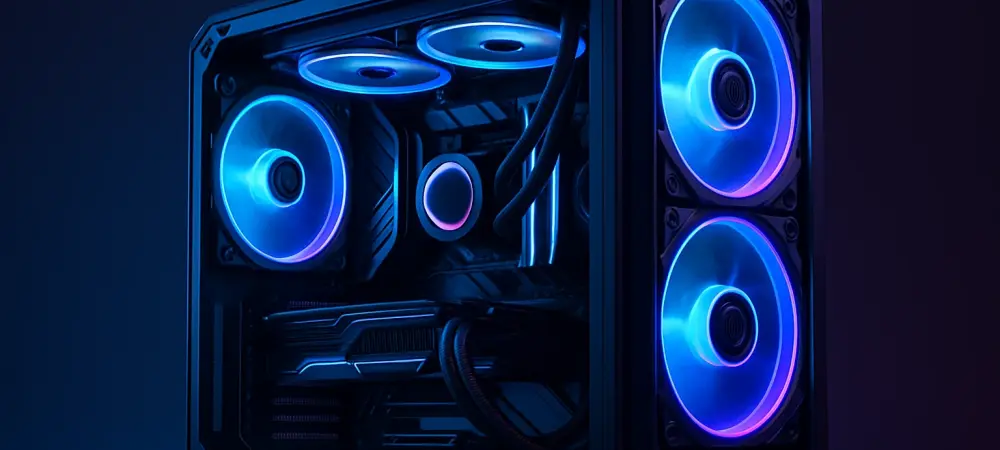
Today, we’re thrilled to sit down with Dominic Jainy, a renowned IT professional whose deep knowledge of cutting-edge technology and innovative hardware solutions has made waves in the gaming industry. With a background in artificial intelligence, machine learning, and blockchain, Dominic brings a unique perspective to the world of high-performance gaming PCs. In this interview, we dive into the groundbreaking APEX Force and APEX Rush systems by MAINGEAR, exploring the inspiration behind their design, the intricacies of their dual-loop liquid cooling, the power of their flagship components, and the aesthetic choices that make them stand out as true masterpieces for gamers.
What inspired the creation of the APEX Force and APEX Rush gaming PCs, and how do they reflect your vision for the future of gaming hardware?
The inspiration behind the APEX Force and APEX Rush came from a desire to push the boundaries of what a gaming PC can be. We wanted to create systems that not only deliver top-tier performance but also redefine cooling and design standards in the industry. Our goal was to craft PCs that could handle the most demanding games and workloads without breaking a sweat, while also being visually stunning. These systems embody our vision of merging cutting-edge technology with artistry—something that elevates the gaming experience to a whole new level. They’re a testament to our commitment to innovation and excellence in the gaming hardware space.
Can you dive into what sets the dual-loop liquid cooling system in these PCs apart from other cooling solutions out there?
Absolutely. The dual-loop liquid cooling in the APEX Force and Rush is a game-changer because it’s custom-designed from the ground up. Unlike traditional all-in-one coolers, which can be limited in their thermal capacity, our dual-loop setup dedicates separate cooling loops for the CPU and GPU. This ensures that each component gets optimal cooling without thermal interference from the other. It’s about maximizing performance sustainability—keeping temperatures low even during extended, intense gaming sessions. This approach allows users to push their hardware to the limit without worrying about overheating.
Why did you opt for custom loops instead of the more common all-in-one coolers for these systems?
Custom loops give us far greater control over cooling performance and aesthetics. All-in-one coolers are convenient, but they often compromise on thermal efficiency for high-end builds like these. With custom loops, we can fine-tune every aspect—radiator size, fan configuration, and coolant flow—to match the specific needs of the hardware. Plus, it lets us create a visually striking setup that’s as much a part of the PC’s identity as its performance. It’s about delivering a complete package that’s both powerful and beautiful to look at.
How do the radiator setups in the APEX Force and Rush contribute to their cooling capabilities?
The radiator setups are a huge part of why these systems stay so cool under pressure. In the APEX Force, we’ve got dual 420mm ultra-thick 60mm radiators, paired with six 140mm fans. That’s a massive surface area for heat dissipation, ensuring even the most demanding components stay within safe temperature ranges. The APEX Rush, while slightly scaled down, still packs dual 360mm radiators with seven 120mm fans, which is more than enough for its configuration. These setups mean better heat transfer and quieter operation, even when the system is fully cranked up during a marathon gaming session.
Let’s talk hardware. What drove the decision to equip these PCs with NVIDIA’s RTX 5080 and 5090 GPUs?
The RTX 5080 and 5090 GPUs are the pinnacle of graphics performance right now, and we wanted the APEX systems to be future-proof for gamers who demand the best. These cards are built for 4K gaming at ultra settings with frame rates that keep everything buttery smooth—think 60 FPS and beyond, even in the most graphically intensive titles. Pairing them with top-tier CPUs like the AMD Ryzen 9000 series and Intel Core Ultra 200S processors ensures there’s no bottleneck, delivering a balanced, high-performance rig that can handle anything you throw at it.
How do the design choices for the chassis of the APEX Force and Rush enhance their overall appeal?
The chassis designs were chosen with both function and form in mind. For the APEX Force, we went with the Phanteks NV9 full-tower because it offers incredible space for our dual 420mm radiators and high-end components, while also providing a sleek, commanding presence. The APEX Rush uses the Lian-Li O11 EVO RGB mid-tower, which is a fan favorite for its compact yet versatile layout and stunning RGB integration. Both chassis not only optimize airflow and cooling efficiency but also serve as a canvas for the custom cooling loops and lighting effects, making each PC a visual standout.
Can you tell us more about the customization options available for the cooling systems in these builds?
Customization is a big part of what makes the APEX systems special. We offer a range of translucent coolant colors for each loop, so users can personalize the look to match their setup or mood. The tubing materials also vary—hard acrylic and metal tubing in the Force for a premium, rigid aesthetic, and softer vinyl or Neoprene in the Rush for flexibility and a different vibe. Add to that options for metal fittings in various colors and diffused RGB lighting zones, and you’ve got a system that’s uniquely yours. These choices let users express their style while maintaining top-notch performance.
What’s your forecast for the future of cooling solutions in high-performance gaming PCs?
I think we’re going to see cooling solutions become even more integrated and intelligent in the coming years. Think adaptive cooling systems that dynamically adjust based on real-time thermal data, or even more compact yet efficient designs that make high-end cooling accessible in smaller form factors. We might also see advancements in materials—coolants with better thermal properties or tubing that’s even more durable and visually striking. The focus will always be on balancing performance, silence, and aesthetics, and I believe custom solutions like ours will continue to lead the charge in setting new standards for what’s possible in gaming hardware.