

The once-unshakable foundation of the x86 processor market experienced a seismic shift in 2025, culminating in a landscape where a former underdog claimed more than a third of all revenue. This historic achievement, which saw Advanced Micro Devices (AMD) secure a landmark 35.4% of x86 CPU revenue, was not the result of a single successful product launch but the validation of a multi-year strategy rooted in targeted, architectural innovation. The question is no longer whether a change has occurred, but what specific engineering breakthroughs enabled this fundamental upheaval in a market long defined by a single giant.
A Fundamental Upheaval in the Rules of Computing
The story of the central processing unit was, for decades, a simple narrative of ever-increasing clock speeds. However, the computing demands of today’s world have rendered that single metric obsolete. The new battleground for processor supremacy is fought across diverse fronts: high-efficiency data centers managing global cloud infrastructure, demanding AAA games requiring instantaneous responsiveness, and the burgeoning field of on-device artificial intelligence. This complex landscape created the perfect opening for a design-first strategy to challenge the established order by addressing specific, high-value problems with purpose-built solutions.
Beyond Clock Speed the New Battlefield for Supremacy
AMD’s strategic pivot away from the gigahertz race was a calculated risk that paid dividends. Instead of pursuing a one-size-fits-all approach, the company focused its engineering resources on creating specialized technologies that delivered a decisive performance edge where it mattered most. This philosophy manifested in three distinct pillars, each designed to conquer a critical market segment: gaming, the data center, and the rapidly growing world of AI-powered mobile computing. Each pillar was built not just on raw power but on a foundation of efficiency and intelligent design.
Deconstructing the Engine of Innovation
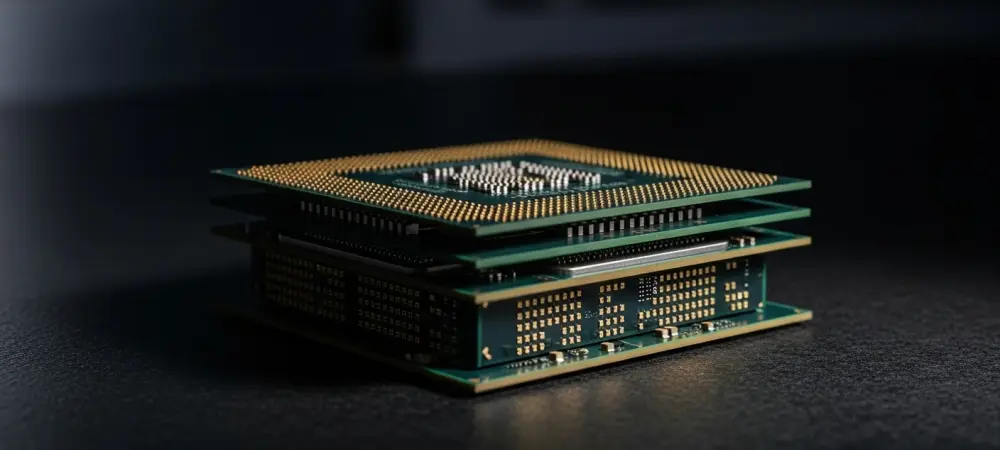
The most visible success of this targeted approach came in the lucrative desktop gaming market, where processors featuring 3D V-Cache technology captured an impressive 42.6% revenue share. By stacking a large L3 cache directly on top of the compute cores in chips like the Ryzen 9 9800X3D, AMD engineers drastically slashed data latency. This innovation provided a tangible, decisive performance advantage in games, proving that clever architecture could triumph over raw clock speed and winning the loyalty of a highly influential consumer base.
Simultaneously, the company’s Epyc server processors redefined efficiency in the data center, climbing to a massive 41.3% revenue share. The key was a modular chiplet design, a groundbreaking approach that allowed hyperscalers to mix and match specialized components to meet their unique workloads. This flexibility enabled new levels of performance-per-watt, a critical metric for enterprises managing vast server farms where energy costs are a primary concern. Epyc’s success demonstrated that in the server world, efficiency is as valuable as raw power.
The final pillar was the integration of dedicated AI hardware into mobile processors. The Ryzen AI series, which combined Zen 5 cores, RDNA 3.5 graphics, and a powerful Neural Processing Unit (NPU), drove significant growth in the laptop segment. This integrated design allows for sophisticated AI applications to run directly on the device, enhancing privacy and responsiveness. By anticipating the shift toward on-device AI, AMD successfully positioned its mobile platform as the engine for the next generation of intelligent computing.
A Market Validates the Vision
The verdict from the market was unequivocal, with definitive data from Mercury Research confirming the success of AMD’s strategic pivot by the close of 2025. The numbers painted a clear picture of broad-based momentum. Beyond the headline figure of 35.4% overall x86 revenue share, the company’s total unit share surged to 29.2%. This growth was not isolated to a single niche; it was a comprehensive advance across all major segments.
In the consumer-focused client business, revenue share jumped by over seven percentage points year-over-year, underscoring strong and sustained demand for its desktop and mobile offerings. Meanwhile, in the critical data center market, Epyc’s unit share approached the 30% threshold, a testament to its widespread adoption by major cloud providers and enterprise clients who validated its performance and efficiency claims with their investments.
The Playbook for Engineering Led Disruption
AMD’s journey offers a clear playbook for market disruption driven by engineering. The first principle was an unwavering commitment to foundational architecture over incremental speed bumps. Long-term bets on the Zen architecture, chiplets, and advanced packaging created a sustainable competitive advantage. Secondly, the strategy hinged on tailoring innovation to high-value segments rather than chasing a universal solution. This focus on performance-per-watt as a core metric resonated deeply in the energy-conscious data center and mobile markets, turning a technical specification into a key selling point.
Ultimately, this success was sustained by building a forward-looking roadmap that instilled confidence in customers and the market. By signaling future advancements, such as the upcoming 2nm Zen 6 “Venice” CPU, the company demonstrated that its recent gains were not an endpoint but a milestone on a continued path of innovation. This combination of long-term vision, targeted execution, and a focus on efficiency rewrote the rules of the CPU market and established a new paradigm for leadership.