

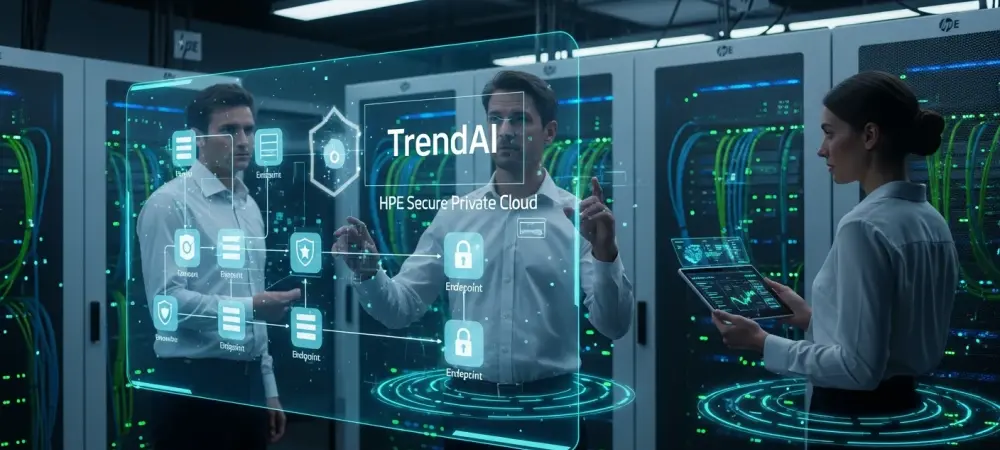
The rapid transition from experimental generative models to full-scale autonomous ecosystems has left many enterprise leaders questioning if their digital foundations can actually withstand the sophisticated threats of a new intelligence age. As organizations move away from the wild-west approach of early AI adoption, the focus has shifted toward creating stable, production-ready environments. This evolution requires more than just raw computational power; it demands a seamless integration of security protocols that are baked into the hardware itself. The collaboration between TrendAI and Hewlett Packard Enterprise (HPE) addresses this exact need by merging advanced threat intelligence with robust infrastructure. Establishing a “secure by design” philosophy is no longer a luxury but a fundamental requirement for corporate stability. By utilizing the HPE Private Cloud AI stack, which leverages high-performance NVIDIA technology, companies are building environments where data remains isolated and protected. This hardware-software synergy ensures that the transition to heavy-duty AI operations does not come at the cost of vulnerability. The “Unleash AI” partner program has become a pivotal influence in this space, setting new benchmarks for how specialized ecosystems should function to maintain global security standards.
Regulatory pressures are also mounting as governments demand higher levels of accountability and data sovereignty. Private and hybrid cloud architectures are becoming the preferred choice for sectors handling sensitive information, such as finance and healthcare, where public cloud risks are often deemed unacceptable. These frameworks allow for localized control while still benefiting from the scalability of modern AI. Consequently, the industry is witnessing a disciplined shift toward infrastructure that satisfies both internal governance and external legal mandates.
Navigating the Evolution of Secure AI Ecosystems
Emerging Drivers in the AI Security Lifecycle
The preference for private and hybrid cloud architectures is largely driven by a growing need for data sovereignty and the mitigation of third-party risks. Enterprises are discovering that while public clouds offer convenience, the loss of direct oversight over training data can lead to catastrophic compliance failures. By keeping AI workloads within a private cloud, organizations ensure that their proprietary logic and sensitive datasets never leave their controlled perimeter, effectively neutralizing many common external attack vectors.
Beyond infrastructure choices, the industry is grappling with the pervasive threat of Shadow AI and intellectual property theft. Unauthorized AI usage by employees often creates invisible backdoors, where corporate secrets are inadvertently fed into public models. To counter this, modern security strategies now prioritize total visibility into all AI-led initiatives. This visibility allows IT departments to monitor every interaction between users and models, ensuring that innovation does not lead to a silent drain of a company’s most valuable intellectual assets.
Furthermore, the concept of using AI-to-protect-AI is becoming a standard operational practice. Automated vulnerability hunting and digital twin simulations allow security teams to predict how an attacker might manipulate a neural network before a single line of malicious code is ever written. These proactive measures create a self-healing security layer that evolves alongside the AI it protects. As these strategies mature, the gap between traditional cybersecurity and AI operations continues to shrink, leading to a more unified defense posture.
Growth Projections and Performance Indicators
Current market data suggests a confident scaling of enterprise AI, with a significant percentage of pilot programs successfully transitioning into integrated production stacks. This shift is fueled by the increased reliability of integrated security features that reduce the perceived risk of deployment. As organizations gain confidence in their ability to protect their models, the volume of live AI applications is expected to rise exponentially throughout the coming years.
Operational productivity gains are also serving as a major performance indicator for the success of these secure stacks. By utilizing AI-driven threat detection, Security Operations Centers (SOCs) are experiencing a dramatic reduction in alert fatigue. Automated systems can now filter through thousands of non-critical events to highlight only the most sophisticated threats. This efficiency allows human analysts to focus on high-level strategy rather than getting bogged down by the noise of routine maintenance.
Looking forward, the impact of these secure AI stacks will likely accelerate global adoption rates across various industries. When the fear of data breaches and model tampering is minimized, even the most conservative organizations are more willing to invest in transformative intelligence tools. This trend indicates that the integration of security into the very fabric of AI infrastructure will be the primary catalyst for the next wave of industrial digital transformation.
Overcoming Obstacles in AI Infrastructure Deployment
Mitigating model tampering and supply chain risks remains one of the most daunting technical challenges for modern enterprises. Because AI logic often relies on a complex web of third-party libraries and open-source components, a single compromised dependency can poison an entire system. Strategies for protecting these pipelines now involve rigorous code scanning and the verification of model integrity at every stage of the lifecycle. By ensuring that the “brain” of the AI remains uncorrupted, companies can rely on the accuracy and safety of their automated outputs.
Moreover, there is a persistent tension between the organizational impatience to deploy new tools and the necessity of maintaining a robust defense. Business units often push for rapid integration to stay competitive, while security teams urge caution to prevent long-term liabilities. Bridging this gap requires a streamlined deployment process where security checks are automated and integrated directly into the development workflow. When security becomes a frictionless part of the process, speed and safety are no longer mutually exclusive.
Managing cross-layer telemetry complexity presents another significant hurdle for IT administrators. Gaining a bird’s-eye view across GPUs, containers, and data pipelines is technically difficult because each layer often uses different reporting standards. To solve this, unified platforms are being developed to aggregate data from every part of the AI stack into a single dashboard. This consolidated view allows teams to identify bottlenecks and security gaps instantly, ensuring that the entire infrastructure operates as a cohesive and transparent unit.
The Regulatory Framework for Private AI Clouds
Governance, control, and data sovereignty have become the cornerstones of the modern private AI cloud. With global data protection standards becoming more stringent, the HPE Private Cloud AI provides a structured environment that simplifies compliance. Organizations can now define exactly where their data resides and who has access to it, fulfilling the “right to audit” requirements that many public services struggle to meet. This level of control is essential for maintaining the trust of both stakeholders and regulatory bodies.
Compliance is further strengthened through proactive exposure management, which identifies potential legal and security risks before they manifest. By continuously discovering threats and assessing the impact of new AI deployments, companies can demonstrate a high level of accountability. This proactive stance is vital for meeting emerging legal requirements that demand transparency in how AI models are trained and utilized. It transforms compliance from a reactive “check-the-box” activity into a strategic advantage. Securing the AI foundation involves building a unified fabric that satisfies both internal audits and external pressures. This fabric acts as a consistent layer of protection that spans across all physical and virtual assets, ensuring that security policies are applied uniformly. When the infrastructure itself is built to be compliant, the burden on individual developers is reduced. This architectural approach creates a resilient environment where innovation can flourish without violating the complex legal landscape governing digital intelligence.
The Future Path of Enterprise Intelligence
The next generation of enterprise intelligence will likely be defined by zero-touch automation and the rise of autonomous security agents. These agents will not simply report vulnerabilities but will preemptively fix code and adjust firewall settings in real-time as threats evolve. This shift toward self-managing security will allow organizations to scale their AI efforts at a pace that was previously impossible. By removing the human bottleneck from routine defense tasks, the enterprise can focus entirely on high-value creative and analytical pursuits.
Unified security without borders is also emerging as a dominant trend, where consistent protection layers span across on-premise, hybrid, and multi-cloud environments. This ensures that a security policy defined in a private cloud remains just as effective when a workload bursts into a public cloud for extra capacity. This fluidity is essential for a modern business landscape that values flexibility and speed. As these borders vanish, the focus moves from protecting a specific location to protecting the data and the model itself, regardless of where they reside.
Innovation will ultimately be a direct result of this newfound resilience. When developers and data scientists work within a secure and stable environment, they are more likely to experiment with ambitious and creative AI applications. The fear of accidental data exposure or system failure currently limits the scope of many projects. However, with the infrastructure and security layers fully integrated, the “safety net” is strong enough to support the most complex and experimental business intelligence models of the future.
Building a Resilient Foundation for the AI-Driven Era
The strategic partnership between TrendAI and HPE successfully synthesized two critical components of the modern enterprise: high-performance infrastructure and advanced cybersecurity. By creating a unified stack, these companies simplified what was once a prohibitively complex series of layers. Organizations that adopted this integrated approach found that they could manage risk more effectively while simultaneously speeding up their time-to-market. The collaboration proved that when security and infrastructure are treated as a single entity, the entire AI lifecycle becomes more manageable.
For stakeholders looking to scale their AI initiatives, the path forward involved prioritizing risk management from the very first day of development. The most successful organizations were those that moved away from siloed security teams and instead adopted a holistic view of their technology stack. Investing in platforms that provided cross-layer telemetry and automated threat hunting became the gold standard for maintaining a competitive edge. These stakeholders recognized that long-term success in AI was not just about the power of the model, but the resilience of the environment it lived in.
Industry prospects remained bright as the integration of infrastructure and security became the essential blueprint for the future of business intelligence. This evolution allowed enterprises to move past the initial phase of AI hype and into a period of sustained, reliable growth. The synergy between TrendAI and HPE provided a clear roadmap for how to handle the complexities of a data-rich world. Ultimately, the transition to secured private AI clouds established a new era of digital trust, where the transformative power of intelligence was protected by an unbreakable foundation.