

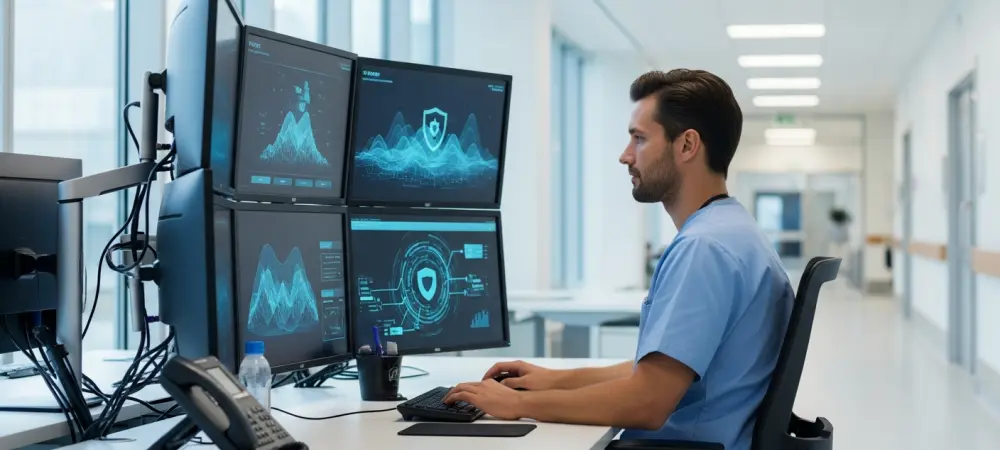
The rapid disintegration of traditional network boundaries in the healthcare sector has created a volatile landscape where clinical data is no longer confined within the secure physical walls of a hospital. As hybrid care models and remote telehealth services become the standard, the attack surface has expanded to a degree that makes conventional perimeter defenses almost entirely ineffective against modern adversaries. These cybercriminals have moved beyond simple data encryption, now executing highly targeted campaigns that specifically hunt for and neutralize secondary backup systems to ensure organizations cannot recover without paying a ransom. This shift represents a fundamental crisis for healthcare IT leadership, where the loss of data integrity can directly translate to delayed surgical procedures or compromised patient safety. Compounding this technical challenge is a persistent shortage of cybersecurity professionals, forcing facilities to reconsider how they protect their most sensitive assets. The current environment demands a move toward data resilience, moving from the illusion of a fortified castle to a more agile, decentralized protection model that assumes a breach is inevitable.
Strengthening Defenses: The Role of Immutable Data
Recovery Agility: The Technical Mechanics of Immutability
To address the aggressive tactics used by modern ransomware groups, healthcare systems are increasingly deploying immutable backup architectures that rely on Write Once, Read Many protocols to prevent data modification. These systems create a secure repository where information, once written, cannot be altered, deleted, or overwritten by any user, including those with elevated administrative credentials that may have been compromised by attackers. The core of this strategy involves both logical and physical isolation, frequently utilizing air-gapped storage or private cloud environments that remain disconnected from the primary production network until a scheduled synchronization occurs. Such measures provide absolute certainty. By implementing such rigid controls, IT departments ensure that even if an adversary gains full control over the primary server environment, the secondary copies remain pristine and ready for restoration. This technical barrier serves as a definitive last line of defense, allowing clinical operations to resume with verified, uncorrupted data sets rather than negotiating with extortionists.
Cloud Integration: Scaling Security Through Managed Services
The integration of multi-cloud environments and specialized managed services has become a critical component for scaling these immutable storage solutions across diverse healthcare landscapes. Managing the massive volume of diagnostic images, electronic health records, and real-time telemetry data requires a synthesis of public cloud agility and private cloud security to maintain performance. By leveraging edge computing resources, hospitals can provide faster access to critical data while ensuring that the central immutable core remains protected from localized threats at remote clinics. These platforms deliver results. Furthermore, the push for these technologies is no longer just a technical recommendation but a compliance necessity, as insurance providers and regulatory bodies now demand proof of immutable storage to qualify for coverage or avoid hefty fines. This regulatory pressure has accelerated the adoption of third-party security platforms that offer continuous monitoring and automated disaster recovery testing, ensuring that the recovery process is not just a theoretical capability but a battle-tested operational reality.
Strategic Implementation: Overcoming Modern IT Vulnerabilities
Legacy Modernization: Transitioning Beyond Perimeter Defense
Legacy backup systems frequently fail during modern cyberattacks because they are often stored on the same network or utilize shared credentials that an attacker can easily discover and exploit. To overcome these operational vulnerabilities, healthcare organizations are shifting their primary metric of success from simple intrusion prevention to what is now known as recovery agility. This concept prioritizes the speed and reliability of the restoration process, recognizing that preventing every single breach is functionally impossible in a hyper-connected environment. Expertise is required. Utilizing managed service providers allows hospitals to overcome the ongoing labor shortage by gaining access to specialized talent that monitors for suspicious patterns around the clock. These experts use behavioral analytics to detect the early stages of a ransomware campaign, often isolating infected segments before the malware can reach the immutable backup layers. By outsourcing the management of these complex environments, IT directors can focus on clinical workflows while knowing that their data protection strategy is handled by specialists.
Future Roadmap: Establishing a Secure Operational Standard
The transition toward a security-first architecture required a fundamental shift in how hospital boards viewed technology investments, moving them from line-item costs to essential pillars of patient safety. Organizations that successfully implemented these frameworks focused on integrating immutable backups into a broader multi-cloud strategy that prioritized automated verification and regular failover drills. Leaders moved away from manual processes and embraced artificial intelligence to manage the complexity of data movement between edge devices and secure repositories. The most effective next steps involved the auditing of all third-party access points and the mandatory implementation of multi-factor authentication for every backup interface. By establishing a culture where data integrity was treated with the same clinical rigor as medical sterilization, healthcare providers built a resilient roadmap for digital expansion. These proactive measures ensured that even if a catastrophic system failure occurred, the pathway to recovery remained clear, protecting both the financial stability of the institution and the lives of the patients who relied on its services.