

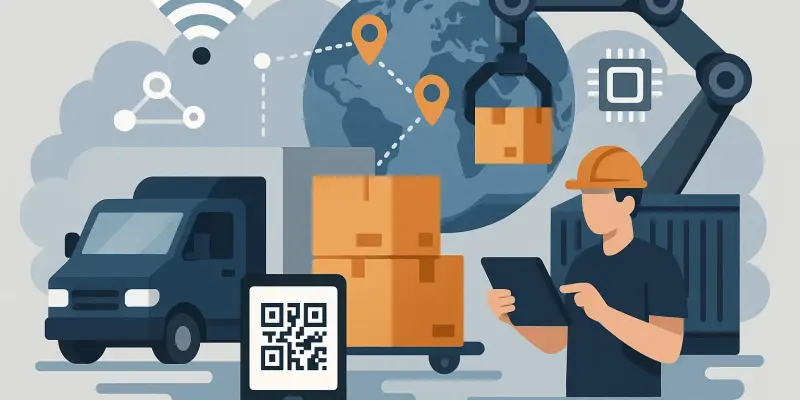
As global supply chains become increasingly complex, companies are adopting innovative technological strategies to enhance efficiency and remain competitive. With the integration of advanced automation, connectivity, and artificial intelligence, the dynamics of supply chains are undergoing a significant transformation. This article examines three pivotal developments that highlight how companies are adjusting to these transformative shifts. The partnerships and acquisitions of Addverb Technologies, AMETEK, and MISUMI underscore the critical role of strategic technology deployment in modern supply chains. Their endeavors reveal a purposeful trend toward creating interconnected and intelligent processes that meet the demands of an evolving market landscape.
Robotics and Connectivity: Enhancing Safety and Scalability
In the robotics sector, Addverb Technologies has taken significant strides by partnering with Infineon Technologies to incorporate Bluetooth Low Energy (BLE) modules into its robotic solutions. This collaboration aims to address safety and scalability challenges in warehouse environments through advanced communication protocols. By integrating BLE technology, Addverb’s robotics fleet is expected to benefit from enhanced reliability in emergency stop and shutdown functions. The introduction of this technology allows for better interaction between robots and their human counterparts, ensuring a safer workflow within dynamic settings. Sangeet Kumar, CEO of Addverb Technologies, emphasizes that BLE technology facilitates the creation of secure, scalable environments conducive to rapid expansion.
The use of BLE modules enables seamless data transmission over short distances, ensuring quicker response times in emergency scenarios. This is particularly vital in warehouse operations, where precision and timing are crucial. The collaboration demonstrates an emerging trend within the logistics industry—prioritizing connectivity and safety enhancements to support the increasing complexity of automated systems. The partnership not only represents an advancement in robotics but also reflects a broader growth in secure, tech-driven solutions. As industries seek to optimize their operations, the implementation of BLE could become a fundamental component in maintaining efficient, scalable workflows, ultimately reshaping the landscape of warehouse management and beyond.
Precision Imaging and Metrology: Expanding Capabilities
In a parallel development, AMETEK’s acquisition of FARO Technologies marks a considerable investment in expanding its metrology and 3D imaging capabilities. FARO, known for its precision laser scanners and 3D software solutions, aligns seamlessly with AMETEK’s portfolio. The acquisition, valued at approximately $920 million and pending requisite approvals, signifies AMETEK’s commitment to bolstering its technological offerings. By integrating FARO’s cutting-edge technology, AMETEK aims to enhance its position in the precision measurement market, offering more sophisticated solutions for industrial applications. This strategic move reflects a growing demand for advanced metrology solutions, driven by the need for accuracy and reliability across various sectors.
Unlike traditional measurement techniques, 3D imaging offers comprehensive data collection, reducing human error and improving overall precision. AMETEK’s approach underscores a commitment to excellence in manufacturing, making it well-positioned to cater to industries where precise measurements are critical. The integration of FARO’s capabilities into AMETEK’s existing framework is expected to streamline processes and promote innovation, setting a benchmark for future developments in the metrology field. As technological advancements continue to shape industry standards, strategic acquisitions like this one are critical in defining the future of precision imaging, wherever accurate data capture is imperative.
AI-Driven Manufacturing: Revolutionizing Efficiency
MISUMI’s acquisition of Fictiv highlights a major step forward in AI-driven manufacturing solutions. Valued at $350 million, this partnership aims to innovate how parts are sourced and produced across multiple industries. Founded in 2013, Fictiv has harnessed artificial intelligence to streamline workflows, enabling faster sourcing and efficient production planning. The collaboration between MISUMI and Fictiv paves the way for a more integrated approach to manufacturing. By merging advanced AI with MISUMI’s extensive distribution network, the companies are set to redefine material sourcing efficiency and production timelines while enhancing bill-of-materials planning.
This strategic acquisition reflects a commitment to revolutionizing the supply chain through technological integration that simplifies complex processes. The use of AI in manufacturing allows companies to minimize disruptions and enhance accuracy, ultimately leading to increased profitability and improved customer satisfaction. Looking ahead, the partnership between MISUMI and Fictiv may serve as a model for others seeking to leverage AI for more streamlined and resilient manufacturing practices. As AI continues to evolve, such initiatives underscore its transformative potential, demonstrating its capability to create smarter, more adaptive supply chains.
Transformative Trends and Future Prospects
As global supply networks grow more intricate, businesses are increasingly adopting cutting-edge technological strategies to boost efficiency and maintain competitiveness. The integration of sophisticated automation, connectivity, and artificial intelligence is radically transforming the dynamics of supply chains. This discussion focuses on three crucial advancements that illustrate how companies are adapting to these transformative shifts. The strategic partnerships and acquisitions made by Addverb Technologies, AMETEK, and MISUMI emphasize the crucial importance of deploying technology effectively in today’s modern supply chains. Their actions reflect a deliberate trend toward establishing interconnected and intelligent processes that respond effectively to the demands of a market landscape that’s perpetually evolving. These innovations not only sharpen efficiency but also pave the way for supply chains that are robust, agile, and ready to face future challenges, signaling a new era of operational excellence in the global market.