

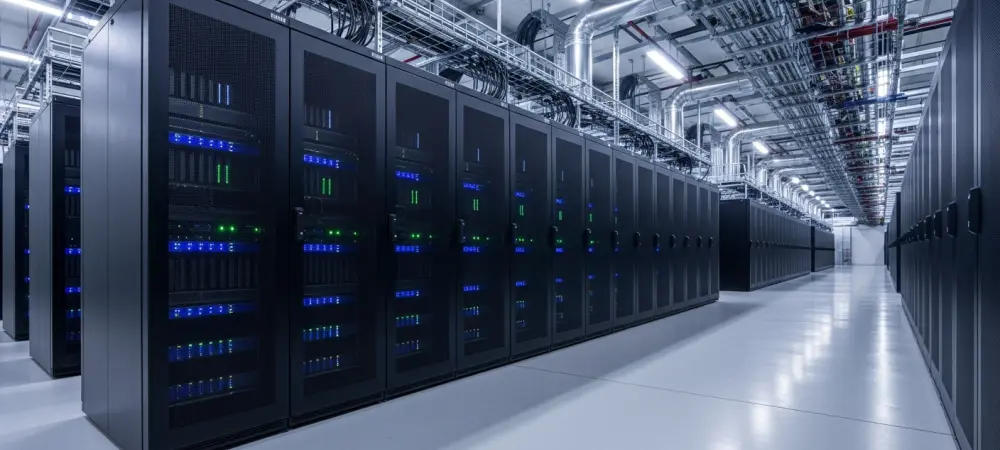
The hum of thousands of high-performance processors has replaced the clatter of assembly lines as the physical infrastructure powering artificial intelligence becomes the most valuable real estate on the planet. This shift marks a fundamental change in how the digital economy operates, where the value of an AI prompt depends entirely on the specialized hardware buried deep within massive concrete shells. Today, the invisible backbone of the AI revolution is no longer just a support system; it is the primary engine of global innovation and national security.
We are currently witnessing the birth of “AI factories,” a new breed of industrial facility designed to process gargantuan datasets in real-time rather than simply storing files in the cloud. Unlike traditional data centers that served as passive digital warehouses, these new structures act as active manufacturing plants for intelligence. They convert raw electrical power and data into sophisticated models, driving the next phase of the industrial revolution through automated reasoning and generative output.
This analysis explores the rapid transition toward gigawatt-scale computing, specifically looking at how nations are racing to secure their technological sovereignty. Through the lens of a major strategic pivot by SK Telecom, the discussion examines the investment frameworks and the massive scaling required to sustain the AI era. From GPU-based architectures to regional economic clusters, the following sections detail the physical and strategic foundations of a high-performance future.
The Global Surge in Specialized AI Infrastructure
Market Evolution: Transitioning to Gigawatt-Scale Capacity
The global demand for computing power has forced a dramatic evolution in the scale of data center construction, moving away from megawatt-level facilities toward massive gigawatt-scale campuses. As organizations transition from traditional CPU-based workloads to accelerated computing architectures, the requirement for density and power has skyrocketed. This trend is not merely about adding more servers; it represents a total reimagining of how energy and silicon are integrated to support long-term targets of up to 15GW of capacity.
Moreover, nations are now competing under initiatives like “AI G3” to become regional hubs for specialized computing power. Consequently, the focus has shifted toward building regional clusters that can handle the specific thermal and electrical demands of modern GPU resources, ensuring that local industries remain competitive on a global stage.
Case Study: SK Hyper and the Industrialization of AI
In response to these shifting demands, SK Telecom launched SK Hyper as a dedicated subsidiary to manage the full lifecycle of AI data centers. By securing a $540 million investment framework through 2030, the company has established a solid foundation to build massive AI campuses that serve as the bedrock for domestic and international enterprise clients. Furthermore, a pivotal collaboration with Nvidia has introduced the DSX AI factory architecture, which is slated to begin operations in 2027. Beyond simple hardware deployment, the two entities are conducting joint research into next-generation architectures, focusing on memory technologies and operational efficiency to maintain a lead in the increasingly crowded AI market.
Strategic Perspectives on the Infrastructure Pivot
The telecommunications industry is undergoing a significant rebranding, shifting from a focus on connectivity to becoming essential infrastructure providers for sovereign AI. By establishing local “AI factories,” these providers allow governments and corporations to process sensitive information within their own borders, mitigating the risks associated with reliance on foreign cloud providers.
Because the construction of hyperscale facilities involves intricate legal, logistical, and technical hurdles, a dedicated entity can move faster than a traditional corporate department. This agility is crucial in a market where the window of opportunity for securing energy contracts and prime real estate is closing rapidly.
The Future Roadmap: Scaling Challenges and Opportunities
Achieving a 15GW capacity target presents immense logistical hurdles, particularly regarding energy consumption and the construction of massive power substations. As the density of computing power increases, the limitations of traditional air cooling have become apparent, prompting a transition toward liquid cooling and other advanced thermal management systems. These innovations are no longer optional; they are required to keep next-generation GPUs running at peak performance without overwhelming the local grid.
Furthermore, the expansion of these AI clusters is driving economic development in regional hubs like Ulsan, Chungcheong, and Honam. By spreading infrastructure across multiple regions, providers can tap into diverse energy sources and create high-tech jobs outside of major metropolitan centers. This distributed approach not only improves the resilience of the network but also ensures that the benefits of the AI economy are felt across the entire national landscape.
Conclusion: Securing the Foundation of the AI Era
The strategic necessity of hyperscale AI data centers established a vital foundation for national competitiveness during a period of rapid technological flux. Initiatives like the formation of SK Hyper functioned as the primary engine for advanced industrial applications, ensuring that physical infrastructure kept pace with the explosive growth of algorithmic complexity. This massive pivot toward specialized “AI factories” ultimately dictated the global hierarchy of technological leadership.
Moving forward, the focus shifted toward optimizing the efficiency of these gigawatt-scale campuses and integrating them into broader sovereign AI strategies. The lessons learned from the initial rollout of these facilities provided a roadmap for future expansions, highlighting the importance of energy independence and advanced cooling. By securing these physical foundations, the industry successfully prepared for a decade defined by the relentless demand for high-performance computing.