

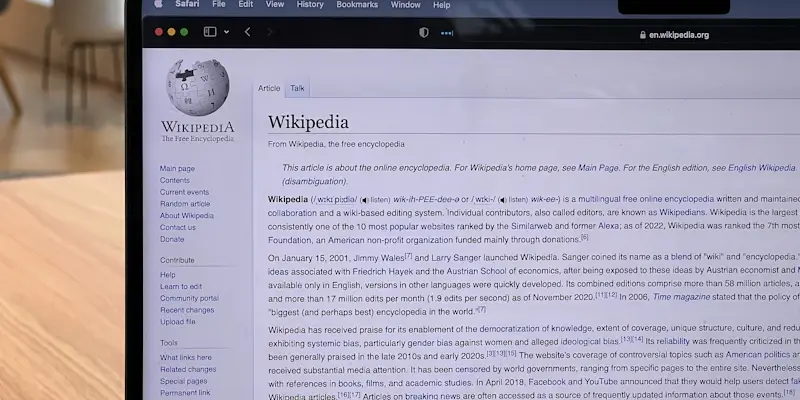
Artificial intelligence has significantly impacted all facets of digital knowledge production, particularly affecting Wikipedia, the largest open-access encyclopedia. As AI technologies continue to advance, they pose unprecedented challenges to the sustainability and role of Wikipedia. The integration of AI in knowledge dissemination presents both opportunities and serious risks that could alter the landscape of how information is accessed and verified. This article delves into the multifaceted challenges presented by AI, exploring critical issues that threaten Wikipedia’s relevance and sustainability in the digital era.
Wikipedia’s Role in AI Training
Wikipedia’s role as an expansive resource of collaboratively edited content makes it indispensable for training large language models (LLMs) such as ChatGPT, Google’s Gemini, and Microsoft’s Copilot. These AI models rely heavily on the structured, verifiable knowledge available on Wikipedia to enhance their ability to respond accurately to users’ queries. However, the integration of Wikipedia data into AI models is often shrouded in opacity; experts interviewed in the study emphasized that despite Wikipedia’s significant contribution to training data, LLMs frequently fail to credit the source.
This lack of attribution has far-reaching implications, not only reducing Wikipedia’s visibility but also disrupting the traditional feedback loop where readers become article contributors. When LLMs bypass direct user engagement with Wikipedia, the site faces a potential decline in content quality and a decreasing recruitment of new editors. Furthermore, the surge of AI-generated content dramatically changes the nature of information dissemination. Wikipedia’s historical role as a community-driven source of vetted information risks being overshadowed by AI outputs that may prioritize efficiency over accuracy.
The study underscores that while LLMs are powerful, they lack the nuanced editorial oversight inherent to human contributors. This absence could lead to misinformation, misinterpretation, and significant knowledge gaps. As these models continue to reshape public access to information, the necessity for human verification and editorial control becomes even more critical. To maintain the integrity and reliability of information, it is essential to uphold the traditional processes of human curation and citation policies that Wikipedia champions.
Sustainability Challenges and Ethical Concerns
The unchecked use of Wikipedia by AI introduces multifaceted sustainability challenges, particularly within the digital commons where volunteers freely contribute content. Despite the altruistic nature of this labor, for-profit tech companies exploit these contributions without offering equitable reciprocity, raising significant ethical issues of exploitation. Contributors did not consent to their work being monetized by AI firms, which parallels broader concerns about digital labor rights in an increasingly automated world.
Systemic biases prevalent in Wikipedia’s content, particularly those related to gender, linguistic, and cultural representation, are further exacerbated by LLMs. These AI models train on existing data and thereby perpetuate Wikipedia’s structural biases, leading to a lack of diversity in AI-generated content. This perpetuation of bias has broad implications, potentially reinforcing stereotypes and omitting critical perspectives from various underrepresented groups. The study calls for AI developers to increase transparency regarding their training methods and to adopt ethical frameworks ensuring equitable use of open-access data.
Another major ethical concern is the potential for AI-generated content to manipulate information. Driven by corporate interests or unmonitored incentives, LLMs could prioritize specific narratives, subtly yet substantially distorting public knowledge. This poses a significant risk to intellectual autonomy, where misinformation or skewed representations compromise the integrity of information. If Wikipedia is not properly credited or responsibly utilized, the very reliability and neutrality of the knowledge base are at risk.
AI’s Disintermediation and Wikipedia’s Future
A significant issue that arises from the increased use of AI is the phenomenon of disintermediation. In this process, large language models act as intermediaries between users and the original knowledge sources, effectively reducing direct traffic to Wikipedia. As users become increasingly reliant on AI-generated summaries, the habit of visiting Wikipedia for detailed information diminishes. This shift has severe implications for Wikipedia’s funding model, which is heavily dependent on reader donations and active user participation.
Fewer site visits translate to fewer donations and contributions, potentially triggering a vicious cycle that threatens Wikipedia’s long-term sustainability. Addressing this, the study suggests that Wikipedia adapt by forming strategic partnerships with AI firms and implementing robust attribution policies to ensure the visibility of its content in AI-generated responses. Such measures are crucial to maintaining the flow of donations necessary for Wikipedia’s continued operation.
Moreover, AI’s growing role in information dissemination could undermine Wikipedia’s role in fostering digital literacy. With AI-generated content becoming a primary information source, users might refrain from critically engaging with the underlying sources or challenging their validity. Wikipedia’s strengths include its rigorous citation policies, community-driven revisions, and high standards of verifiability—attributes that AI-generated summaries often lack. Promoting digital literacy, source verification, and critical thinking will remain essential to prevent AI from monopolizing information accessibility without the accountability that Wikipedia upholds.
Pathways to a Sustainable Future
Artificial intelligence has profoundly influenced every aspect of digital knowledge production, particularly impacting Wikipedia, the largest open-access encyclopedia in the world. As AI technologies continue to progress, they introduce unprecedented challenges to Wikipedia’s sustainability and role in society. The integration of AI in information dissemination offers both opportunities and significant risks that could transform how information is accessed and verified. This article explores the complex challenges AI presents, focusing on critical issues that threaten Wikipedia’s relevance and sustainability in today’s digital age. Key areas of concern include the potential for AI-generated misinformation, the reliability of AI-driven content moderation, and the ethical implications of using AI in knowledge curation. As Wikipedia relies heavily on human contributions to ensure accuracy and neutrality, the rise of AI-generated content raises questions about the future of knowledge verification and editorial oversight. This examination addresses these concerns and highlights the need for balanced approaches to incorporate AI while preserving Wikipedia’s core values and mission.