

Dominic Jainy is a seasoned IT professional whose expertise spans the cutting edge of artificial intelligence, machine learning, and hardware architecture. With a keen eye for how emerging technologies reshape consumer electronics, he has spent years analyzing the intersection of semiconductor efficiency and energy storage. As the mobile industry pivots toward extreme endurance, Dominic provides a technical perspective on the engineering hurdles and market shifts required to make ultra-high-capacity devices a reality.
The following discussion explores the technological leap toward 12,000mAh mobile batteries, the role of 3nm silicon in managing power, and the strategic differentiation between regional markets. We delve into the trade-offs of silicon-carbon chemistry and how these advancements redefine what a flagship device can achieve in an era of incremental upgrades.
Mobile devices are beginning to transition toward 12,000mAh batteries using silicon-carbon technology. How does this shift affect the physical footprint and weight of a handset, and what engineering trade-offs are required to maintain a slim profile while nearly doubling standard capacities?
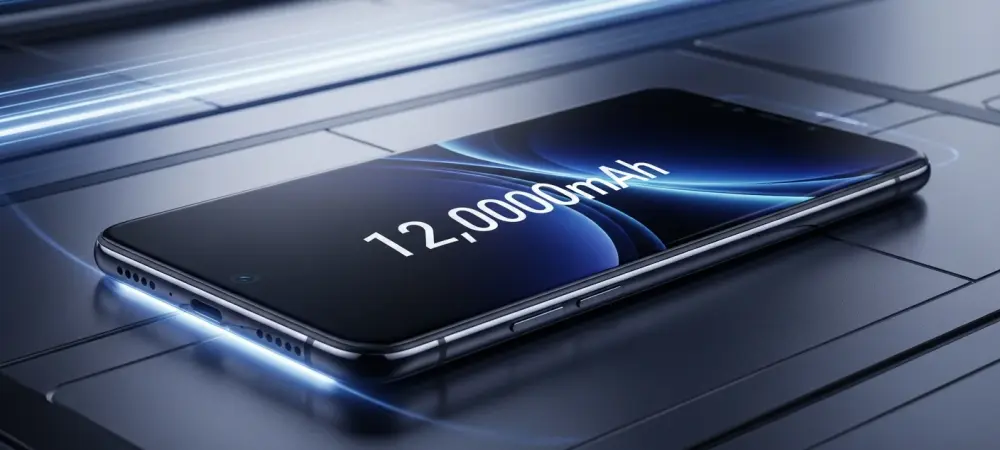
The shift toward silicon-carbon technology is a game-changer because it allows us to increase energy density without the massive physical bloating we saw in early high-capacity “brick” phones. By integrating silicon into the carbon anode, manufacturers can store more ions in a smaller space, which is exactly how Honor is targeting a 12,000mAh capacity while trying to avoid a proportional increase in thickness. However, the engineering trade-off is incredibly delicate because as you cram more energy into a slim profile, you lose the internal air gap needed for heat dissipation. Designers have to rethink the entire internal chassis, often shaving millimeters off other components to ensure the device doesn’t feel like a heavy lead weight in the user’s hand. Even with silicon-carbon, a jump from the 10,080mAh seen in the Power 2 to a 12,000mAh cell requires a obsessive focus on structural integrity so the phone remains pocketable and ergonomic.
The industry is moving from 4nm to 3nm chipsets like the Dimensity 8600 to improve efficiency. Beyond raw processing speed, how does this specific manufacturing node enhance the longevity of high-capacity batteries, and what thermal management hurdles arise when pairing such powerful chips with massive energy cells?
Moving from a 4nm process to a 3nm node, like the one expected in the upcoming Dimensity 8600, is less about hitting higher clock speeds and more about the “performance-per-watt” ratio. At 3nm, the transistors are more densely packed and require less voltage to switch, which directly translates to less “leakage” or wasted energy during background tasks. This efficiency works in tandem with a 12,000mAh battery to create a device that could realistically last several days on a single charge under heavy use. The hurdle, however, is that while the chip is more efficient, a massive battery acting as a heat reservoir can create a “thermal blanket” effect inside the phone. Engineers must develop advanced cooling solutions to prevent the heat from the high-performance chipset from degrading the chemical health of the large battery cell over time.
While some regional markets see phones with 10,000mAh or 11,000mAh batteries, international versions often ship with smaller capacities. What logistical, safety, or regulatory factors drive this discrepancy, and how might a global rollout change the way developers optimize mobile software for extreme endurance?
The discrepancy between the massive batteries found in Chinese domestic models and their smaller international counterparts is largely driven by strict shipping regulations and local consumer preferences regarding weight. International aviation safety standards, for instance, have very specific thresholds for lithium-based batteries, and exceeding certain watt-hour limits can complicate global logistics and increase insurance costs for the manufacturer. Furthermore, global markets often prioritize a “sleek” aesthetic over raw endurance, leading brands to scale back capacity to meet Western design expectations. If we saw a true global rollout of 12,000mAh devices, it would force a paradigm shift in software development where “low power modes” become obsolete. Instead, developers would focus on “always-on” high-performance features, such as local AI processing, that were previously throttled to save juice on standard 5,000mAh handsets.
Charging a 12,000mAh battery presents significant practical challenges for the average user. What specific advancements in charging wattage and heat dissipation are necessary to keep charge times reasonable, and how do these high-speed solutions impact the long-term chemical stability of the battery?
When you are dealing with a 12,000mAh reservoir, traditional 30W or even 65W charging starts to feel painfully slow, potentially taking hours to reach a full state. To make these devices viable, we are seeing a push toward ultra-high wattage solutions that can push massive current without causing the battery to swell or overheat. The engineering headache here is that fast charging generates intense heat, and silicon-carbon cells are particularly sensitive to thermal stress during rapid expansion and contraction. To maintain long-term chemical stability, Honor and its peers must implement sophisticated “charge splitting” techniques and real-time thermal monitoring. If the hardware can’t dissipate that heat effectively, the longevity of that massive 12,000mAh capacity will drop significantly after just a year of use, defeating the purpose of an endurance-focused device.
Competitors like Oppo and Realme are pushing beyond the 7,000mAh mark, yet a jump to 12,000mAh remains a massive leap. Which specific user demographics or professional use cases benefit most from this level of endurance, and how does this capacity shift redefine the “flagship” category?
The jump to 12,000mAh moves a phone out of the “convenience” category and into the “essential tool” category for specific power users like field engineers, long-haul travelers, and mobile gamers. For someone in a remote area without easy access to a power grid, a phone that lasts three or four days is a critical piece of infrastructure rather than just a luxury. This shift redefines the “flagship” category by moving the focus away from incremental camera upgrades and toward “utility-first” premium hardware. While the Honor Power 3 may target the domestic Chinese market initially, its existence challenges the definition of a flagship; it suggests that true luxury is no longer just about the thinnest frame, but about the total freedom from the charging cable. This creates a new tier of devices where “extreme endurance” is the primary status symbol, rather than just a secondary feature.
What is your forecast for battery-focused smartphones?
I expect that the era of the 5,000mAh “standard” is coming to an end as silicon-carbon technology matures and becomes more affordable to manufacture at scale. Within the next three years, we will likely see 7,000mAh to 8,000mAh become the baseline for mainstream flagships, while specialized “Power” series devices like those from Honor will push toward the 15,000mAh ceiling. As AI continues to run more locally on our devices, the demand for energy will skyrocket, making these massive batteries a necessity rather than a niche experiment. We are entering a decade where “battery anxiety” will finally be solved through a combination of 3nm efficiency and high-density chemical storage, fundamentally changing how we interact with mobile technology.