

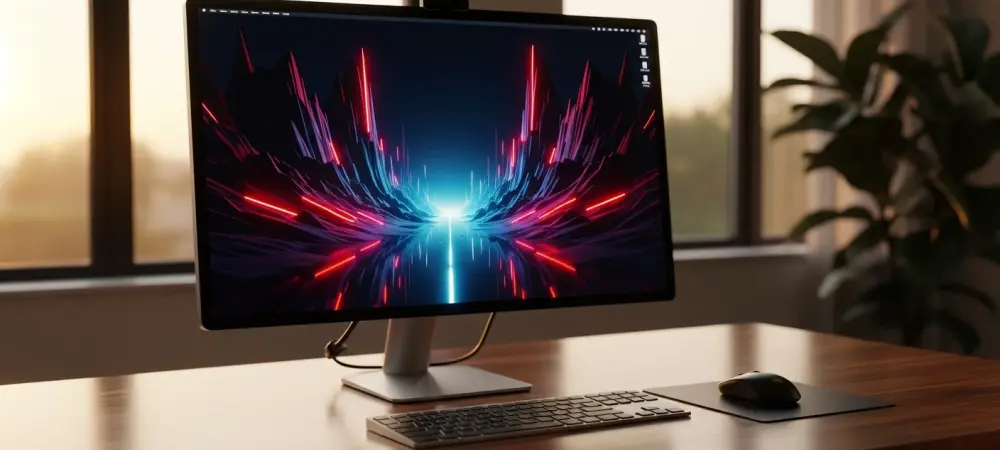
The arrival of the Hisense 32UX marks the first instance where a desktop monitor successfully harvests the raw power of true RGB Mini LED backlighting to redefine visual fidelity. While the display industry often experiences incremental updates, this specific unit introduces an architectural shift by integrating professional-grade television technology into a 32-inch form factor. It addresses a long-standing demand for high-luminance panels that do not sacrifice color accuracy or longevity for peak performance.
The Emergence of RGB Mini LED Technology in Desktop Displays
Mini LED technology originally gained traction as a means to bridge the gap between traditional LCDs and organic light-emitting diodes. However, the early iterations relied on white LEDs or blue chips with yellow phosphor, which often resulted in a limited color gamut and “haloing” effects around bright objects. The RGB Mini LED approach changes this by using individual red, green, and blue LEDs in the backlight array itself, removing the need for traditional color conversion layers.
This shift is particularly relevant as the demand for high dynamic range (HDR) content reaches its zenith in both gaming and professional video editing. By generating light at the desired wavelength from the source, the system achieves a level of spectral purity that was previously unattainable in consumer-grade monitors. This evolution represents a move toward a more modular and efficient light-delivery system that prioritizes color volume over simple brightness.
Technical Architecture and Core Innovations
Direct RGB Backlighting and Peak Luminance
The primary innovation resides in the direct RGB backlighting system, which allows the monitor to reach a peak brightness of 2000 nits. Unlike conventional monitors that lose light intensity as it passes through various filters, this direct emission ensures that every nit of brightness contributes directly to the perceived image. This results in a more vibrant HDR experience, where highlights are piercing and specular reflections appear lifelike. Moreover, the dense array of LEDs provides thousands of local dimming zones, offering precise control over contrast. This granularity ensures that deep blacks are maintained even when they are adjacent to bright light sources, effectively mimicking the contrast ratios of self-emissive displays. The significance of this system lies in its ability to provide this performance without the dimming or “auto-brightness limiting” often seen in competing panel types.
4K Resolution and 180Hz Refresh Rate Capabilities
Beyond the backlight, the display utilizes a 4K resolution panel that delivers exceptional pixel density for a 32-inch screen. This clarity is essential for reading fine text and editing high-resolution photography, providing a workspace that feels expansive yet detailed. When combined with the 180Hz refresh rate, the monitor transitions from a static powerhouse into a fluid gaming machine, handling fast-paced motion with minimal blur.
The 180Hz capability is particularly impressive given the complexity of controlling thousands of RGB LEDs in sync with such a high frame rate. This synchronization ensures that the backlight responds instantly to changes on screen, preventing the “ghosting” or lag that plagued earlier high-zone-count monitors. This makes the 32UX a dual-purpose tool that satisfies the requirements of both competitive esports and cinematic exploration.
Current Trends and Shifts in High-End Display Markets
The high-end display market is currently witnessing a pushback against the limitations of OLED technology, specifically regarding burn-in and overall brightness. Consumers are increasingly looking for “forever” monitors—devices that can maintain peak performance for years without degradation. This shift has cleared a path for advanced Mini LED solutions like the 32UX to establish themselves as the premium alternative for those who find OLED insufficient for bright rooms.
Furthermore, the industry is moving toward a more specialized approach to panel development, where the backlight is no longer treated as a secondary component. Manufacturers are recognizing that the quality of light is just as important as the quality of the LCD crystals. This trend toward backlight-centric design is driving innovation in driver ICs and thermal management, as the energy required to power thousands of individual LEDs is substantial.
Real-World Applications for Gamers and Creators
For content creators, this technology provides a canvas that can accurately simulate the HDR mastering process. The ability to see 2000 nits of brightness while maintaining color accuracy across the entire spectrum allows editors to make informed decisions about light and shadow. This removes the guesswork often associated with editing on lower-end displays that cannot truly represent the range of modern camera sensors.
Gamers, on the other hand, benefit from an immersive experience that traditional panels cannot match. In titles with complex lighting, such as those featuring ray-tracing, the 32UX brings a physical weight to light sources, making the virtual environment feel more grounded and tangible. The high refresh rate ensures that this visual fidelity does not come at the cost of responsiveness, providing a competitive edge in high-stakes environments.
Technical Hurdles and Market Obstacles
Despite its performance, the technology faces significant hurdles, primarily regarding production costs and heat dissipation. The 32UX carries a premium price tag that places it above many flagship OLED competitors, making it a difficult sell for the average consumer. Additionally, the power required to drive an RGB Mini LED array is significantly higher than that of a standard backlight, necessitating robust cooling solutions that can lead to a thicker chassis.
There is also the challenge of software integration and backlight algorithm tuning. Managing thousands of zones effectively requires sophisticated AI-driven processing to avoid “blooming” or delayed transitions. While Hisense has made great strides, the complexity of these systems means that firmware updates and continuous optimization are necessary to ensure the hardware reaches its full potential across all types of content.
Future Outlook for RGB Mini LED Innovation
The future of this technology lies in the further miniaturization of the LED components and the reduction of manufacturing complexity. As production scales, the cost of RGB Mini LED arrays is expected to drop, potentially bringing this level of performance to mid-range displays. We may also see the integration of more intelligent sensors that adjust the backlight behavior based on ambient lighting conditions, further improving efficiency. Long-term, the lessons learned from the 32UX will likely influence the development of Micro LED technology, which represents the ultimate goal of the industry. By perfecting the control and color output of Mini LED arrays, manufacturers are building the foundation for a future where every pixel is its own light source without the organic degradation of current technologies. This evolution will eventually redefine what users expect from every screen in their lives.
Final Assessment: Defining the New Standard for LCD Performance
The 32UX successfully validated the potential of RGB Mini LED as a superior alternative to traditional backlighting methods. It demonstrated that LCD technology could achieve OLED-like contrast while offering brightness levels that were previously thought impossible for the desktop. The market recognized the device as a bold experiment that paid off for a specific niche of high-end enthusiasts.
The adoption of this technology encouraged other manufacturers to rethink their reliance on blue-phosphor systems, leading to a broader diversification of the high-end monitor market. Ultimately, the 32UX provided a blueprint for how professional-grade visual performance could be miniaturized without losing its impact. It functioned not just as a product, but as a statement of intent for the next era of desktop display evolution.