

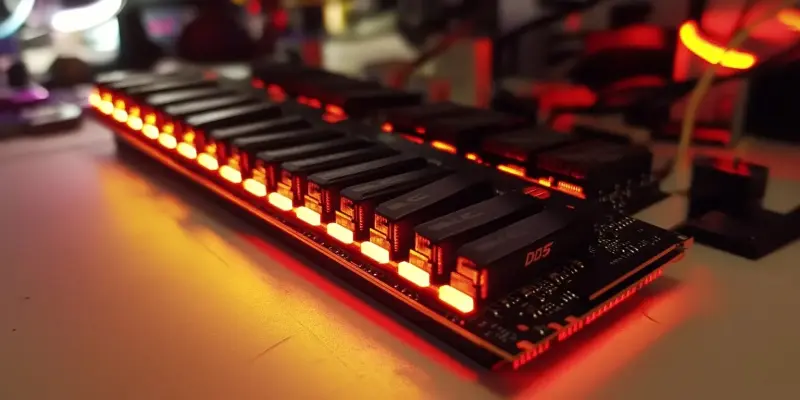
In a groundbreaking achievement for the overclocking community, overclocker Hicookie has set a new DDR5 memory speed world record, reaching an impressive 12726 MT/s on the Z890 AORUS Tachyon ICE motherboard. This astonishing accomplishment surpasses the previous record of 12698 MT/s held by Splave and has captured the attention of tech enthusiasts worldwide. Utilizing a V-Color Manta Xfinity RGB DDR5 memory module paired with an Intel Core Ultra 9 285K processor, this remarkable feat was made possible with the aid of liquid nitrogen cooling, which maintained optimal performance levels throughout the overclocking process. This triumph not only highlights the advancements in DDR5 memory technology but also the unwavering dedication of overclocking enthusiasts to push hardware capabilities to their very limits.
The Role of Cutting-Edge Hardware
The Z890 AORUS Tachyon ICE motherboard was an instrumental component in this record-setting achievement due to its overclocking-friendly features, including an all-digital power design, shortcut keys, and voltage detection functions. Gigabyte, the manufacturer of the motherboard, expressed immense pride in this milestone through their enthusiastic press release, underscoring the significant role their hardware played in this success. Overclocking, a practice where enthusiasts push computer hardware beyond its factory settings to achieve higher performance, has always demanded superior and specialized equipment. The Z890 AORUS Tachyon ICE is celebrated for supporting these rigorous demands, making it a popular choice among overclockers aiming to break records.
That said, achieving such high memory frequencies comes with trade-offs, most notably increased memory latency. For this record, the memory latency was recorded at CL 68-127-127-254, which is significantly higher compared to the more efficient CL 48-58-58-140 achieved at lower speeds. Despite this drawback, the excitement within the overclocking community remains strong. Such achievements are often pursued not necessarily for practical performance gains but rather for the challenge, prestige, and technical prowess they represent. This aspect of overclocking culture continues to captivate and inspire technology enthusiasts around the globe.
The Excitement and Future of Overclocking
Hicookie’s recent triumph includes establishing three world records in the 3DMark CPU Profile for 1T, 2T, and 8T configurations. These milestones reinforce his standing in the overclocking world and highlight a period of extraordinary success. Such achievements hint that the elusive 13000 MT/s benchmark might soon be attained, reflecting the fast-paced advancements in the overclocking field. As other overclockers continue to push the envelope and develop cutting-edge hardware, this breakneck speed of progress is expected to persist.
This major stride in DDR5 memory overclocking stems from the overclocking community’s relentless drive for performance. With the support of passionate enthusiasts and cutting-edge technology, each new record sets a higher standard and energizes ongoing innovation. As overclockers continuously challenge the limits of what’s achievable, Hicookie’s accomplishment showcases the limitless potential and exhilarating future of tech advancements.
Hicookie’s record-setting DDR5 memory speed at 12726 MT/s marks a pivotal moment. Using advanced hardware like the Z890 AORUS Tachyon ICE motherboard, liquid nitrogen cooling, and leading memory modules enabled this feat. With 13000 MT/s now within sight, driven by the unwavering commitment of overclockers worldwide, this accomplishment not only highlights technological excellence but also propels the pursuit of peak performance and innovation forward.