

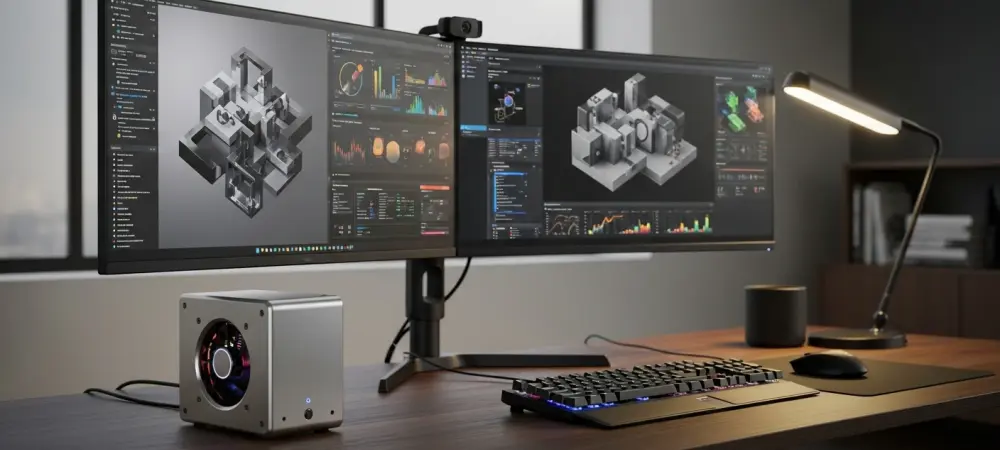
The landscape of compact computing is undergoing a radical transformation as the industry moves away from basic media hubs toward sophisticated workstations capable of driving complex artificial intelligence workloads. GMKtec is preparing to lead this transition with the release of the EVO-T2, a device that signifies the arrival of the “AI PC” era.
The Evolution of the Mini PC Market and the Shift Toward AI Workstations
Professional environments are increasingly replacing bulky towers with small form factor (SFF) hardware that does not compromise on performance. This shift is driven by a demand for localized AI processing, allowing creators to handle data-heavy tasks without relying on cloud latency.
Miniaturization has enabled a new class of flagship workstations for specialized industries. As competition intensifies, hardware manufacturers are focusing on modular designs and high-performance integration to satisfy a workforce that values both portability and extreme computational power.
High-Performance Trends and Data-Driven Market Projections
Emerging Technologies and the Rise of On-Device AI Performance
Intel’s Panther Lake architecture serves as the foundation for this new generation, offering unified AI units that redefine efficiency. The EVO-T2 leverages this to provide a total of 180 TOPS, which has become the new benchmark for modern professional hardware.
The integrated Xe3 graphics architecture within these chips provides enough power to handle AAA gaming and professional rendering. This eliminates the traditional requirement for discrete GPUs in many mobile workflows, streamlining the physical footprint of the device.
Market Growth Indicators and the Future of Compact Computing
Forecasts through 2027 indicate a significant rise in the adoption of AI-enabled mini PCs within corporate sectors. The integration of 128 GB LPDDR5X memory and Gen 5 storage ensures that these devices remain viable for the next several years of software development.
Technical Barriers and Engineering Challenges in Flagship SFF Devices
Balancing an 80W power draw within a compact chassis requires advanced thermal engineering to prevent performance throttling. Maintaining acoustic efficiency while cooling a 16-core processor is a primary challenge that determines the success of high-end SFF units.
Moreover, managing PCIe Gen 5.0 lanes in a miniaturized layout demands precise motherboard design to avoid signal interference. Overcoming these engineering hurdles is essential for delivering the stability required by professional users and gamers alike.
Regulatory Standards and the Impact of Connectivity Compliance
The move toward USB-IF standards and 100W Power Delivery has simplified the modern workspace, allowing for universal connectivity. Adhering to these international safety and frequency standards is mandatory for deploying high-performance hardware in global markets.
Local AI processing also introduces new security considerations for data handling. The inclusion of ports like OCulink reflects a growing trend toward modular ecosystems, where users can safely expand their hardware capabilities as their professional needs evolve.
The Future Trajectory of Portable Professional Hardware
Future hardware iterations will likely see the total elimination of entry-level dedicated GPUs as integrated solutions become more robust. The industry is moving toward extreme memory capacities to support massive local datasets and real-time AI inference.
Global economic conditions and supply chain stability will influence the pricing of these premium devices. However, the convergence of high-performance local hardware and cloud resources will continue to define the professional computing landscape.
Conclusion: Setting a New Benchmark with the EVO-T2
The launch of the EVO-T2 established a new standard for what a portable workstation achieved in a compact form. It demonstrated that high-performance AI processing was accessible without the need for traditional desktop infrastructure.
Forward-looking organizations prioritized these systems to secure a competitive advantage in an increasingly automated economy. The transition toward the 180 TOPS standard ensured that professional workflows remained efficient and future-proofed against evolving digital demands.