

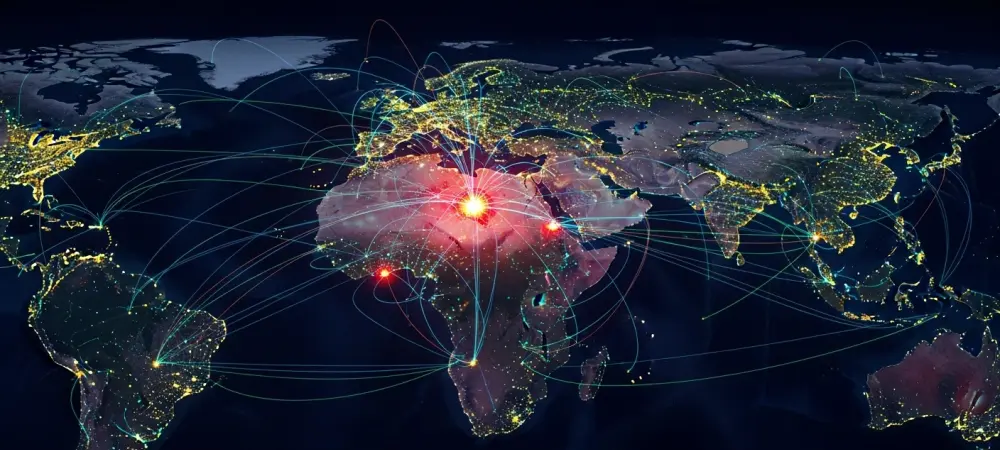
The synchronized severing of a sovereign nation’s undersea cables and satellite links on February 28, 2026, transformed what was once a localized kinetic strike into a boundless digital insurrection. When Operations Epic Fury and Roaring Lion commenced, the objective seemed contained within the traditional theater of war. However, the immediate plunge of Iran’s internet connectivity to a staggering low of one percent did more than just silence a government; it dismantled the guardrails of state-controlled cyber conflict. This unprecedented blackout signaled the birth of a decentralized global warfare era where the absence of a central command has invited a chaotic surge of independent actors. The modern battlefield no longer requires physical presence to inflict devastating damage on civilian and state infrastructure. As command-and-control links between central intelligence and their regional cells evaporated during the initial strike, the world witnessed a paradigm shift in how digital power is exercised. This transition from organized military maneuvers to a fragmented free-for-all has turned the global internet into a volatile front line. The current situation proves that while a physical offensive can paralyze a nation’s nervous system, it simultaneously releases a swarm of uncoordinated threats that operate far beyond the reach of conventional diplomacy or military deterrence.
From Isolation to Anarchy: Why the Middle East Offensive Changed Everything
The strategic logic behind the joint U.S.-Israeli operation relied on the assumption that total digital isolation would neuter offensive capabilities. In reality, this “digital blackout” created a vacuum that was instantly filled by a more dangerous and erratic set of players. By severing the tethers between state-sponsored units and their central oversight, the offensive inadvertently birthed “operational isolation,” where smaller cells now execute attacks without the constraints of national policy. This shift has fundamentally moved the needle from a predictable state-versus-state chess match toward a multi-front conflict involving ideological hacktivists and opportunistic criminal syndicates.
Moreover, the decentralization of these threats means that neutralizing a single target no longer stops the cascade of incoming attacks. These newly autonomous units are prioritizing aggressive targeting patterns that favor high-impact disruptions over long-term espionage. The fallout from the Middle East offensive has demonstrated a sobering truth: in the digital age, disabling a target’s primary connection does not eliminate the threat—it merely forces it to evolve into a more resilient and less predictable form. The resulting anarchy has left global cybersecurity teams struggling to keep pace with a threat landscape that changes by the hour.
Mapping the New Landscape of Global Cyber Hostilities
This escalation has reshaped the very architecture of digital warfare, moving it away from isolated incidents toward massive, coordinated campaigns involving multi-national coalitions. One of the most significant developments is the emergence of the “Electronic Operations Room,” a digital hub that serves as a nexus for over 60 distinct entities. This alliance includes pro-Russian collectives and various anti-Western groups that have found a “consensus viewpoint” in their opposition to recent military actions. Their coordinated strikes on financial systems and regional energy grids prove that decentralized alliances can be just as potent as state-level military divisions.
Beyond infrastructure, the conflict has pivoted toward the exploitation of human psychology through sophisticated social engineering. In Israel, attackers distributed a malicious clone of the “RedAlert” emergency application, turning a tool meant for survival into a gateway for mobile surveillance. Simultaneously, the United Arab Emirates saw a dramatic rise in “vishing” scams where actors impersonated government officials to exfiltrate personal data. These campaigns illustrate how the “fog of war” provides an ideal environment for cyber actors to weaponize public anxiety, using the very tools designed for safety to compromise individual and national security.
The most disturbing evolution in this current climate is the bridge between digital intrusion and physical intimidation. Groups such as Handala Hack have moved beyond the sabotage of fuel systems to send direct death threats to private individuals in North America. By harvesting residential addresses through data breaches and combining them with threats of physical harm, these actors have transformed traditional hacking into a personalized form of global terrorism. This synthesis of cyber capabilities and physical threats marks a dangerous maturation of hacktivist tactics that targets the psychological well-being of the public.
Expert Analysis: Tracking the Key Players and Critical Compromises
Technical forensic data reveals that the current wave of attacks is increasingly focused on the vital organs of national infrastructure. The FAD Team and the Cyber Islamic Resistance have specifically targeted Industrial Control Systems, claiming unauthorized access to the digital brains managing water and electricity. These are not merely symbolic defacements; they represent “kinetic-impact” cyber operations where a single line of malicious code can result in a dry faucet or a catastrophic equipment failure. The focus on SCADA and PLC systems indicates a clear intent to bring the consequences of the digital war into the physical lives of millions.
The geography of these hostilities has also expanded well beyond the initial conflict zone, with groups like DieNet launching strikes against financial hubs and airports in Saudi Arabia, Jordan, and Bahrain. This expansion is further complicated by the involvement of ransomware-as-a-service groups, such as Tarnished Scorpius, which have blended financial extortion with geopolitical extremism. By defacing corporate leak sites with ideological symbolism, these groups have blurred the lines between profit-driven crime and state-aligned warfare. This intersection makes the task of attribution and defense significantly more complex for international law enforcement.
Building the Digital Fortress: Strategies for a Multi-Actor Era
In an environment where dozens of groups can coordinate a strike within minutes, the traditional reliance on perimeter security has become obsolete. Organizations must now transition toward a hardened, proactive security posture that assumes a breach is always imminent. The first and most critical line of defense is the implementation of rigorous data isolation and the maintenance of immutable, offline backups. This ensures that even in the event of a successful wiper attack or a ransomware deployment, the essential data required for recovery remains beyond the reach of the attacker.
Furthermore, strengthening the “human firewall” is essential to combat the rise of sophisticated social engineering. Organizations and individuals needed to prioritize training that focuses on the hallmarks of vishing and the dangers of unverified emergency applications. By adopting “Zero Trust” architectures and ensuring that all internet-facing assets are patched the moment a vulnerability is identified, defenders reduced their attack surface significantly. Strategic geographic IP blocking and real-time alignment with intelligence from agencies like CISA and the NCSC emerged as vital components of a resilient defense strategy. Ultimately, the lessons learned from this escalation provided a blueprint for a future where digital sovereignty is protected by constant vigilance and technological agility.