

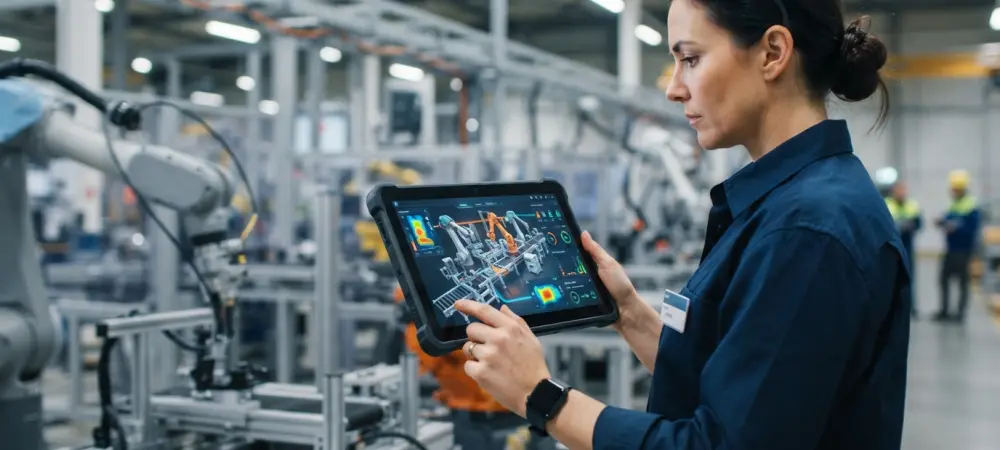
The collaboration between Siemens and NVIDIA has demonstrated that AI-agent-based production planning can improve adaptive manufacturing efficiency by as much as twenty percent. This significant development highlights the transformative potential of the “Joint Declaration of Intent” signed by the German federal government and NVIDIA during the Invest in Germany Summit in Berlin. As Europe’s largest economy seeks to solidify its role in the digital era, this partnership focuses on integrating advanced computational intelligence into the nation’s legendary manufacturing and engineering sectors. The core objective is to redefine the “Industry 4.0” framework by emphasizing physical artificial intelligence—technology that interacts with and optimizes the physical world rather than simply processing digital data. By merging traditional mechanical excellence with cutting-edge AI models, the initiative aims to create a feedback loop between virtual simulations and the factory floor, ensuring long-term competitiveness.
Strengthening the Industrial Backbone Through Political Strategy
Strategic Vision: Transforming Germany into an AI Hub
Chancellor Friedrich Merz and NVIDIA CEO Jensen Huang have articulated a comprehensive vision intended to transform Germany into a preeminent global hub for industrial AI integration. This high-level political commitment establishes a framework for bridging the gap between Silicon Valley’s software innovation and Germany’s precision engineering. The agreement includes a structured oversight mechanism, with annual progress reviews intended to keep the partnership as a top-tier political priority. This strategy ensures that Germany is not merely an adopter of foreign technology but a foundational architect of its industrial application. By aligning federal policy with NVIDIA’s high-performance computing roadmap, the nation seeks to bypass traditional digital adoption hurdles and modernize its industrial infrastructure. This proactive stance signals to the global market that Germany is ready to lead the next industrial revolution, focusing on sovereignty and technical excellence across all sectors.
A critical component of this strategy involves the “Mittelstand,” Germany’s powerful sector of small and medium-sized enterprises, which holds vast repositories of specialized industrial data. Chancellor Merz has characterized this proprietary information as a “secret weapon” that could propel the nation ahead of global competitors if utilized correctly. However, unlocking this potential requires addressing long-standing hesitations regarding data privacy and security that have historically slowed digital transformation. The Chancellor issued a direct call to action for these business leaders to open their doors to AI-driven methodologies, treating operating data as a strategic asset. The government has planned specific support frameworks to assist these smaller entities in navigating the complexities of AI adoption. By empowering the Mittelstand to develop specialized AI models, the partnership ensures that the benefits of computational intelligence are distributed throughout the entire economy.
Industrial Intelligence: The Shift Toward Autonomous Production
Unlike the generative AI models that focus on text and imagery, industrial physical AI utilizes digital twins and world models to simulate and manage complex physical environments. This distinction is vital for a manufacturing powerhouse, as it allows for virtual production ramp-ups and real-time optimization of the factory floor. A primary example is the collaboration at the Siemens Erlangen factory, which serves as a global blueprint for autonomous production. By utilizing NVIDIA’s Omniverse platform, Siemens reported a reduction in engineering efforts by up to eighty-five percent during virtual setups. This capability allows manufacturers to test stress points and predict maintenance needs with unprecedented accuracy before physical implementation. This technology does not seek to replace the foundational knowledge of German engineering but rather to augment it, providing a powerful new instrument for solving physical problems. It marks the transition to a more agile and responsive industrial base.
To support this ecosystem, NVIDIA committed nearly $10 billion to the European technology sector, including specific investments in German startups like Agile Robots and Reflex Aerospace. These financial resources also fueled high-performance computing research, exemplified by the 104-qubit quantum simulation performed on the JUPITER supercomputer at the Jülich Supercomputing Centre. Following the formalization of these goals, stakeholders took several actionable steps to ensure the partnership’s success. Industry leaders established standardized data protocols that allowed for the safe exchange of proprietary information across AI clusters. Furthermore, the government launched specialized vocational training programs to upskill the workforce in digital twin management. Companies also formed dedicated task forces to integrate autonomous agents into their supply chains, thereby realizing immediate efficiency gains. These efforts moved the declaration from a theoretical framework to a functional industrial reality.