
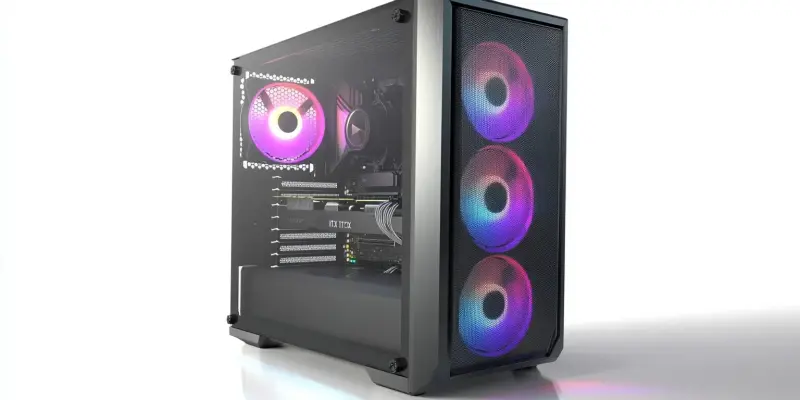
Geometric Future’s Model 0 Flamingo: Compact, Sleek Mini-ITX Case Launch

The burgeoning demand for compact and efficient PC builds led to the creation of the Geometric Future Model 0 Flamingo, a mini-ITX case designed to fit seamlessly into modern living spaces. Set to launch on January 30, this innovative small form factor PC case was first spotted at Computex 2024, capturing attention with its unique patented folding design and sleek, tool-free build process. The case stands out by incorporating magnets for easy assembly and a remarkably small footprint of just 3 liters. Despite its diminutive size, the Model 0 Flamingo houses an 80 Plus Bronze-certified 200W power supply, ensuring sufficient power for everyday tasks.

The absence of expansion slots in the Model 0 Flamingo means it is designed for builds that do not require a discrete GPU. Instead, it caters to users with modest graphics needs, relying on CPUs with integrated GPUs like the AMD Ryzen 7 8700G. Effective thermal management is a critical aspect of this case, achieved through a substantial mesh top circle and numerous ventilation holes, ensuring that components remain cool during operation. Its aesthetic appeal is enhanced by a matte black finish complemented with stylish orange accents, delivering a modern look that fits well in contemporary settings.

The materials used in the Model 0 Flamingo’s construction are notable for their durability. The case panels boast an Alcantara-like finish that is resistant to static, fire, and mildew, offering a tactile experience that suggests a premium product. Additionally, the design includes a tactile button for powering the PC, further contributing to the case’s user-friendly interface. The tiny magnetic feet are another highlight, allowing for versatile positioning in various environments, whether on a desk or tucked away in a living room setup.

Positioned as an ideal multimedia PC case, the Model 0 Flamingo is marketed with emphasis on its aesthetic appeal and space-saving design. With an anticipated price range between $90 and $110, the case promises to deliver both functionality and style without breaking the bank. As the release date approaches, potential buyers can look forward to a compact, efficient, and chic solution for their computing needs. This launch underlined the blend of form and function, setting a new standard for small form factor cases that don’t compromise on essential features.

Explore more

How Firm Size Shapes Embedded Finance Strategy

The rapid transformation of mundane business platforms into sophisticated financial ecosystems has effectively redrawn the competitive boundaries for companies operating in the modern economy. In this environment, the integration of banking, payments, and lending services directly into a non-financial company’s digital interface is no longer a luxury for the avant-garde but a baseline requirement for economic viability. Whether a company

What Is Embedded Finance vs. BaaS in the 2026 Landscape?

The modern consumer no longer wakes up with the intention of visiting a bank, because the very concept of a financial institution has migrated from a physical storefront into the digital oxygen of everyday life. This transformation marks the definitive end of banking as a standalone chore, replacing it with a fluid experience where capital management is an invisible byproduct

How Can Payroll Analytics Improve Government Efficiency?

While the hum of a government office often suggests a routine of paperwork and protocol, the digital pulses within its payroll systems represent the heartbeat of a nation’s economic stability. In many public administrations, payroll data is viewed as little more than a digital receipt—a record of transactions that concludes once a salary reaches a bank account. Yet, this information

Global RPA Market to Hit $50 Billion by 2033 as AI Adoption Surges

The quiet hum of high-speed data processing has replaced the frantic clicking of keyboards in modern back offices, marking a permanent shift in how global businesses manage their most critical internal operations. This transition is not merely about speed; it is about the fundamental transformation of human-led workflows into self-sustaining digital systems. As organizations move deeper into the current decade,

New AGILE Framework to Guide AI in Canada’s Financial Sector

The quiet hum of servers across Canada’s financial heartland now dictates more than just basic transactions; it increasingly determines who qualifies for a mortgage or how a retirement fund reacts to global volatility. As algorithms transition from the shadows of back-office automation to the forefront of consumer-facing decisions, the stakes for oversight have never been higher. The findings from the