

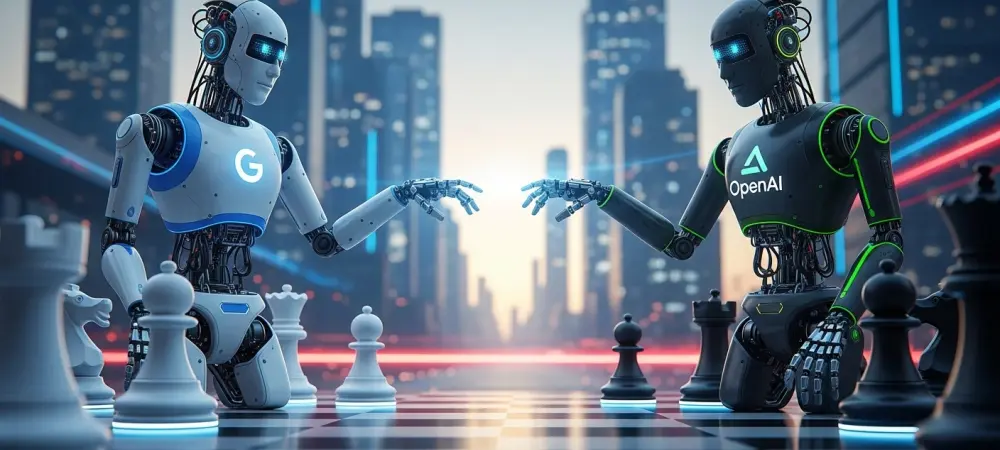
In a world where artificial intelligence has transitioned from a futuristic concept to an operational necessity, the choice of AI tools can define a team’s success. To navigate this landscape, we turn to Dominic Jainy, an IT professional whose expertise cuts across AI, machine learning, and blockchain. He joins us to dissect the two titans of generative AI, Google Gemini and ChatGPT, not to declare a winner, but to illuminate which tool best aligns with specific professional workflows and strategic goals.
For a team deeply embedded in the Google ecosystem, how does Gemini’s integration with tools like Docs and Sheets practically enhance daily productivity, and what are the main trade-offs compared to using a more standalone AI platform? Please share a specific example.
The integration is absolutely seamless, and that’s Gemini’s killer feature. Imagine you’re a project manager living in Google Workspace. You can be analyzing a complex dataset in Sheets, ask Gemini to summarize the key trends, and then immediately pivot to a Google Doc to draft a project update using that summary, all without ever leaving your workflow. The context is maintained, the friction is gone. The trade-off, however, is a potential lack of flexibility. You are essentially committing to the Google way of doing things. If your team relies on a mix of platforms, a more standalone tool like ChatGPT might offer better versatility, as its power isn’t tethered to a single ecosystem.
Creative professionals often need a tool that excels at advanced reasoning and generating long-form content. In what specific scenarios, such as marketing or technical writing, does ChatGPT outperform competitors, and could you walk us through a typical workflow for a writer using it?
ChatGPT truly shines when you need to go beyond simple summaries and generate something with depth, nuance, and a specific voice. For a marketing professional, it’s an unparalleled creative partner. A typical workflow starts with brainstorming; you can feed it a core concept and ask for ten different blog titles, each targeting a different audience. Once you pick one, you can have it generate a detailed outline. Then, you can ask it to draft the introduction in a witty, engaging tone, and then the body with a more informative, data-driven approach. It’s this ability to adapt its tone and structure, to handle long-form, logic-driven tasks, that makes it the go-to for writers who need to produce high-quality, structured content at scale.
Gemini is noted for its multimodal intelligence across text, audio, and video. How does this “all-in-one” approach benefit a business’s collaborative projects, and when would specialized functions like ChatGPT’s code interpretation prove to be a more effective choice for a team?
Gemini’s multimodal approach is revolutionary for collaboration because modern projects are rarely just text-based. Think of a design team reviewing a video advertisement. They can use Gemini to analyze the video, transcribe the audio, and generate a text summary of viewer feedback, all within a single platform. This creates a unified workspace where different types of media can be processed and discussed together, which is incredibly efficient. However, if you have a team of developers trying to debug a complex piece of software, ChatGPT’s specialized code interpretation is far more effective. It’s designed for that specific, highly technical task. So, the choice comes down to whether you need a versatile, media-rich collaborator or a focused, expert specialist.
Access to real-time information is a key differentiator for some AI tools. Can you illustrate how pulling live data from Google Search gives Gemini an edge for tasks like market research, and what are the potential pitfalls or limitations of relying on this capability?
This is a massive advantage for any role that relies on timeliness. For a market researcher, it’s a game-changer. You could ask Gemini to summarize the latest consumer trends in the electric vehicle market over the last 24 hours, citing recent news articles and stock performance. It can pull that live data directly from Google Search, giving you an up-to-the-minute snapshot that would have previously taken hours of manual research. The biggest pitfall, however, is the inherent bias and noise of the internet. You’re still at the mercy of the search algorithm’s results, so critical thinking is essential. You must be prepared to fact-check and understand that “real-time” doesn’t always mean “100% accurate.”
Many users find value in a hybrid approach. Could you outline a workflow where a professional might use Gemini for its collaborative and productivity features while leveraging ChatGPT for its creative and deep-research capabilities? Please describe how these tools would complement each other.
Absolutely, a hybrid approach is often the most powerful. Consider a team developing a new product launch campaign. They could use Gemini within their shared Google Drive to organize meeting notes, summarize long documents, and draft internal communications to keep everyone aligned—all the productivity-focused tasks. Simultaneously, the marketing lead could be using ChatGPT to generate creative ad copy, write long-form blog posts announcing the product, and develop a structured FAQ for the website. In this workflow, Gemini acts as the operational hub, streamlining the team’s internal processes, while ChatGPT serves as the creative engine, generating the polished, external-facing content. They complement each other perfectly.
What is your forecast for the AI tool landscape by 2026?
By 2026, I believe the debate won’t be about which single AI tool is “best,” but about how well we can build integrated, multi-tool workflows. We’ll see platforms become even more specialized, with some excelling at data analysis and others at creative visualization. The real innovation will be in how these tools talk to each other, allowing users to seamlessly pass tasks from a productivity-focused AI like Gemini to a creative powerhouse like ChatGPT. The winning enterprise teams won’t be those who pick one platform, but those who master the art of orchestrating several, creating a bespoke AI toolkit that perfectly matches their unique operational needs and delivers a measurable impact.