

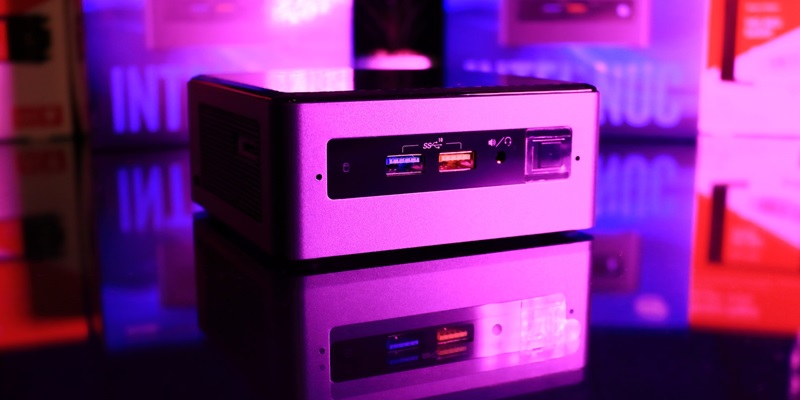
Geekom, a renowned hardware manufacturer, has recently unveiled its latest offering in the Mini PC category – the IT12 Mini PC. This compact powerhouse comes equipped with the cutting-edge Intel 12th Gen Alder Lake option, offering business-centric performance and versatility. In this comprehensive review, we will delve into the features, specifications, and performance of the Geekom IT12 Mini PC to determine whether it justifies its price tag of $549.00 US.
Testing the Geekom Mini IT12: Assessing Value for Money
The first aspect we will examine is the pricing and value proposition of the Geekom IT12. Priced at a modest sub-$500 US range, this Mini PC aims to provide an optimal balance between performance and affordability. We will evaluate whether it lives up to expectations and whether it is worth the investment for business and professional users seeking a compact computing solution.
CPU Features and Specifications: The Power of Intel’s 12th Gen Alder Lake
The Geekom IT12 features the latest Intel 12th Gen ‘Alder Lake’ CPU. This processor delightfully combines a P-Core and E-Core hybrid architecture, offering a plethora of possibilities for business-centric applications. Our focus will be on the Intel Core i7-12650H ‘Alder Lake’ CPU, boasting 10 cores – 6 P-Cores and 4 E-Cores – along with 16 threads, a substantial 24 MB of cache, and an impressive boost clock speed of up to 4.70 GHz. We’ll assess its performance capabilities across varied workloads.
GPU Details: UHD iGPU for Graphics-intensive Tasks
The integrated GPU, UHD iGPU, embedded within the Intel Core i7-12650H CPU, brings seamless graphics execution to the Geekom IT12. With 64 Execution Units operating at 1.40 GHz, the UHD iGPU delivers competent graphical performance for everyday tasks, multimedia consumption, and lightweight graphics-intensive applications.
Memory and Storage: Seamless Multitasking and Rapid Data Access
To ensure efficient multitasking, the Geekom IT12 Mini PC is equipped with 32GB of DDR4 Dual-Channel memory running at a commendable speed of 3200 MT/s. This substantial memory allocation enables smooth operability and enhances productivity, even when handling demanding workloads. Additionally, the IT12 Mini boasts a single M.2 2280 SSD slot running at blistering Gen 4.0 speeds, enabling lightning-fast data access and quick file transfers.
I/O Ports and Connectivity: Versatile Options for Enhanced Productivity
The Geekom IT12 Mini PC offers an impressive array of I/O ports to cater to various connectivity needs. It includes two USB4 (40 Gbps / DP) ports, three USB 3.2 Gen 2 Type-A ports, a single USB 2.0 port, a 2.5 GbE LAN port, an SD card reader, a DC Jack, a power button, two HDMI 2.0b outputs, and a 3.5mm headphone jack. This well-rounded selection ensures seamless connectivity and compatibility with a broad range of peripheral devices, monitors, and audio equipment.
Packaging and Design: Sleek and Minimalist Appeal
The Geekom IT12 Mini PC comes in an elegant black cardboard package. The simplistic design exudes a sophisticated vibe, affirming Geekom’s commitment to delivering a high-quality product. The compact dimensions of 117x112x49mm (W/L/H) and a weight of 0.5 kg make it easily portable, allowing users to set up their workstation anywhere, whether it be at home or in a professional environment.
The Geekom IT12 Mini PC, powered by Intel’s 12th Gen Alder Lake architecture, proves to be a solid choice for business users seeking a compact yet powerful computing solution. With its Intel Core i7-12650H CPU, UHD iGPU, ample memory, and high-speed storage, this Mini PC delivers remarkable performance across various workloads. The versatile I/O ports, sleek design, and attractive price point further enhance its appeal. Overall, the Geekom IT12 Mini PC is a worthy investment for those who prioritize productivity without compromising on space or budget.