

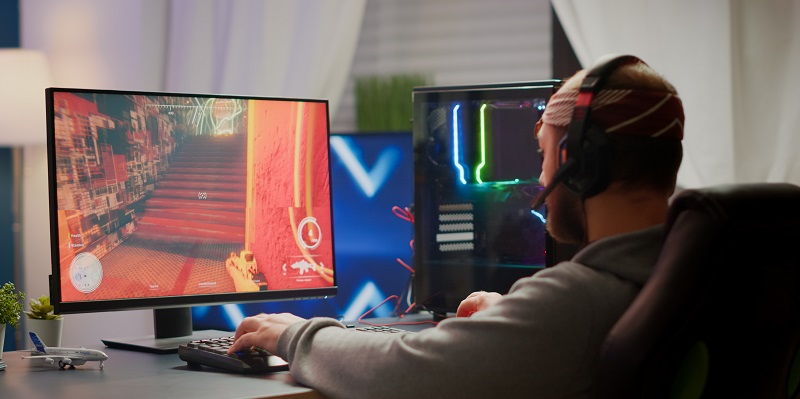
“Forspoken” has recently emerged as the chosen title to showcase AMD’s highly anticipated FidelityFX Super Resolution 3 (FSR 3) technology. With its innovative approach, FSR 3 aims to provide gamers with enhanced performance and visual fidelity, serving as a potential competitor to NVIDIA’s Deep Learning Super Sampling 3 (DLSS 3) technology. In this article, we will delve into the details of FSR 3 and explore its impact on “Forspoken.”
Comparison of FSR 3 and NVIDIA’s DLSS 3
While both FSR 3 and DLSS 3 are designed to improve gaming performance, they differ in their approaches. FSR 3 takes a more open-ended approach, focusing on providing users with a range of options to optimize their gaming experience. On the other hand, DLSS 3 relies on deep learning algorithms to upscale lower-resolution images, resulting in improved graphics.
Availability of FSR 3 in Forspoken
Exciting news for Forspoken enthusiasts! The latest patch for the game now includes support for AMD’s FSR 3 technology. This means that players can benefit from the performance enhancements and visual improvements offered by FSR 3 in their Forspoken gaming experience.
There are 3 modes in Forspoken
1. Exploration Mode: This mode allows players to freely explore the open world, interact with non-playable characters, and discover hidden secrets.
2. Combat Mode: In combat mode, players engage in intense battles and fights using a variety of weapons and abilities.
3. Puzzle Mode: This mode challenges players with various puzzles and riddles that they must solve to progress in the game.
FSR 3 in Forspoken introduces several modes to cater to different user preferences. These modes include Frame Generation, FSR 3 AA, Quality Mode, Performance Mode, and Ultra-Performance Mode. Let’s take a closer look at each mode and its specific features.
FSR 3 AA Mode: An Alternative to DLAA
One of the noteworthy modes in FSR 3 is FSR 3 AA, which can be compared to NVIDIA’s DLAA. FSR 3 AA enhances image quality without the need for upscaling, resulting in sharper and more visually appealing graphics. This mode provides a significant improvement in visual fidelity for Forspoken players.
Visual Fidelities and Performance Implications
The other modes available in FSR 3 – Quality, Balanced, Performance, and Ultra-Performance – offer users the flexibility to balance visual fidelity and performance according to their preference. The Quality mode prioritizes superior graphics, whereas the Balanced mode strikes a balance between visual fidelity and performance. Performance and Ultra-Performance modes focus on maximizing frame rates for smoother gameplay.
Frame Generation: An Unparalleled Performance Boost
One of the standout features of FSR 3 in Forspoken is Frame Generation. This mode introduces interpolated frames, resulting in a remarkable performance increase. In fact, it offers over 2x the performance boost compared to traditional rendering methods. With Frame Generation enabled, Forspoken players can enjoy a smoother gaming experience without compromising on visual quality.
Compatibility with upscaling technologies
It’s important to note that Frame Generation is exclusive to FSR 3 and cannot be used in conjunction with other upscaling technologies such as DLSS 2. AMD has specifically designed FSR 3 with its own unique set of features and optimizations for an optimal gaming experience.
Performance testing with RTX 4090
To assess the performance of FSR 3 with Forspoken, a comprehensive evaluation was conducted using the RTX 4090 at 4K resolution with ray tracing maxed out. The results showcased a significant improvement in overall performance, with FSR 3 successfully delivering on its promise of optimized gaming experiences.
In conclusion, Forspoken’s integration of AMD’s FSR 3 technology has proven to be a game-changer for both performance and visual fidelity. FSR 3, with its various modes and Frame Generation feature, offers greater flexibility and scalability for gamers. The Radeon team’s work in developing FSR 3 has showcased their commitment to pushing the boundaries of gaming technology. As we look to the future, we eagerly anticipate further advancements from the Radeon team and the continued evolution of FSR 3 in Forspoken and beyond.