

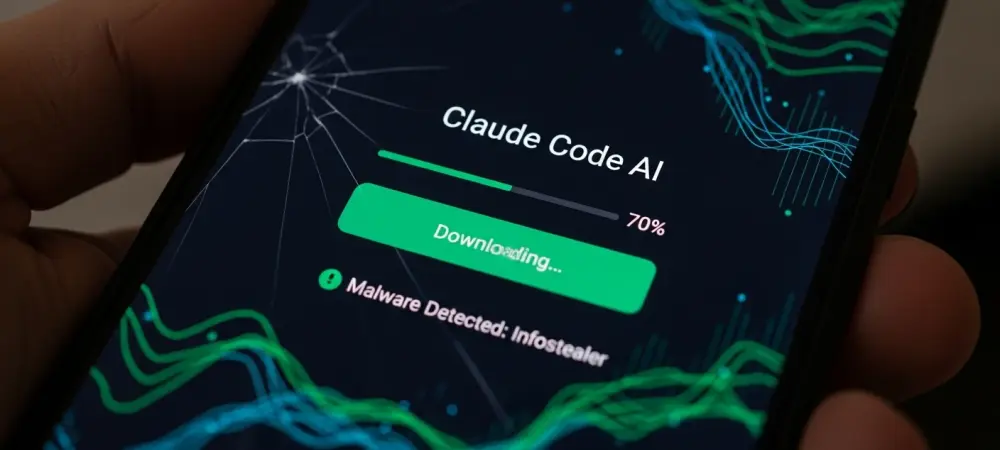
The rapid integration of artificial intelligence into the software development lifecycle has created a lucrative new frontier for cybercriminals who capitalize on the trust users place in industry-leading brands. As developers race to adopt tools like Anthropic’s “Claude Code” to streamline their workflows, threat actors are deploying sophisticated social engineering tactics to intercept this transition. This research explores a specific campaign that uses high-fidelity clones of official software portals to distribute malicious payloads, fundamentally shifting the threat landscape toward technical users with administrative access. The central challenge identified in this study involves the difficulty of detecting threats that mimic the professional environment of a developer so precisely. By exploiting brand recognition, attackers bypass the initial skepticism that typically protects corporate networks. This study is critical because it highlights how the focus of phishing has moved from generic mass-mailing toward highly targeted, high-value objectives. Understanding these mechanisms is vital for securing private code repositories and sensitive cloud infrastructure that these professionals manage daily.
The Exploitation of AI Brand Trust and Developer Productivity
Modern cyberattacks often succeed not through brute force, but by aligning with the natural behavior and productivity goals of their targets. In this specific campaign, the attackers built web environments that mirror the aesthetic and functional design of legitimate AI platforms. By providing a seamless and visually convincing experience, the adversaries convince developers that they are downloading a standard utility designed to enhance their coding efficiency. This psychological manipulation is the cornerstone of the campaign, as it effectively lowers the barrier of entry for the subsequent technical infection.
Furthermore, the targeting of IT professionals and developers represents a strategic shift in risk. These users often possess the “keys to the kingdom,” including access to internal source code, API keys, and server configurations. The research emphasizes that the compromise of a single developer workstation is no longer just an isolated incident; it serves as a primary entry point for broader supply chain attacks or corporate espionage. The exploitation of productivity tools thus becomes a gateway to an entire organization’s intellectual property and digital assets.
Background and Context of the AI-Themed Threat Landscape
As artificial intelligence moves from a novel concept to a foundational element of the tech stack, the brand equity of companies like Anthropic has grown exponentially. Cybercriminals have taken notice, moving away from traditional banking trojans toward AI-themed decoys. This trend is particularly dangerous because it targets a demographic that is generally more tech-savvy but also more likely to experiment with cutting-edge, unverified software. The speed of AI development creates a “fog of war” where new tools are released frequently, making it harder for users to distinguish between an official update and a malicious imitation.
This research is essential for contextualizing how social engineering has evolved to meet the current technological moment. The campaign does not rely on obscure vulnerabilities; instead, it uses the very tools and platforms that developers trust most. By analyzing these attack vectors, security teams can better understand the convergence of administrative privilege and software adoption. The study serves as a warning that the next generation of malware distribution will likely continue to hide behind the names of the most influential technology providers in the AI space.
Research Methodology, Findings, and Implications
Methodology: Monitoring Deception and Telemetry
The investigation utilized a multi-layered approach involving behavioral analysis and endpoint telemetry to map the attacker’s movement. Analysts focused on tracking the registration of deceptive domains that squat on AI-related keywords and monitored the network traffic originating from these sites. By using the MITRE ATT&CK framework, the research team categorized specific behaviors, such as the abuse of mshta.exe (T1218.005), which is a signed Microsoft binary. This methodology allowed for a comprehensive view of how the infection moves from a web browser to deep system memory without triggering traditional alarms.
Findings: The Stealth of Fileless Execution
The research revealed that the infection chain relies heavily on “Living off the Land” techniques to minimize its footprint on the physical disk. Once a user visits the fake portal and downloads the supposed AI tool, they actually trigger a malicious HTML Application (HTA). This HTA file is executed by the legitimate Windows process mshta.exe, which then fetches a remote payload from a command-and-control server. Because the execution happens within a trusted system process, it often bypasses signature-based antivirus solutions, allowing the malware to harvest browser credentials and session tokens while remaining virtually invisible to basic monitoring.
Implications: Beyond Traditional Signature Defense
The findings indicate that organizations can no longer rely solely on file-based detection to protect their developers. Since the malware operates in memory and uses native Windows components, the practical implication is a move toward behavioral monitoring. If a developer’s environment is compromised through these fake tools, the resulting data theft can lead to an immediate escalation within the corporate network. This research underscores the need for a zero-trust approach to software installation, even when the source appears to be a well-known AI brand or a productivity-enhancing utility.
Reflection and Future Directions
Reflection: The Challenge of Ephemeral Infrastructure
The study successfully mapped the execution chain, yet it also highlighted the extreme agility of modern threat actors. One of the most difficult aspects of the investigation was the short lifespan of the deceptive domains, which were often abandoned or moved as soon as they were flagged by threat intelligence communities. This cat-and-mouse game suggests that while technical mapping is effective, it is often reactive. The research effectively demonstrated the convergence of technical stealth and psychological pressure, though further study into the backend infrastructure of these groups would provide more clarity on their long-term objectives.
Future Directions: Automation and Behavioral Response
Future research should prioritize the development of automated systems that can identify and take down domain-squatting sites before they can gain traction. There is also a significant need to refine how Endpoint Detection and Response (EDR) platforms interpret the behavior of native binaries. Distinguishing between a legitimate administrative use of mshta.exe and a malicious remote execution remains a complex task that requires more nuanced heuristic modeling. Additionally, identifying whether these campaigns are the work of commercially driven groups or state-sponsored actors will be crucial for determining the level of threat they pose to national infrastructure.
Defending Against the Evolution of AI-Assisted Cybercrime
The investigation concluded that the popularity of AI tools will continue to be a primary lure for sophisticated malware distribution for the foreseeable future. Analysts observed that the success of this campaign rested on the combination of high-fidelity social engineering and the abuse of trusted system processes. It was determined that standard security protocols were often insufficient because they did not account for the legitimacy of the binaries being used to facilitate the theft. Consequently, the research suggested that the most effective defense is a combination of strict application control and proactive monitoring of network activity originating from native Windows processes.
To mitigate these risks moving forward, organizations were encouraged to adopt a more rigorous verification process for all third-party software. The study emphasized that user training must evolve to include the specific nuances of AI-themed phishing, ensuring that developers are aware of the risks associated with unofficial download portals. Ultimately, the research established that maintaining a resilient security posture in the age of AI requires not only technical updates but also a culture of skepticism toward any software that sidesteps official distribution channels. Security teams were advised to treat any unusual remote connections from system binaries as high-signal indicators of a possible breach.