

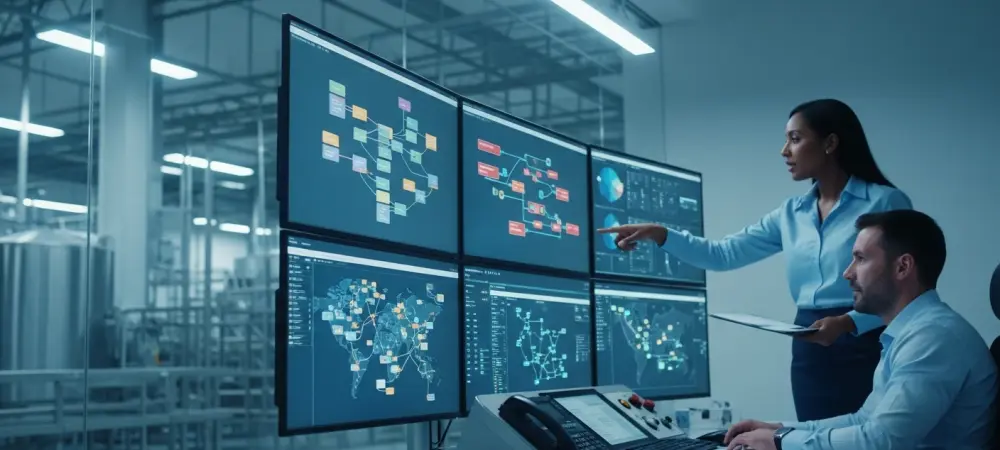
The relentless pressure of rising operational costs combined with a dwindling supply of skilled laborers has forced the food and beverage manufacturing sector into a period of rapid and necessary transformation. For decades, the industry relied heavily on human-centric, manual processes to manage production cycles and quality control, but the modern environment has rendered these legacy methods completely obsolete. Today, manufacturers face the dual challenge of navigating the FDA’s Food Safety Modernization Act Rule 204 while simultaneously managing a global shortage of labor that threatens to stall growth. As market conditions fluctuate, the ability to adapt has become the primary marker of business viability, forcing leaders to seek out infrastructure that facilitates a transition from reactive survival to proactive, data-driven scaling. This shift is not merely about replacing workers with machines; it is about providing the remaining workforce with the sophisticated digital tools necessary to maintain safety, efficiency, and transparency in a high-stakes market.
Modernizing Infrastructure for Workforce Efficiency
Overcoming Manual Limitations: The Risk of Fragmented Data
A significant portion of food and beverage manufacturers continue to operate using a patchwork of disconnected systems, ranging from disparate spreadsheets to legacy software that lacks integration. While these manual workflows may have sufficed for small-scale operations in previous years, they create systemic fragility as a company expands, resulting in data silos where inventory and production records remain isolated from financial reports. This fragmentation leads to delayed decision-making because leadership often receives information that is already outdated by the time it reaches their desks. Without a unified view of the production floor, businesses cannot respond effectively to sudden supply chain disruptions or shifts in ingredient costs. Consequently, the reliance on manual data entry becomes a liability, as the time spent reconciling various spreadsheets is time taken away from strategic improvements or quality assurance tasks.
The move toward integrated systems is also driven by the non-negotiable requirements of modern traceability laws, specifically those outlined in recent food safety regulations. Under the stringent demands of FSMA Rule 204, manufacturers must be able to provide detailed supply chain data quickly, a task that is nearly impossible when relying on paper-based records or disconnected digital files. Manual systems make the traceability process agonizingly slow, exposing a company to prolonged product holds, expensive recalls, and significant legal risks that can tarnish a brand’s reputation indefinitely. By adopting a unified system of record, manufacturers ensure that every ingredient and finished product is accounted for in real-time, allowing them to meet compliance standards without the need for additional clerical staff. This transition replaces the anxiety of a potential audit with the confidence of having a digital paper trail that can be accessed and shared in just a few minutes.
Strategic Integration: Implementing Unified Digital Ecosystems
To combat the complexities of the current market, the industry is trending toward the adoption of Enterprise Resource Planning solutions that act as a single source of truth for the entire organization. By creating a centralized repository for production, inventory, and finance, manufacturers eliminate the need for redundant data entry across different departments, which directly addresses the labor shortage. This synthesis allows for automated scheduling and enhanced tracking, ensuring that raw materials are used efficiently and that finished goods are accounted for accurately. When a single system manages the flow of information, the “human gap” is bridged by digital assistance that performs high-volume processes such as production reconciliation and labeling. This approach allows a leaner team to manage higher output, effectively force-multiplying the existing staff’s capabilities through automation.
Furthermore, the implementation of these unified ecosystems provides a level of operational visibility that was previously unattainable for many mid-sized manufacturers. By connecting labeling data directly to production events, companies can ensure that their labeling and warehouse processes are synchronized perfectly with their inventory levels. This integration prevents the common issue of over-producing goods that cannot be labeled or shipped due to administrative bottlenecks. As the system handles the “drudge work” of data reconciliation, employees are freed from repetitive manual tasks and can be redeployed to higher-value roles that require critical thinking and problem-solving. This strategic shift not only optimizes the current workforce but also creates a more resilient operational framework that can withstand the inherent unpredictability of the global supply chain while maintaining high quality.
Driving Financial Growth and Scalability
Resource Optimization: The Financial Imperative of Real-Time Visibility
The transition to a digitized environment is a financial necessity, as inventory represents a massive portion of tied-up capital for food manufacturers in the current economic landscape. Without real-time visibility into their stock levels, companies often over-order raw materials to buffer against uncertainty, leading to waste and increased carrying costs. Conversely, a lack of data can lead to stockouts that halt production entirely, resulting in missed deadlines and lost revenue. A data-driven approach allows for the precise alignment of supply with actual demand signals, ensuring that capital is not unnecessarily tied up in excess ingredients. This level of agility allows leadership to make capital allocation decisions based on the current landscape rather than relying on a month-old perspective that no longer reflects the reality of the market.
Documented success stories within the industry illustrate the tangible benefits of this digital shift, showing how integrating production and inventory workflows can save hundreds of thousands of dollars. For example, some manufacturers have managed to avoid roughly four hundred thousand dollars in annual inventory carrying costs by simply gaining better visibility into their supply chains. Furthermore, the efficiency gains in financial reporting are often staggering, with some organizations slashing the time required for month-end closing from thirty days to just two. This dramatic reduction in administrative lead time allows businesses to react faster to market trends and reinvest their savings into research, development, or facility upgrades. By treating technology as a core financial strategy rather than just an IT expense, food manufacturers are building a more profitable and sustainable business model for the years between 2026 and 2028.
Scaling for Success: Building Resilient Operational Foundations
As food manufacturers grow by adding new facilities, distribution channels, or product lines, technology acts as the primary stabilizer in the growth equation. The goal for a modern enterprise is to ensure that this increasing complexity does not outpace the company’s ability to manage its operations effectively. High-level automation ensures that as production scales, the administrative burden does not grow at the same rate, allowing companies to expand without a proportional increase in headcount. By automating warehouse processes and inventory tracking, manufacturers can eliminate thousands of hours of manual labor that were previously spent on relabeling and manual reconciliation. This efficiency is what separates the companies that thrive during periods of expansion from those that struggle to keep up with their own success and eventually face operational collapse.
The competitive differentiator in the modern food sector is becoming the quality of a company’s digital infrastructure rather than just its product recipes or marketing budgets. Market turbulence, including supply chain volatility and labor scarcity, is unlikely to disappear in the near future, making digital resilience a prerequisite for long-term viability. Companies that invested in robust ERP systems early have found themselves better equipped to handle the demands of a globalized market. These systems provide the scalability needed to integrate new acquisitions or launch specialized product lines with minimal friction. Ultimately, the integration of these technologies ensures that the manufacturing process remains lean and responsive, allowing the business to maintain its competitive edge even when faced with significant external pressures or sudden changes in consumer preferences.
Strategic Evolution of Manufacturing Operations
The fundamental shift from manual processes to automated ERP solutions represented a critical evolution in how food manufacturers navigated tight margins and strict regulations. By unifying disparate data points into a cohesive system, businesses gained the visibility needed to reduce waste and optimize their workforces during a period of intense labor scarcity. The findings of this analysis suggested that the most successful manufacturers were those that viewed technology not as an optional upgrade, but as a core strategy for ensuring compliance and operational resilience. Through the implementation of real-time data tracking and streamlined financial reporting, these companies built a scalable foundation that remained strong against the inherent unpredictability of the global market. The era of managing complex food production through spreadsheets and manual entry ended, replaced by an age where digital integration became the standard for industrial excellence. Moving forward, manufacturers should prioritize the audit of their current data silos to identify exactly where manual intervention is causing the most significant bottlenecks. Addressing these points of friction through targeted automation is the first step toward building a truly agile enterprise that can thrive under the new regulatory and economic realities. Investing in employee training to manage these digital systems will also be essential, as the role of the manufacturing worker continues to shift from manual laborer to system overseer. Companies must also ensure that their digital infrastructure is flexible enough to integrate with future emerging technologies, such as advanced predictive analytics and automated quality sensors. By focusing on these actionable steps, food and beverage manufacturers can secure their position in an increasingly competitive landscape, ensuring that their operations are both efficient and fully compliant with all global standards.