

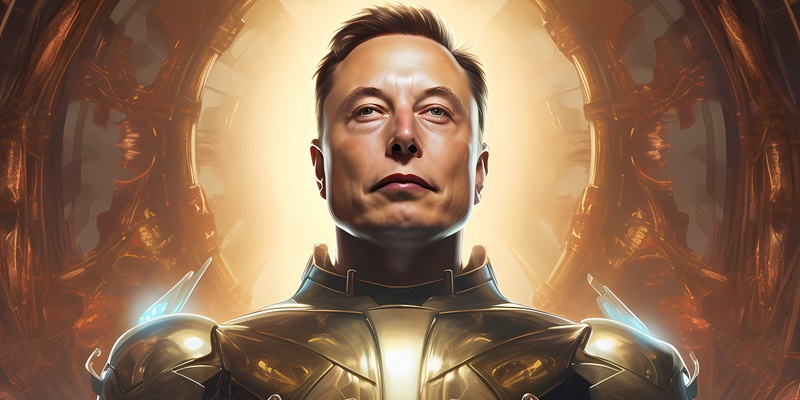
Elon Musk, the renowned entrepreneur and visionary behind Tesla and SpaceX, has emerged with a new and ambitious venture in the field of artificial intelligence (AI). Recently, Musk unveiled Grok AI, a generative AI chatbot that aims to rival established language models like OpenAI’s ChatGPT, Google’s PaLM 2, and Anthropic’s Claude 2. With the launch of Grok AI, Musk’s xAI venture takes a significant step towards creating a safer and more comprehensive AI model.
The Development of Grok AI
xAI, the generative AI venture founded by Elon Musk in July, holds a central role in the development of Grok AI. Musk’s overarching objective is to enable AI models to understand the true nature of the universe, thereby enhancing their safety and reliability. Grok AI, christened after the iconic “Hitchhiker’s Guide to the Galaxy,” is designed not only to answer a wide array of questions but also to suggest inquiries users may not have considered. Grok AI boasts distinct features that set it apart from its competitors. Beyond providing insightful responses, Grok is fashioned with a touch of wit and a rebellious streak, ensuring engaging interactions for users seeking knowledge and a touch of entertainment.
Early Stage and Capabilities
While Grok AI has been unveiled, the xAI team emphasizes that it is currently in a “very early beta product” stage, having undergone just two months of training. However, even in its nascent form, Grok AI’s capabilities are impressive. The underlying engine, Grok-1, is versatile and adaptable, catering to various natural language processing tasks. These encompass question-answering, information retrieval, creative writing, and even coding assistance. Its potential applications evoke immense possibilities for a wide range of users and industries.
Performance Comparison
To assess Grok-1’s performance, the xAI team conducted benchmark tests against established language models such as PaLM 2, Claude 2, Inflection-1, LLaMA 2, GPT-3.5, and GPT-4. Remarkably, Grok-1 surpassed the performance of all models except GPT-4. The xAI team attributes GPT-4’s superiority to its training on a significantly larger amount of data and compute resources. Nonetheless, Grok-1’s impressive performance solidifies its position as a formidable competitor in the AI chatbot space.
Availability and Future Plans
Currently, Grok AI is available to a limited number of users in the United States. However, there are plans to expand its reach, making it accessible to all X users who have a subscription. Musk’s commitment to AI safety is evident in his inclusion of the director of the Center for AI Safety on the xAI advisory team. This collaborative approach ensures a balance between AI development, innovation, and the necessary precautions to mitigate potential risks.
Elon Musk’s venture into generative AI with the launch of Grok AI signifies a significant milestone in the field. As Grok AI competes with established language models, Musk’s focus on creating a safer AI landscape remains evident. Despite being in the early beta stage, Grok AI demonstrates impressive capabilities through its engine, Grok-1, which can facilitate a variety of natural language processing tasks. As Grok AI becomes more widely available, it will undoubtedly capture the interest of users and industries looking for intelligent conversational agents while prioritizing safety. With its wit, rebelliousness, and pursuit of knowledge, Grok AI has the potential to revolutionize how we interact with AI chatbots and inspire further advancements in the field of artificial intelligence.