

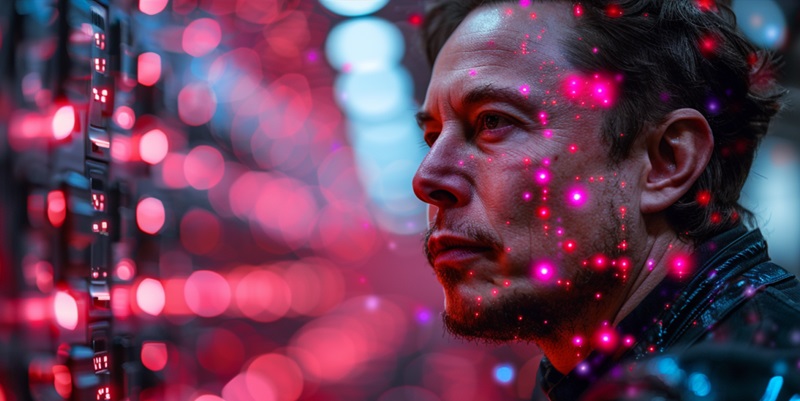
Elon Musk, a figure synonymous with technological breakthroughs and daring predictions, has once again sent ripples through the tech community. This time, his forecast is directed at the realm of artificial intelligence – a field that has been advancing at an exponential rate. Musk’s latest projection posits that we are potentially a mere calendar turn away from the development of a superhuman artificial intelligence. In contrast to his earlier prediction of 2029 as the tipping point, Musk believes that the breakthrough could come as soon as next year. This accelerated timeline is indicative of the rapid progress being made in AI and raises a multitude of questions regarding its implications for society.
The Rapid Evolution of AI
In a recent livestream event that doubled as the launchpad for his new AI venture, named xAI, Musk expanded on his views. He discussed the astonishing pace at which AI development is unfolding, citing the significant advancements made in natural language processing and machine learning algorithms. Undoubtedly, the enigmatic billionaire’s track record in pioneering industries from electric vehicles to commercial spaceflight lends credence to his foresight. His past ventures have not only pushed the envelope but often redefined industries altogether. With xAI, Musk signals his entry into the competitive landscape dominated by entities like OpenAI and its ChatGPT models.
The promise of a superhuman AI has often been the subject of debate, with concerns ranging from ethical issues to its potential impact on the job market. Musk himself has frequently voiced his apprehension about the unregulated expansion of AI capabilities, warning of a future that could mimic dystopian sci-fi scenarios. However, alongside his cautionary notes, he also acknowledges the monumental benefits that AI could endow upon technological progress, enhancing both our personal lives and our collective societal experiences. In his view, it is a dual-edged sword that requires careful handling and foresight.
Challenges and Competition
Tech visionary Elon Musk has stirred the tech world with a bold forecast in artificial intelligence—predicting the advent of superhuman AI could be just around the corner, possibly emerging next year. Earlier, Musk pinpointed 2029 as the critical year for this AI breakthrough, but the swift pace of technological advances has led him to revise that estimate. The sheer speed of AI development underscores this new prediction, suggesting an even more imminent approach to a technological epoch. As we stand on the brink of such a transformative leap, the impact on society and ethical questions associated with superhuman AI become increasingly pressing. Musk’s adjusted timeline reflects the dynamic nature of AI evolution, as well as the imperative to consider how such progress will shape our future.