

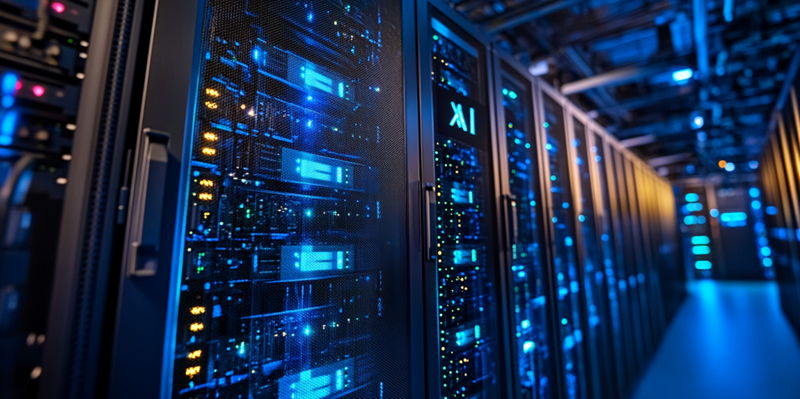
Elon Musk, a prominent figure in the technology world, is once again pushing the boundaries with his ambitious plans for the future of artificial intelligence (AI). This time, Musk’s company xAI is set to undertake a colossal expansion of its supercomputer, aptly named Colossus, with the goal of significantly advancing its Grok language model. The plan involves expanding Colossus from its current 100,000 GPU capacity to an unprecedented 1 million GPUs. These upgrades will be powered specifically by Nvidia #00 "Hopper" AI accelerators. This move, although tremendously costly with estimations exceeding $20 billion, is aimed at revolutionizing xAI’s computational capabilities.
The Strategy and Investment in AI
The Power of Increased Computational Resources
Elon Musk’s core belief that more computational resources and data can lead to significant improvements in AI’s performance drives xAI’s strategy. This philosophy is not unique to xAI, as major players like Google and Microsoft follow similar tenets in their AI ventures. By massively increasing Colossus’ GPU capacity, Musk aims to overcome current limitations and enhance the Grok language model’s functionality. The underlying assumption is that more powerful hardware can potentially lead to more sophisticated and reliable AI outputs, a notion that continues to propel substantial investments across the tech landscape.
However, this approach is not without its challenges. Despite the massive scalability and the anticipated gains in processing power, there is no guaranteed improvement in AI functionalities solely from increased hardware. Key challenges like AI hallucinations, where models produce incorrect or nonsensical outputs, still persist even with advanced computational resources. This raises questions about the effectiveness of sheer hardware expansion in resolving fundamental AI issues. Additionally, the venture’s high operational costs, driven by the need to replace burnt-out GPUs continuously, underscore the financial challenges inherent in maintaining such a gargantuan system.
Facility Expansion and Collaboration with Industry Leaders
To support this massive expansion, xAI is strategically increasing its infrastructure and collaborating with key industry players. The expansion includes the development of new facilities in Tennessee, leveraging the expertise and resources of Nvidia, Dell, and Supermicro. These partners play crucial roles in ensuring the seamless integration of additional GPUs and optimizing the supercomputer’s performance. The choice of Nvidia #00 "Hopper" AI accelerators is aligned with industry standards and expected to provide the necessary boost to carry forward xAI’s ambitious goals.
Moreover, the expansion projects aim to create a robust and scalable backbone for xAI’s AI initiatives, guaranteeing sustainability and performance efficiency. This approach reflects a common trend within the tech sector, where companies are investing heavily in infrastructure to support increasingly complex AI workloads. By aligning with top-notch technology providers, xAI is positioning itself at the forefront of the AI revolution, harnessing the best resources available to push the boundaries of what AI can achieve.
The Challenges and Uncertainties in AI Development
Persistent Issues in AI Functionality
Despite the considerable investments in expanding xAI’s supercomputer capabilities, inherent challenges in AI development remain unresolved. One of the most significant issues is the occurrence of AI hallucinations. These are instances where AI models generate outputs that are factually incorrect or logically inconsistent. Even with advanced computational power, these problems persist, suggesting that hardware alone cannot remedy all AI shortcomings. Researchers and developers continuously grapple with these challenges, striving to refine algorithms and models to minimize such errors.
Furthermore, the unpredictable nature of AI improvement raises questions about the efficacy of simply increasing computational resources. While more GPUs and powerful processors may enhance the speed and capacity of AI systems, they do not inherently guarantee better performance or accuracy. This unpredictability underscores the need for a balanced approach, combining robust hardware with innovative software development and rigorous testing. As xAI moves forward with its plans, it must address these challenges to ensure that the expanded computational power translates into tangible improvements in AI functionality.
High Operational Costs and Sustainability
The substantial financial commitment required for xAI’s expansion is another critical aspect of the venture. With cost estimations surpassing $20 billion, the project represents a significant investment. Part of this cost involves the continuous need to replace burnt-out GPUs. High-performance AI accelerators, such as Nvidia #00 "Hopper," are subject to wear and tear under intensive use, necessitating frequent replacements to maintain system performance. This adds an ongoing operational expense that must be factored into the overall budget.
Moreover, the sustainability of such a large-scale supercomputer poses additional challenges. The energy consumption associated with running 1 million GPUs is immense, demanding efficient cooling systems and substantial power resources. These requirements highlight the environmental and financial implications of scaling up AI infrastructure. xAI’s ability to manage these operational costs effectively will be crucial in maintaining long-term viability and achieving its ambitious goals. Balancing the desire for cutting-edge AI capabilities with practical considerations of cost and sustainability will be a constant challenge for Musk and his team.
The Future of AI and xAI’s Position
Industry Trends and Financial Backing
The pursuit of larger, more powerful AI compute clusters is a prevailing trend in the tech industry. Companies are investing heavily in scaling their AI capabilities, driven by the belief that more computational power can unlock greater AI potential. xAI’s bold expansion plans reflect this broader industry movement. Despite some skepticism regarding the ultimate promise of generative AI, the company maintains a strong financial position. Valued at approximately $45 billion and recently securing an additional $5 billion from investors, xAI has the financial backing necessary to undertake such massive initiatives.
These substantial investments underscore the confidence of stakeholders in Musk’s vision for AI advancements. The strategic collaborations with industry leaders and the continued support from investors position xAI favorably within the competitive AI landscape. As the company progresses with its ambitious plans, it will be essential to demonstrate the practical benefits of its expanded hardware. Proving that such large-scale investments can lead to meaningful advancements in AI will be key to maintaining investor confidence and industry leadership.
Balancing Ambition with Realistic Expectations
Elon Musk, a well-known figure in the tech industry, is once again pushing the limits with his ambitious vision for the future of artificial intelligence (AI). This time, Musk’s company, xAI, is planning a massive upgrade of its supercomputer named Colossus, aiming to greatly enhance its Grok language model. The expansion involves increasing Colossus’s capacity from 100,000 GPUs to an extraordinary 1 million GPUs. This colossal upgrade will be powered by Nvidia #00 "Hopper" AI accelerators. Although this venture is expected to be extremely expensive, with costs projected to surpass $20 billion, it is designed to transform the computational prowess of xAI. Musk’s initiative underscores the relentless drive to advance AI technology, reflecting his broader commitment to pushing the boundaries of innovation. By scaling up Colossus, xAI hopes to make significant strides in AI capabilities, potentially leading to groundbreaking developments in various applications and industries.