

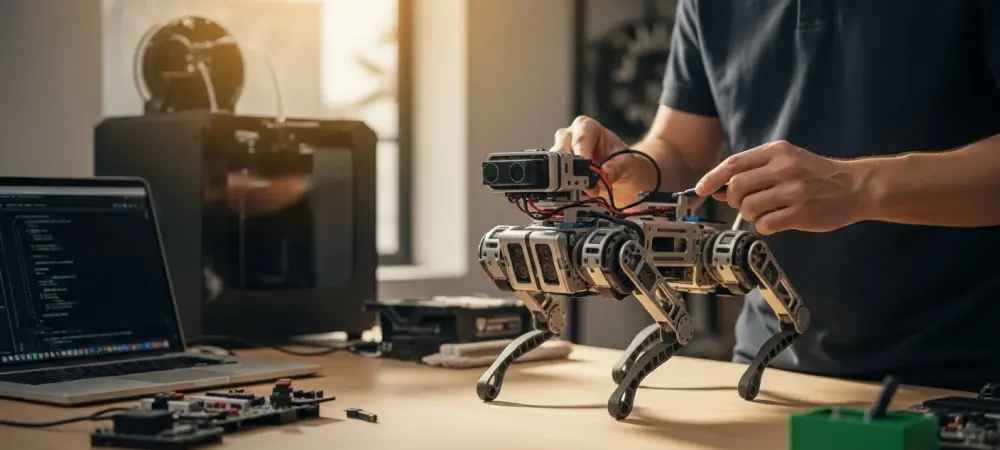
A single hobbyist sitting at a cluttered kitchen table can now deploy an autonomous navigation stack that once required a team of specialized engineers and a six-figure research budget. The era of robotics being confined to multi-million dollar research facilities has officially ended. Today, anyone with a handful of affordable components can replicate the complex navigation systems used in autonomous vehicles or build a functional replica of a planetary rover. This shift is about a fundamental change in how people conceive, build, and deploy intelligent machines from their own homes.
The Vanishing Barrier Between Professional Labs and the Home Workbench
As hardware becomes more accessible, the bottleneck for innovation has shifted from financial backing to individual creativity. The rise of standardized platforms like Arduino and Raspberry Pi has created a universal language for builders, allowing for a rapid exchange of ideas across the global maker community. This trend is crucial because it accelerates the development of real-world solutions—from automated manufacturing to environmental monitoring—by placing the tools of production into the hands of a diverse group of innovators.
Why the Democratization of Robotics Reshapes the Tech Landscape
The progression of DIY robotics now mirrors the complexity of professional engineering, moving beyond basic movement into the realm of environmental perception. The integration of pneumatic systems and articulated arms within the maker space demonstrates a move toward professional-grade precision. By studying industrial automation alongside DIY projects, enthusiasts learn to apply rigorous engineering principles to creative endeavors, ensuring their builds are both functional and robust.
From Simple Circuits to Intelligent Autonomy
Modern robotics is increasingly defined by the ability to see and think. The implementation of AI-enhanced cameras and Lidar-based navigation allows robots to transition from following pre-programmed paths to interacting dynamically with their surroundings. Specific projects, such as specialized drawing robots, serve as more than just novelties; they represent the practical application of complex mathematics and software engineering, proving that high-tech hardware can be successfully adapted for educational purposes.
Expert Perspectives on the Evolution of the Maker Scene
Industry veterans highlight a consistent theme: the maker scene is no longer just a hobbyist niche; it is a vital research engine for the broader tech industry. The consensus among professionals is that grassroots innovation often anticipates industrial trends, particularly in computer vision and modular hardware design. By observing how enthusiasts solve problems with limited resources, industrial engineers often find inspiration for more efficient, cost-effective professional systems.
A Practical Roadmap for Navigating the Modern Robotics Landscape
Transitioning from a basic builder to a sophisticated robotics developer requires a structured approach to hardware and software integration. Choosing a foundation depends on processing power and real-time control requirements. To move beyond basic obstacle avoidance, builders should integrate Lidar and AI-driven vision modules. Starting with pre-trained models for object recognition allows a developer to implement sophisticated behaviors without needing advanced degrees in machine learning.
The ultimate goal of modern DIY robotics was the creation of unique, specialized solutions. By following a modular design philosophy—where sensors, actuators, and logic were treated as interchangeable components—makers turned simple robotic arms into complex, automated workstations. This evolution established a clear path for future explorations into edge computing and collaborative swarms, ensuring that independent developers remained at the forefront of technological progress.