

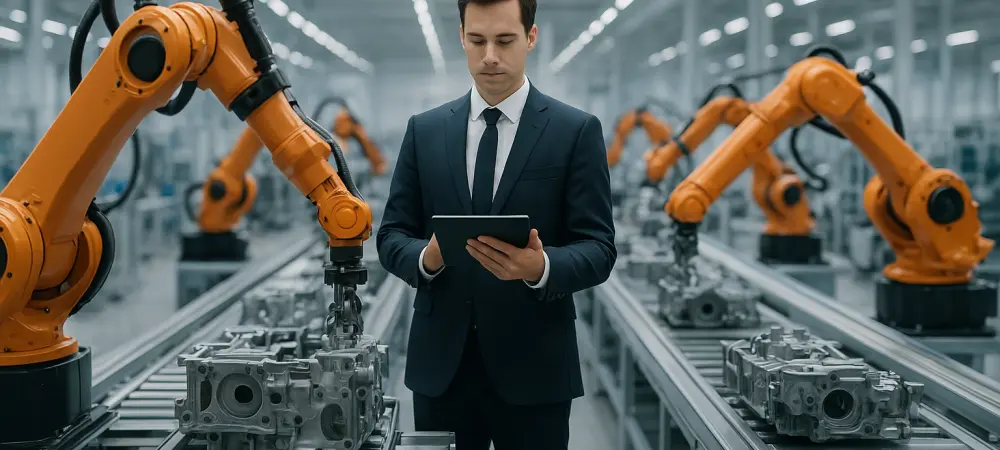
Physical industries that adopt the operational agility of software companies are becoming increasingly resilient to market fluctuations and better prepared for global competition. In Dubai, a pioneering artificial intelligence startup recently announced a breakthrough by achieving a 90% automation rate for customer orders and inquiries within the heavy industrial sector. This milestone represents a transformative shift in the Middle East and North Africa region, where the focus has moved beyond consumer-facing mobile applications toward the core of the economy, including manufacturing, logistics, and construction. By integrating advanced machine learning models into these traditionally manual environments, the company has established a robust framework for managing complex supply chains. This development suggests that the era of digital transformation in the physical world is a current reality that is reshaping how foundational industries operate today.
Regional Growth: The Shift to Industrial Deep Tech
Dubai has successfully positioned itself as a global laboratory for deep-tech innovation, bolstered by strategic investments in specialized technology parks and a regulatory environment that encourages experimentation. For several years, the local ecosystem primarily concentrated on e-commerce and financial technology, but the landscape has significantly matured to address the tangible complexities of the physical economy. This evolution demonstrates that the region is no longer merely adopting global technological trends but is actively taking a leadership role in the digital transformation of industrial production. By focusing on the movement of goods and the manufacturing of essential materials, Dubai is creating a template for other metropolitan hubs to follow. The transition from digital services to physical automation requires a deep understanding of infrastructure and logistics, a challenge that this new generation of startups is meeting with sophisticated architectures.
For a considerable period, physical industries have struggled with manual processes that created significant operational bottlenecks, particularly when managing complex technical specifications and specialized industrial orders. Traditional methods typically relied on human intervention to coordinate inventory levels, manufacturing timelines, and intricate shipping schedules, which frequently resulted in delayed response times and costly errors. The introduction of domain-expert AI has allowed companies to bypass these manual silos entirely. These systems are trained to understand the specific nuances of industrial logistics, providing a level of precision that was once impossible without intensive human labor. By automating the intake and processing of detailed technical inquiries, businesses are now able to provide instant, accurate responses to clients, thereby streamlining the entire procurement cycle and ensuring that production remains continuous and responsive to market demands.
Autonomous Systems: The Reimagined Industrial Workforce
The achievement of a 90% automation threshold marks a significant qualitative leap from basic conversational chatbots to fully autonomous AI agents capable of managing the entire lifecycle of a client interaction. To reach this level of autonomy, the underlying AI infrastructure must intelligently interpret vast amounts of unstructured data and verify real-time inventory capacities across multiple warehouses. Furthermore, these systems must integrate seamlessly with existing Enterprise Resource Planning software to ensure that data flows without interruption between different departments. This level of technical sophistication ensures that even the most complex industrial inquiries are resolved with industry-specific accuracy, minimizing the need for human hand-offs in high-stakes environments. As these autonomous agents become more reliable, they are taking over tasks that involve processing technical drawings and specialized material requests, which were previously thought to be complex. The integration of high-level automation triggers a fundamental reimagining of the industrial workforce, where technology acts as a supplement to human effort rather than a simple replacement. By freeing employees from the burden of repetitive data entry and administrative tasks, companies are now able to reallocate their most valuable talent to strategic roles such as relationship management and complex problem-solving. This approach allows traditional industrial firms to adopt the agility and scalability of software companies, enabling them to expand their operations without significantly increasing their overhead costs. The workforce is evolving into a more specialized group of professionals who oversee the AI systems and focus on high-level decision-making that requires human intuition and empathy. Consequently, the workplace is becoming more productive, as the synergy between human creativity and machine precision leads to better outcomes for both the company and clients today.
Economic Resilience: Future Operational Standards and Benchmarks
The successful integration of industrial artificial intelligence serves as a cornerstone for the broader economic diversification goals within the MENA region, helping foundational sectors like construction and manufacturing remain competitive on a global scale. By automating the intersection of industrial operations and customer service, Dubai is actively creating a sustainable, tech-driven future that reduces the economy’s reliance on traditional drivers. This milestone proves that even the most manual-heavy sectors can be revolutionized through the thoughtful application of technology, establishing a new global benchmark for operational excellence. As other regions look to optimize their own industrial bases, the success of this Dubai-based startup provides a clear roadmap for how to implement AI in a way that yields tangible economic benefits. The focus on enhancing the efficiency of the “heavy” economy ensures that the region remains a vital link in global supply chains, attracting further investment.
In conclusion, the advancement toward near-total automation in physical industries provided a blueprint for future industrial development. Organizations that prioritized the integration of autonomous agents found themselves better equipped to handle the complexities of a modern global market. To maintain this momentum, industry leaders focused on continuous data refinement and the upgrading of legacy systems to support more advanced AI capabilities. This shift encouraged a culture of innovation where technical agility became the standard rather than the exception. The transition also highlighted the importance of developing robust ethical frameworks for AI deployment to ensure that the benefits of automation were distributed across the entire workforce. Ultimately, the successful implementation of these technologies demonstrated that the path to increased productivity lay in the harmonious collaboration between human expertise and machine efficiency, paving the way for a more resilient and efficient economy.