

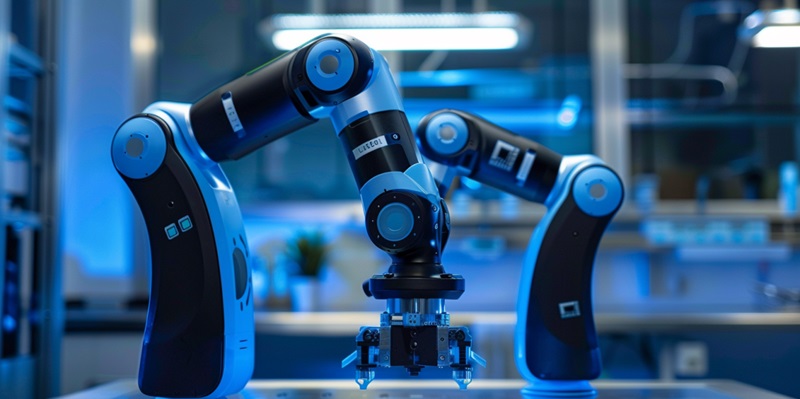
At Automate 2024 in Chicago, Doosan Robotics introduced the Prime-Series (P-Series) collaborative robots (cobots), a transformative step for industries looking to enhance their palletizing processes. This new lineup, with the P3020 model as the focal point, provides a solution that blends the strength of traditional industrial robots with the versatility and safety of modern cobots. The P3020 is remarkable not just for its 30 kg payload capacity, but also for its extensive reach of 2,030 mm, allowing it to handle tasks typically reserved for larger, more cumbersome equipment.
Revolutionizing warehouse automation, the P-Series cobots address the tricky issue of robot singularities. By skillfully crafting a 5-degree-of-freedom architecture and forgoing the standard 4th axis, Doosan Robotics has created a machine that circumvents the typical movement limitations. This improvement is critical for maintaining smooth and reliable palletizing operations, important for industries where maximizing uptime is synonymous with increased profitability.
Advanced Design and Safety
Safety is another cornerstone of the P-Series design. The P3020 boasts the highest safety ratings achievable, meeting both Performance Level e (PL e) and Category 4 standards, ensuring that it can collaborate with human workers without posing a risk to their well-being. This commitment to safety reflects the P-Series’ role not only as a tool of productivity but also as a partner in the dynamic human-robot workspaces of the future.
As industries worldwide continue to grapple with the balance between performance and energy consumption, the P-Series cobots offer a significant advantage. The gravity compensation feature marks Doosan’s engagement with sustainable practices, allowing these robots to operate with lower energy requirements. This commitment is not simply an environmental consideration; it’s also an economic one, promising reduced operational costs over the lifespan of the robot.
Implications for Human-Robot Collaboration
At Automate 2024 in Chicago, Doosan Robotics unveiled its game-changing P-Series collaborative robots, tailored for advanced palletizing. Central to this series is the P3020 model, a hybrid that marries the power of traditional industrial robots with the flexibility of cobots. It boasts a hefty 30 kg payload and an impressive reach of 2,030 mm—usually the domain of bulkier machinery.
Innovatively designed with 5 degrees of freedom and eliminating the common 4th axis, the P-Series expertly avoids the limitations caused by robot singularities, ensuring uninterrupted palletizing workflows. This strategic design choice is pivotal for businesses that count on continuous, seamless operations for greater productivity and profitability. The P-Series marks a pivotal step forward in warehouse automation, providing a robust solution that’s both powerful and adaptable.