

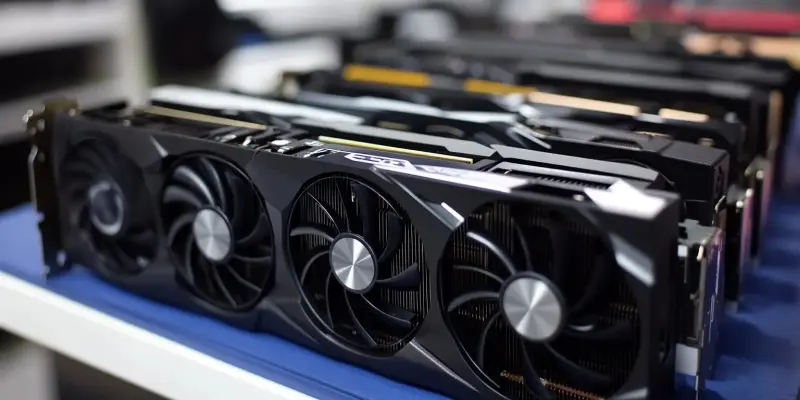
The AMD RX 9070 XT and RX 7900 GRE are two high-performance graphics cards offering significant capabilities for gaming and productivity. This article dives deep into various aspects of these GPUs, comparing their specs, performance metrics, efficiency, and pricing to help you make an informed purchasing decision.
Gaming and Productivity Performance
Benchmark Analysis
Several gaming benchmarks demonstrate that the RX 9070 XT significantly outperforms the RX 7900 GRE, particularly in 1440p settings. For instance, games like Marvel Rivals and God of War Ragnarok show substantial improvement in frame rates. Benchmarks reveal that the RX 9070 XT achieves an average of 88 FPS in Marvel Rivals, which is a 24.2% increase over the RX 7900 GRE’s 69 FPS. Similarly, in God of War Ragnarok, the RX 9070 XT delivers 163 FPS, outperforming the RX 7900 GRE by 32.9%, which stands at 117 FPS.
In productivity-focused benchmarks, the RX 9070 XT also takes the lead. Applications such as Adobe Premiere Pro and DaVinci Resolve run more efficiently, highlighting the GPU’s prowess in handling heavy workloads. For example, in Adobe Premiere Pro, the RX 9070 XT scores 12,234 points compared to the RX 7900 GRE’s 11,152 points. Even in DaVinci Resolve, where the differences are marginal, the RX 9070 XT maintains a slight edge. These performance metrics underline the RX 9070 XT’s superior efficiency in tackling demanding tasks, making it a more compelling choice for professionals.
AI and Rendering Performance
The RX 9070 XT showcases a strong edge in AI-based tasks, making it an excellent choice for users focused on machine learning and image generation. Its advanced architecture allows for superior performance in rendering tasks, further distinguishing it from the RX 7900 GRE. In AI image generation benchmarks, such as those using Stable Diffusion, the RX 9070 XT secures 2,646 points, significantly outperforming the RX 7900 GRE’s 1,586 points.
These productivity gains are instrumental for professionals who require robust processing power for everyday tasks, enhancing efficiency and output quality. In rendering tasks, the RX 9070 XT’s advanced RDNA 4.0 architecture ensures faster and higher-quality outputs, thereby reducing the time and computational resources needed. This, combined with its strong performance in AI tasks, positions the RX 9070 XT as a top-tier GPU for users whose workloads extend beyond gaming into intensive data processing and rendering applications.
Architectural and Technological Features
Core Architecture
Despite both GPUs being built on a 5nm process node, their architectures differ significantly. The RX 9070 XT boasts the advanced RDNA 4.0 technology, offering higher clock speeds and better overall performance than the RDNA 3.0 architecture in the RX 7900 GRE. The RX 9070 XT’s base clock speed ranges from 1660 MHz to 2970 MHz boost, while the RX 7900 GRE ranges from 1287 MHz base to 2245 MHz boost, highlighting the RX 9070 XT’s superior processing capabilities.
This next-gen architecture not only ensures faster processing but also brings new features like FSR 4 for improved rendering quality, adding to the RX 9070 XT’s future-proofing credentials. FSR 4 enhances rendering quality and performance, making games and applications appear more vibrant and smoother, particularly at higher resolutions. These technological advancements make the RX 9070 XT a forward-looking choice for tech enthusiasts and professionals alike, guaranteeing longevity and adaptability to future innovations in the graphic and gaming sectors.
Memory and Bandwidth
Memory specifications play a crucial role in the performance of these GPUs. The RX 9070 XT and RX 7900 GRE both feature 16GB GDDR6 VRAM with a 256-bit bus width, but the former provides higher memory bandwidth, enhancing data transfer rates during intensive tasks. RX 9070 XT offers a memory bandwidth of 644.6 GB/s compared to RX 7900 GRE’s 576.0 GB/s, underscoring the RX 9070 XT’s capability to handle more data efficiently.
Such enhancements significantly impact gaming and productivity, ensuring smoother and faster operations even with data-heavy applications. High memory bandwidth is essential for seamless multitasking and ensures that bottlenecks are minimized during extensive computational tasks, such as 3D rendering, large-scale simulations, and high-resolution gaming. Both gamers and professionals benefit from these improvements, experiencing less latency and more responsive performance, which is critical for high-stakes, time-sensitive applications.
Power Efficiency
Gaming Power Consumption
The power consumption differences between the RX 9070 XT and RX 7900 GRE are notable. The RX 9070 XT, despite having a higher TDP of 300W, is more power-efficient during gaming due to its advanced RDNA 4.0 architecture compared to the RX 7900 GRE’s 260W TDP. Specific power metrics, such as idle, gaming, and peak performance scenarios, repeatedly show the RX 9070 XT consuming power more judiciously, translating into a performance-per-watt advantage.
This efficiency translates into better long-term operational costs and becomes a deciding factor for eco-conscious and budget-savvy consumers. With the RX 9070 XT, users can expect reduced electricity bills and lower environmental impact without compromising on performance. Similarly, gamers who are mindful of their systems’ thermal performance will find this efficiency particularly valuable, allowing for sustained high performance without excessive heat generation or noise.
Heat Management
Effective heat management is essential for maintaining optimal GPU performance. Here, the RX 9070 XT has the advantage. Through its architectural advancements, it manages to remain cooler under heavy loads, ensuring sustained performance over extended periods. The RX 9070 XT’s architecture allows it to operate at lower temperatures, even during intensive gaming and productivity tasks, reducing the likelihood of thermal throttling and extending the lifespan of the GPU.
This cooling efficiency reduces the need for additional cooling solutions, providing a quieter and more cost-effective experience. The robust thermal management of the RX 9070 XT means that high system performance can be maintained without the need for aftermarket cooling systems, which can be both expensive and cumbersome to install. As a result, users can experience high-end performance in a more stable and less noisy environment, making the RX 9070 XT an ideal choice for both gaming enthusiasts and professionals who need reliable, long-term performance.
Price and Value Proposition
Current Pricing Trends
Initial pricing for the RX 9070 XT and RX 7900 GRE has evolved significantly. From starting prices of $599 and $549, respectively, market dynamics have driven the RX 7900 GRE as high as $960, while the RX 9070 XT has seen a price increase to $749. These shifts impact their value propositions, making the RX 7900 GRE a less attractive option at its current price point despite its strong performance and efficiency.
The fluctuating prices call for a careful evaluation of each GPU’s value based on performance metrics and future-proof features. Consumers should consider not just the current market price but also potential future costs and trends in the tech market. For instance, while the RX 7900 GRE’s current price spike makes it less competitive, it might become more feasible with future discounts or promotions. Conversely, the RX 9070 XT’s higher price might still justify its performance and advanced features, offering a longer-term investment that pays off in sustained and superior performance.
Cost-to-Performance Ratio
The AMD RX 9070 XT stands out with its staggering clock speeds and robust architecture, making it an excellent choice for hardcore gamers and professional content creators. Its advanced cooling system ensures consistent performance during extended usage. On the other hand, the RX 7900 GRE offers a balanced mix of performance and efficiency, designed to handle intensive gaming sessions and demanding software without a hitch.
Performance metrics reveal that both cards excel in delivering high frame rates in modern games, supporting 4K resolution and offering smooth gameplay. However, the RX 9070 XT edges out slightly in raw power, whereas the RX 7900 GRE provides better energy efficiency, making it a great option for users mindful of power consumption.
In terms of pricing, both GPUs are positioned in the premium segment. The RX 9070 XT tends to be more expensive due to its superior capabilities, while the RX 7900 GRE offers a more budget-friendly alternative without compromising too much on performance.
Thus, whether you prioritize peak performance or a combination of efficiency and cost, this guide provides the insights needed to choose the ideal graphics card for your specific needs.