

Introduction
The physical security of server memory has long been viewed as a solved problem within the vault-like environments of modern data centers, but the emergence of the DDRop attack has revealed that even the most advanced encryption can be undermined by a simple circuit board. This discovery challenges the long-standing assumption that hardware-level encryption is sufficient to protect sensitive data from a sophisticated attacker with brief physical access. By manipulating the very signals that govern how data is written to a memory module, this exploit bypasses the high-level security protocols that global cloud providers rely on to isolate their customers.
This article examines the technical mechanics, industry impact, and potential mitigations for the DDRop hardware attack. It serves as an exploration of the fundamental gaps in memory freshness that allow stale data to masquerade as current information within secure enclaves. Readers will gain an understanding of how active interposers function on DDR5 systems and the specific risks these devices pose to the infrastructure of confidential computing from 2026 to 2028.
Key Questions or Key Topics Section
What Is the DDRop Attack and Why Does It Target Modern Servers?
Confidential computing environments like Intel Trust Domain Extensions and AMD Secure Encrypted Virtualization are designed to provide a secure harbor for data, even when the underlying host operating system is compromised. These systems use hardware-based encryption to ensure that every piece of information stored in the Dual In-line Memory Modules is unreadable to anyone but the authorized processor. This architectural defense was thought to be nearly impenetrable, especially as the industry transitioned to the more complex DDR5 standard, which introduced higher speeds and more intricate signal requirements that were expected to deter physical tampering. The DDRop attack shatters this illusion by targeting the integrity of the memory write process itself using a low-cost physical device known as an active interposer. Rather than attempting to crack the encryption or simply listen to the data bus, this attack focuses on the command bus to selectively prevent new data from being recorded in the RAM. By “dropping” specific write instructions, the attacker forces the system to rely on older, previously stored versions of encrypted data. This method is particularly effective against large-scale server environments because it exploits a fundamental design choice where performance is prioritized over the absolute verification of data timelines.
How Does an Inexpensive Active Interposer Bypass DDR5 Security Measures?
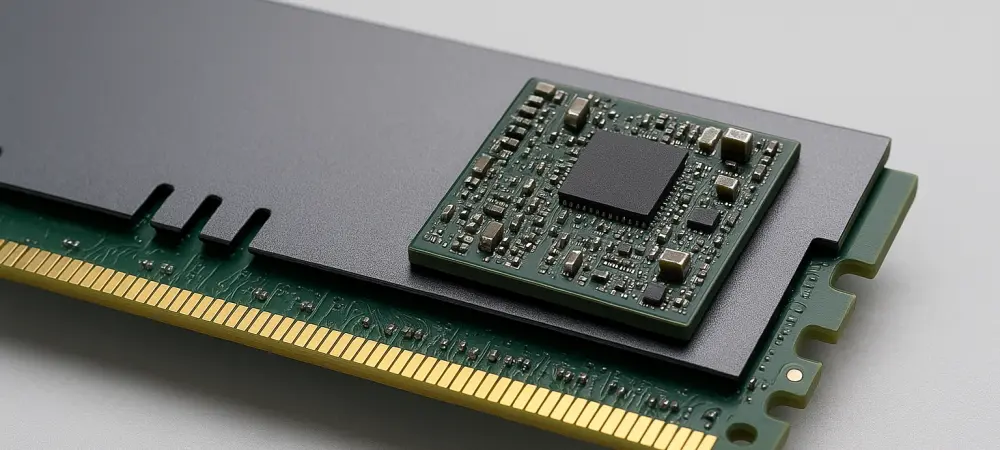
Implementing an attack on the high-speed memory bus of a modern server usually requires laboratory conditions and equipment costing tens of thousands of dollars. The DDR5 interface operates at frequencies so high that even a microscopic timing error can lead to a total system failure, which served as a natural barrier against hobbyist-level physical intervention. Because of this technical hurdle, many hardware architects focused their defensive efforts on software-based threats while treating physical bus manipulation as a niche concern that was too expensive or difficult for most adversaries to pursue. Surprisingly, the active interposer required to execute the DDRop attack costs only about $159 to $200, making it an accessible tool for a wide range of actors. The device works by monitoring command signals in real-time and injecting a precisely timed error that causes the memory module to discard a write instruction. Crucially, the interposer also physically severs the wire used by the memory to report errors back to the central processor. Since the error signal is suppressed, the processor continues its operations under the assumption that the write was successful, leaving the memory in its previous state without triggering any alarms or system crashes.
Why Is the Lack of Memory Freshness a Critical Vulnerability in Confidential Computing?
The security of encrypted memory relies on three primary pillars which are confidentiality, integrity, and freshness. Confidentiality ensures that data is scrambled, while integrity ensures that it hasn’t been modified by an outside party. Freshness, however, is the guarantee that the data being read by the processor is the exact version that was most recently written. While current server architectures from 2026 to 2029 provide robust confidentiality and integrity, they often omit freshness checks at the hardware level to avoid the massive performance penalties associated with tracking the version history of every single memory block.
This absence of freshness verification creates a systemic gap where valid but outdated encrypted data can be replayed to the processor without detection. Because the hardware encryption engine only checks if a memory block belongs to the correct owner and possesses a valid cryptographic signature, it cannot distinguish between a fresh write and a version from several minutes prior. DDRop exploits this by ensuring that new updates never reach the physical memory chips, forcing the system to fall back on older data that still satisfies all the standard cryptographic requirements. This effectively allows an attacker to control the state of the machine by deciding which updates are allowed to persist.
What Are the Specific Security Implications for Intel TDX and AMD SEV-SNP?
The practical impact of dropping write commands depends heavily on how a specific processor manages its internal security metadata and memory mapping. Researchers have found that while both Intel and AMD products are vulnerable to the core mechanism of DDRop, the depth of the resulting compromise varies between the two architectures. On Intel Trust Domain Extensions, the attack surface is remarkably broad because the system uses trusted firmware to manage page tables, which are the maps that tell the processor where specific data is located in physical RAM. By dropping the writes that occur during the initialization or clearing of these page tables, an attacker can leave chosen data in the memory that the system believes is clean. This allows a malicious actor to map their own virtual machine onto the physical memory of a victim, leading to a total compromise of data privacy. Furthermore, the attack can be used to toggle debug modes or forge attestation measurements, which are the digital receipts used to prove a system is secure. In the case of AMD Secure Encrypted Virtualization, the attack allows for the unauthorized copying of data between protected pages, which breaks the isolation guarantees promised to cloud tenants.
How Can Cloud Providers and Hardware Vendors Mitigate This Hardware Vulnerability?
Closing the freshness gap is a significant challenge because there is no simple software patch for a vulnerability rooted in the physical behavior of the memory bus. Hardware manufacturers like Intel and AMD have noted that physical access to a server is often considered outside the standard threat model for their confidential computing products. This perspective suggests that the primary defense against DDRop remains the physical security of the data center, including biometric access controls and rigorous background checks for staff who handle the hardware.
For organizations that require a more technical defense, certain hardware configurations offer inherent resistance to these types of interposer attacks. For instance, systems that use on-package memory, where the RAM is integrated directly into the processor housing, are immune because there is no exposed bus for an interposer to sit on. Additionally, the industry is looking toward future solutions like cache-line versioning, which would embed a version number into every block of memory to ensure that stale data is immediately recognized and rejected. While these technologies are being refined, some current processors offer an optional cryptographic integrity mode that can block specific aspects of the attack, though often at the cost of reduced system performance.
Summary or Recap
The discovery of the DDRop attack highlights a critical oversight in the current generation of confidential computing hardware. By using affordable and easily constructed interposers, attackers can manipulate the memory bus to prevent data updates, thereby exploiting the lack of freshness checks in DDR5 memory systems. This vulnerability allows for the reintroduction of stale encrypted data, which can be used to subvert system logic and gain unauthorized access to private virtual machines. Intel platforms are particularly susceptible to this exploit due to the way they manage trusted memory structures, though AMD systems also face significant integrity risks.
Cloud providers and hardware designers must now contend with the reality that physical bus manipulation is no longer a prohibitively expensive or complex undertaking. While physical security remains the first line of defense, the long-term solution lies in moving toward hardware that can cryptographically verify the age of data in addition to its authenticity. The industry’s reliance on performance-driven design choices has created a structural weakness that requires a fundamental shift in how memory integrity is handled from 2026 toward the end of the decade.
Conclusion or Final Thoughts
The emergence of DDRop demonstrated that the sophisticated encryption used in modern data centers was only as strong as the physical bus it traveled across. It was determined that the complexity of the DDR5 interface did not prevent active tampering, but rather provided a false sense of security for those who designed the hardware. The research proved that the trade-off between memory performance and absolute data freshness resulted in a gap that could be exploited with minimal financial investment. Consequently, the industry recognized that the digital boundaries of the virtual world were still vulnerable to physical interventions at the electrical level. Future hardware development shifted toward a model where every transaction on the memory bus was verified for both its origin and its timing. This led to the adoption of more integrated silicon designs that reduced the physical attack surface available to interposers. Organizations began to implement more rigorous supply chain audits and real-time hardware monitoring to detect the subtle electrical signatures of unauthorized devices. Ultimately, the lesson from this vulnerability was that security must be holistic, ensuring that the physical and digital layers of a system are equally resilient against the evolving tactics of modern adversaries.