

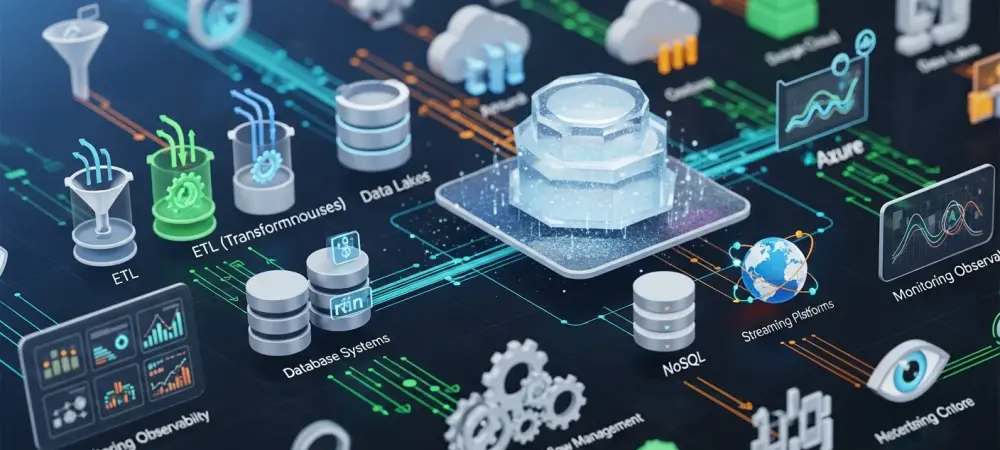
The massive volume of telemetry and transactional data generated by modern distributed applications has turned the once-static field of database management into a high-velocity engineering discipline that dictates the success of every digital enterprise today. Organizations no longer view data simply as a byproduct of business operations; rather, it is the primary fuel for the predictive models and automated decision-making engines that define market leadership. As this dependency has deepened, the tools used to collect, refine, and transport this data have undergone a radical transformation, moving away from rigid, on-premises legacy systems toward flexible, cloud-native architectures that prioritize speed and reliability. This evolution represents a fundamental shift in how engineers interact with infrastructure, bridging the gap between traditional software development and data administration. Consequently, the selection of a data engineering stack is no longer just a technical decision for IT departments but a strategic maneuver that determines an organization’s ability to respond to market shifts in real time.
Foundations of Modern Data Engineering Infrastructure
At the core of every modern data strategy lies the fundamental process of moving information from its point of origin to a location where it can be analyzed and utilized. Historically, this followed the Extract, Transform, Load (ETL) model, where data was heavily modified in a staging area before being pushed into a warehouse. This approach was largely a response to the high cost of storage and the limited processing power of early database systems, requiring data to be “clean” before it ever touched the final destination. However, the rise of cloud computing has ushered in the era of Extract, Load, Transform (ELT). In this modern paradigm, raw data is loaded directly into highly scalable cloud environments in its native state, allowing the transformation logic to be applied later using the massive, distributed compute power of the cloud. This shift has unlocked unprecedented flexibility, as engineers can now re-process historical data with new logic without having to re-extract it from the source systems.
The convergence of DevOps and data management has further accelerated this technical evolution, giving birth to a culture where data pipelines are treated with the same rigor as application code. Automated pipelines have become the standard, replacing manual scripts with version-controlled, reproducible workflows that ensure infrastructure reliability and deployment speed. This “Data-as-Code” movement means that every change to a data model or a pipeline configuration is tested, validated, and deployed through Continuous Integration and Continuous Deployment (CI/CD) systems. By treating data infrastructure as an evergreen product rather than a series of one-off projects, organizations can significantly reduce the risk of downtime and data corruption. This reliability is the bedrock upon which modern digital services are built, ensuring that the metrics used to monitor system health and customer behavior are always accurate and available.
The broader technological landscape is feeling the weight of this shift, as the global data pipeline market is projected to expand from its current levels to a staggering $43.61 billion by 2032. This growth is driven by the realization that data is the primary differentiator in an economy increasingly dominated by artificial intelligence and machine learning. As organizations transition toward autonomous data pipelines that can self-heal and auto-scale, the demand for sophisticated engineering tools continues to skyrocket. These tools are no longer optional accessories; they are the essential connective tissue of the modern enterprise, responsible for managing the staggering complexity of multi-cloud environments and the sheer velocity of data production. The review that follows explores the technical nuances of these systems, evaluating how they empower teams to turn raw information into a competitive asset.
Core Categories and Technical Components of the Modern Data Stack
Cloud-Native Data Warehousing and Elastic Scaling
The architectural centerpiece of many modern organizations is the cloud-native data warehouse, exemplified by platforms like Snowflake and Amazon Redshift. These systems have revolutionized data management by fundamentally decoupling compute resources from storage capacity. In traditional architectures, adding storage often required purchasing more compute nodes, leading to inefficient resource utilization and “idling” costs during low-activity periods. By separating these layers, cloud-native warehouses allow an enterprise to store petabytes of data at a low cost while spinning up massive clusters of virtual warehouses only when a heavy query needs to be executed. This elasticity is critical for handling high-concurrency workloads, such as when hundreds of business analysts and automated reporting tools all attempt to access the same dataset simultaneously without causing a performance bottleneck.
Performance metrics in these environments are often measured through the lens of virtual warehouse efficiency and the ability to scale independently across multi-cloud regions. For instance, the ability to resize a compute cluster in seconds without interrupting ongoing operations allows organizations to meet peak demand—such as during a major product launch or a financial quarter-end—and then immediately scale back down to minimize expenses. Furthermore, the integration of native support for semi-structured data like JSON and Parquet means that engineers no longer need to spend hours flattening complex data structures before ingestion. Instead, the warehouse handles the schema-on-read logic, allowing for faster time-to-insight. This level of technical sophistication ensures that the data warehouse remains a performant, central repository that can serve both traditional business intelligence and modern, high-speed data science applications.
Unified Lakehouse Architectures and Distributed Processing
While warehouses excel at structured data and fast SQL queries, the rise of unstructured data and machine learning led to the popularity of data lakes. However, managing these lakes often resulted in “data swamps” characterized by poor performance and a lack of data integrity. The emergence of the Lakehouse architecture, pioneered by platforms like Databricks, seeks to resolve this by merging the flexibility and cost-effectiveness of a data lake with the reliability and performance of a traditional warehouse. At the heart of this technical merger is the implementation of ACID (Atomicity, Consistency, Isolation, Durability) transactions on top of low-cost cloud storage. This is achieved through the use of transaction logs that track every change made to the data files, ensuring that even if a write operation fails mid-way, the data remains consistent and uncorrupted.
Distributed data processing is the engine that powers the Lakehouse, utilizing frameworks like Apache Spark to split massive computational tasks across hundreds of nodes. This capability is essential for modern AI and machine learning workloads, which require processing billions of rows of data to train predictive models. By providing a unified environment where data engineers can build pipelines in Python or SQL and data scientists can build models in the same workspace, the Lakehouse eliminates the need to move data between disparate systems. This consolidation significantly reduces latency and simplifies the governance of the data lifecycle. The result is a dependable, high-performance ecosystem that supports a wide range of use cases, from real-time streaming analytics to the long-term archival of historical records.
Serverless Data Integration and Metadata Management
The administrative burden of managing data servers has led many organizations to adopt serverless data integration components, such as AWS Glue and Azure Data Factory. These tools operate on a pay-as-you-go basis, allowing engineers to define data movement and transformation logic without having to provision or manage the underlying virtual machines. A standout technical capability of these serverless offerings is their ability to automate schema discovery and metadata indexing. Through the use of “crawlers,” these systems can scan various data sources—databases, S3 buckets, or APIs—to automatically identify the structure of the data and update a centralized data catalog. This automated metadata management is vital for maintaining a searchable, organized inventory of an organization’s information assets, preventing the loss of critical knowledge as the data ecosystem expands.
Reviewing the performance of these tools reveals their effectiveness in managing hybrid and multi-cloud environments. Visual pipeline builders allow engineers to map out complex data journeys across diverse regions and platforms using a drag-and-drop interface, which accelerates the development cycle for new integrations. For organizations with strict security requirements, self-hosted runtimes enable the serverless platform to interact with on-premises legacy systems securely, bridging the gap between old and new technology. This flexibility ensures that data can move freely between local data centers and the public cloud while maintaining a consistent management layer. As data movement becomes more automated and less dependent on manual server configuration, teams can shift their focus from “keeping the lights on” to building high-value data features.
SQL-Based Transformation and Semantic Layers
As data stacks have moved toward an ELT model, the “Transform” step has become the most critical part of the pipeline. Tools like dbt (data build tool) have transformed this phase by allowing anyone who knows SQL to function as a data engineer. The significance of this approach lies in the application of software engineering best practices—such as version control, modularity, and automated testing—to the world of data modeling. Instead of writing long, monolithic SQL scripts that are difficult to debug, engineers use dbt to create small, reusable models that build upon one another. This modularity ensures that if a change is needed in a core business logic—such as how “active users” are calculated—it only needs to be updated in one place to propagate across the entire analytical stack.
Beyond simple transformation, the rise of the semantic layer represents a major step toward data consistency. The semantic layer acts as a translation gateway between the complex underlying data models and the end-user applications like dashboards or AI assistants. By defining metrics once in a central semantic layer, organizations ensure that a “revenue” figure seen by the sales team in a dashboard matches the “revenue” figure used by the finance team in their quarterly report. This eliminates the “multiple versions of the truth” problem that plagued earlier generations of business intelligence. When combined with version-controlled, modular data models, the semantic layer provides a robust framework for delivering high-quality, trusted data to every corner of the enterprise, regardless of the complexity of the underlying infrastructure.
Emerging Trends in Pipeline Automation and DataOps
The industry is currently witnessing a significant shift toward “DataOps,” a methodology that applies the principles of CI/CD directly to data transformations and pipeline deployments. This trend is driven by the need for greater speed and reliability in a landscape where data changes constantly. In a DataOps environment, every change to a pipeline is automatically tested against a subset of real data to ensure that it doesn’t break downstream reports or corrupt the database. This approach drastically reduces the time it takes to move a new data feature from the development phase to production, allowing organizations to be more responsive to business needs. Moreover, the integration of automated data quality checks ensures that “bad data” is caught and quarantined before it ever reaches the final warehouse, preserving the integrity of the entire system.
Another major trend is the rise of real-time streaming data processing, which allows organizations to react to events as they happen rather than waiting for a batch process to run overnight. This is being bolstered by the influence of AI-assisted code generation, which is significantly lowering the barrier to entry for building complex pipelines. Engineers can now describe a data transformation in natural language, and AI tools can generate the corresponding SQL or Python code, accelerating the development process. While these tools still require human oversight to ensure accuracy and security, they are effectively acting as a force multiplier for data teams. This automation is particularly useful in managing the increasingly common consumption-based pricing models, where efficient code and resource optimization can lead to significant cost savings.
Consumption-based pricing is itself influencing how organizations approach pipeline design. Because cloud providers charge based on the amount of data processed or the number of compute units used, there is a renewed focus on workload management and resource optimization. Engineers are now incentivized to write highly efficient code and to use techniques like incremental loading, which only processes new or changed data rather than the entire dataset. This shift toward financial accountability—often referred to as “FinOps”—is forcing data teams to become more aware of the economic impact of their technical choices. As a result, the tools of the future will likely include more sophisticated cost-forecasting and optimization features, helping organizations strike a balance between high-performance data processing and budgetary constraints.
Strategic Real-World Applications and Use Cases
The practical impact of these data engineering tools is most visible in the field of predictive analytics, where they provide the clean, high-velocity datasets required to fuel high-accuracy machine learning models. In sectors like retail, these tools are used to ingest millions of point-of-sale transactions and website interactions to predict inventory demand or customer churn. Without the ability to transform and normalize this data in real time, the predictive models would be working with stale or inconsistent information, leading to poor business decisions. By providing a stable and automated pipeline, data engineering tools allow data scientists to focus on refining their algorithms rather than spending 80 percent of their time on data preparation.
In industries such as fintech and e-commerce, real-time data integration is frequently deployed to monitor system logs and user interactions for fraud detection. These systems can analyze thousands of data points per second—looking for patterns that deviate from a user’s normal behavior—and trigger an alert or block a transaction in milliseconds. This level of responsiveness is only possible because of the low-latency processing capabilities of modern lakehouses and streaming platforms. Furthermore, e-commerce platforms use these same tools to provide personalized shopping experiences, updating product recommendations in real time as a user browses the site. This immediate feedback loop significantly enhances the customer experience and drives higher conversion rates, demonstrating the direct link between data engineering and revenue generation.
Unique use cases also involve hybrid cloud deployments that bridge on-premises legacy systems with modern cloud-native analytics. For example, a healthcare provider might maintain sensitive patient records on a secure, local server while using cloud-based tools to perform large-scale genomic research or population health analytics. Data engineering tools act as the secure bridge, anonymizing and encrypting data before it leaves the local environment and ensuring it is correctly formatted for the cloud tools. This ability to integrate disparate systems allows organizations to leverage the power of the cloud without compromising data privacy or abandoning their existing investments in legacy hardware. This pragmatic approach to data management is essential for large enterprises that cannot simply “rip and replace” their entire infrastructure overnight.
Technical Hurdles and Governance Limitations
Despite the significant advancements in the field, organizations still face substantial technical hurdles, particularly regarding the complexity of cloud pricing models. While serverless scaling offers great agility, it can lead to unpredictable expenses if not monitored closely. For instance, Amazon Redshift’s use of Redshift Processing Units (RPUs) or AWS Glue’s Data Processing Units (DPUs) creates a layer of abstraction that can make it difficult for finance teams to understand exactly what they are paying for. A poorly optimized query or an infinite loop in an automated pipeline can quickly consume thousands of dollars in credits before it is noticed. This cost complexity requires organizations to implement strict budget alerts and automated governance policies to prevent “bill shock,” highlighting the need for better transparency in cloud billing.
Regulatory issues also remain a major obstacle, especially for global organizations that must navigate complex data sovereignty and privacy laws. Implementing role-based access controls (RBAC) and ensuring that sensitive data is only stored in specific geographic regions is a technical challenge that requires constant vigilance. Data engineering tools must now include sophisticated governance features that can automatically tag sensitive data—such as social security numbers or medical records—and ensure it is encrypted and handled according to local laws like GDPR or various national data protection acts. As the regulatory environment becomes more fragmented, the ability to maintain a consistent governance posture across multiple cloud providers and regions will become a key differentiator for enterprise-level data platforms.
To mitigate these challenges, there is an ongoing development effort centered on enhancing data observability and automated testing frameworks. Observability tools allow engineers to track the “lineage” of data, seeing exactly where it came from, how it was changed, and who has accessed it. This transparency is crucial for troubleshooting pipeline failures and ensuring data quality. When a report looks “wrong,” an observability tool can quickly identify which upstream pipeline failed or which data source provided inaccurate information. Furthermore, automated testing frameworks are becoming more integrated into the development lifecycle, allowing teams to catch errors before they impact the business. These efforts are slowly reducing the “operational debt” that often accumulates in complex data environments, making the systems more resilient and easier to manage over time.
Future Outlook: The Rise of Autonomous Data Ecosystems
The coming decade will likely be defined by the transition from manual orchestration to autonomous, self-healing data pipelines. In this future state, the data engineering system will not only detect that a pipeline has failed but will also analyze the root cause and attempt to fix it automatically—perhaps by scaling up compute resources or adjusting a transformation script to account for a change in source data. This shift toward autonomy will be powered by deep integration with artificial intelligence, which will move from simply assisting with code generation to managing the entire data lifecycle. As these systems become more intelligent, the role of the data engineer will shift from low-level troubleshooting to high-level system design and governance, focusing on the strategic alignment of data with business objectives.
Breakthroughs in AI-driven data modeling are also expected to reshape how data is organized. Instead of humans manually defining every table and relationship, AI could analyze data usage patterns and automatically optimize the underlying storage structures for performance and cost. Parallel to this, the “Data Mesh” architecture is gaining traction as a decentralized alternative to the traditional monolithic data warehouse. In a Data Mesh, different business units—such as marketing, finance, or operations—take full ownership of their own data products, using a shared self-service infrastructure provided by a central platform team. This decentralized approach aims to eliminate the bottlenecks associated with centralized data teams and allows the people who understand the data best to be the ones who manage and share it.
The integration between infrastructure-as-code and data-as-code will also deepen, fundamentally reshaping the role of the DevOps engineer. In the future, the distinction between “deploying an app” and “deploying a data pipeline” will largely disappear, as both will be managed through the same unified control planes. This will lead to a more holistic view of the digital enterprise, where data flow is treated as just another component of the overall system health. As the complexity of multi-cloud and edge computing environments continues to grow, these unified, autonomous ecosystems will be the only way to manage data at the scale required by the global economy. The organizations that successfully navigate this transition will be well-positioned to lead in an increasingly data-driven world.
Summary of Findings and Overall Assessment
The current landscape of data engineering tools has reached a state of impressive maturity, characterized by highly scalable cloud-native architectures and the widespread adoption of DevOps principles. Platforms like Snowflake and Databricks have solved the traditional problems of resource contention and data corruption, while tools like dbt and AWS Glue have democratized the ability to build and manage complex pipelines. The shift toward the Lakehouse model and the implementation of ACID transactions on cloud storage have created a reliable foundation for the next generation of AI and machine learning workloads. Collectively, these advancements have significantly reduced the technical barriers to entry, allowing organizations of all sizes to leverage the power of big data.
However, this increased capability has come with a corresponding increase in management complexity and cost. The transition to serverless and consumption-based models requires a new level of financial and operational discipline that many organizations are still developing. Furthermore, the growing importance of data sovereignty and privacy has turned governance from a backend checkbox into a primary design requirement. Despite these hurdles, the overall performance and automation capabilities of modern platforms represent a massive leap forward compared to the legacy systems of the past. The technology is no longer a bottleneck; rather, the challenge has shifted to how effectively an organization can organize its teams and processes to take advantage of these powerful tools.
Ultimately, data engineering tools have become the essential infrastructure for the modern digital business, enabling the fast, data-driven decision-making that is required to compete in a global market. By automating the tedious work of data integration and transformation, these platforms allow engineers to focus on creating value and driving innovation. As the industry moves toward autonomous ecosystems and decentralized architectures, the role of data in the enterprise will only continue to grow. These tools have laid the groundwork for a future where data is not just an asset to be managed, but a dynamic and self-sustaining force that powers every aspect of the organization’s digital life. This evolution marks a significant milestone in the history of information technology, signaling the end of the era of static data and the beginning of the era of the intelligent, data-driven enterprise.