

With the relentless advance of AI creating an insatiable appetite for energy, the data center industry finds itself at a critical juncture. The traditional model of relying on the grid is becoming untenable, forcing operators to forge a new path toward energy independence. To unpack this monumental shift, we’re speaking with Dominic Jainy, an IT professional whose work at the intersection of artificial intelligence and infrastructure provides a unique perspective on the challenges and opportunities ahead. He joins us to discuss the seismic changes in power strategy, from on-site generation and supply chain battles to the very architecture of power distribution within these massive facilities.
Given the widening gap between utility power delivery timelines and the urgent needs of hyperscalers, what specific, immediate steps are operators taking to bridge this energy deficit, and what are the primary financial and operational trade-offs they face when pursuing on-site power solutions?
What we’re seeing is a fundamental, almost philosophical, shift in the industry’s approach to power. The gap you mentioned is no longer a minor inconvenience; it’s a chasm. In hubs like Northern Virginia and Atlanta, operators are hearing about delivery timelines that are up to two years longer than they anticipated just six months ago. The immediate, and frankly necessary, step is to take control of their own power destiny. This means planning for fully self-powered campuses, a strategy that about a third of hyperscalers are now aiming for by 2030. The trade-off is immense. Financially, the upfront capital expenditure is staggering, as you’re essentially building a private power plant. Operationally, you’re taking on entirely new complexities, from fuel procurement and emissions permitting to managing a 24/7 power generation facility, which is a far cry from simply plugging into the grid.
Gas turbines and engines are emerging as a “bankable” option for powering gigawatt-scale facilities. Could you walk us through the step-by-step process of planning for such a system, from assessing natural gas capacity to navigating the multi-year lead times for pipeline upgrades and other critical infrastructure?
Absolutely. Choosing gas turbines is a serious commitment that feels more like developing public infrastructure than building a data center. The first step is a deep, realistic assessment of the local natural gas supply. You can’t just assume the capacity is there. Once you start talking about a 500 MW load, you’re not a customer anymore; you’re a power-plant-class user. This triggers a whole new level of engagement with the gas utility. They’ll need to determine if new laterals or compression stations are needed, and that’s when the clock really starts ticking. These pipeline upgrades often come with multi-year lead times, a timeline that runs parallel to, and often complicates, your own construction schedule. So, the process involves intense, early-stage collaboration with energy providers, navigating complex permitting for both emissions and construction, and locking in fuel transport and backup sources long before you ever break ground.
With nearly half of operators expecting to adopt DC power architectures by 2028, what are the key efficiency gains this offers over traditional AC designs? Please describe the practical challenges engineers face when retrofitting or designing a new facility around a DC distribution model.
The move toward DC power is all about eliminating waste. In a traditional AC setup, power comes in, gets converted multiple times to different voltages and from AC to DC before it finally reaches the chip. Each conversion sheds energy as heat. A native DC architecture aligns directly with modern IT loads, which all run on DC power, thereby cutting out many of those conversion steps. The efficiency gains are significant, reducing both energy consumption and the cooling load required to remove that waste heat. However, the practical challenges are not trivial. For a new build, it requires a complete rethinking of electrical design and sourcing specialized equipment. For retrofitting, it’s even harder. You’re trying to perform open-heart surgery on a live, mission-critical facility. It involves immense complexity in managing cutovers, ensuring compatibility between new and old systems, and training staff on an entirely different electrical topology.
On-site power generation introduces significant supply chain hurdles, such as multi-year lead times for large transformers. Beyond stockpiling components, what innovative procurement or engineering strategies are firms using to mitigate these chokepoints and keep projects on schedule?
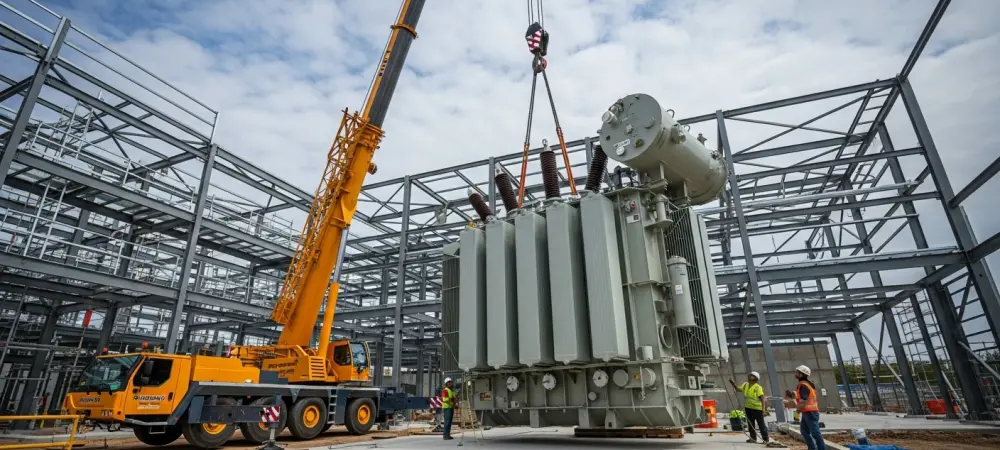
This is truly the universal chokepoint. The idea that you can bypass the supply chain issues plaguing utilities by going on-site is a fantasy. Those large MV/HV transformers have the same multi-year lead times no matter who the buyer is. The most effective strategy right now isn’t some secret technology; it’s aggressive, long-range planning and deep supply chain integration. Firms are placing non-cancellable orders years in advance, long before the project design is even finalized. They are also working with engineering partners to standardize designs across their portfolios, allowing them to procure components in larger, more predictable blocks. We’re also seeing more collaboration, where partners might share or trade components to keep a high-priority project on track. It’s less about a single silver-bullet solution and more about a complete overhaul of procurement philosophy, moving from just-in-time to just-in-case.
As regulators increase scrutiny, data center operators face new rules requiring them to pay for transmission and grid support services. How does this change the economic model for fully off-grid or hybrid power systems, and what new complexities does it add to achieving energy independence?
This is where the dream of “unplugging” from the grid meets the hard reality of physics and regulation. Regulators like FERC are making it clear that large loads, even if they generate their own power, can’t just be invisible to the grid. They are now being required to be fully visible in planning and to contribute financially to grid stability services like transmission, regulation, and black start capabilities. This fundamentally alters the economic model. You might be generating your own power, but you’re still on the hook for services that ensure the entire system doesn’t collapse. It complicates the idea of energy independence by creating a persistent financial and regulatory tether to the grid, preventing operators from simply “netting away” their impact and forcing a more integrated, hybrid approach rather than true isolation.
Long-duration storage is often described as a “force multiplier” rather than a primary fuel source. Can you provide a concrete example of how a data center might integrate this technology to trim generator run-hours, manage peak loads, and improve the overall reliability of its on-site power?
That “force multiplier” concept is key. Imagine a large data center campus running primarily on its own natural gas turbines. Instead of running those turbines at a constant, high output, you can run them at their most efficient baseline level. During the day, when a massive AI training job kicks in and power demand spikes, you don’t have to fire up another generator. Instead, you draw from your long-duration storage system. Later, during off-peak hours, you can use the excess capacity from your turbines to recharge the storage. This strategy trims total generator run-hours, which saves fuel, reduces emissions, and cuts down on maintenance. It also acts as a critical bridge during a momentary fuel supply interruption or a generator fault, providing a seamless buffer that enhances overall reliability far beyond what generators alone could offer.
What is your forecast for the data center energy landscape over the next five years?
The next five years will be defined by a forced march toward energy self-sufficiency, driven by necessity rather than choice. We will see the maturation of the on-site power playbook, with gas turbines becoming a standard feature in hyperscale designs, not an exotic exception. This will be paralleled by a frantic race to solve the associated supply chain and regulatory puzzles. While promising technologies like small modular reactors will remain on the distant horizon, expect to see significant innovation and adoption in DC power architectures and sophisticated energy storage integration to maximize the efficiency of every watt generated. Ultimately, the operators who succeed will be those who stop thinking of themselves as real estate developers and start acting like sophisticated, integrated energy companies.