

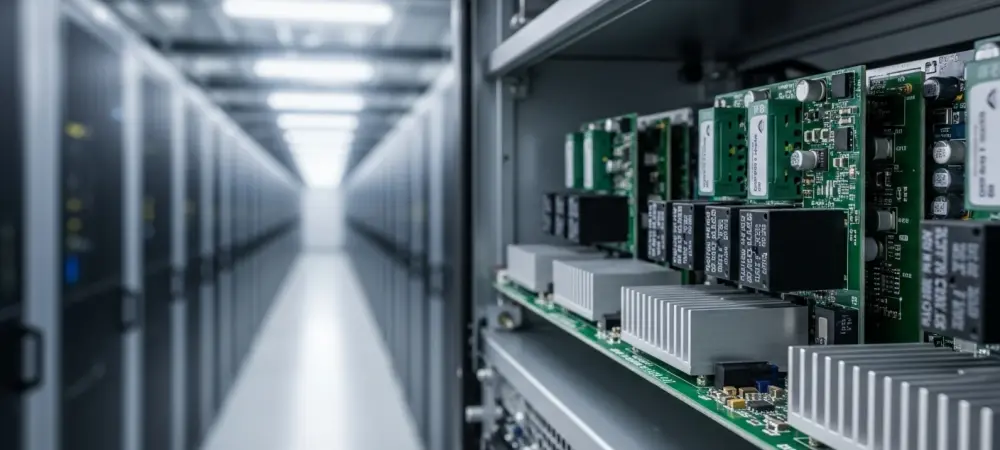
The staggering intensity of modern artificial intelligence has transformed data centers from digital libraries into high-voltage industrial powerhouses that consume electricity at the scale of entire cities. As computational models grow exponentially, the infrastructure supporting them is undergoing its most significant evolution. The megawatt-per-rack era has arrived, turning every square foot of the data center floor into a high-stakes engineering challenge. This transition is not merely about incremental improvements but rather a total reconstruction of how electricity moves from the grid to the processor. To maintain the pace of innovation, the industry is pivoting toward an 800V DC architecture that promises to resolve the physical limitations currently hindering AI factories. This shift represents the final departure from low-voltage standards that have dominated the landscape for a generation. By streamlining power delivery, operators can manage the unprecedented energy densities required by the latest silicon.
The End of Traditional Power Delivery in the Megawatt Era
The electricity required to run a single modern server rack has reached a startling milestone, now consuming as much energy as a small suburban neighborhood. As artificial intelligence evolves from a niche tool into a global industrial factory, the legacy power systems designed for the last decade of computing are physically beginning to melt under the pressure. This surge in demand is forcing a radical departure from long-standing electrical standards to prevent the AI revolution from grinding to a halt.
In this new megawatt era, power delivery must be as streamlined as the data itself, leading to the rapid adoption of higher voltage thresholds once reserved for utility-grade transmission. Facility operators are now prioritizing direct current architectures to minimize conversion losses and ensure the stability of the global computing grid under the weight of generative models.
Why Legacy Infrastructure Is Throttling the AI Revolution
For years, the 48V/54V power standard was the gold material for data center efficiency, but the staggering density of next-generation hardware has turned this former asset into a bottleneck. As power demands for upcoming architectures like NVIDIA’s Rubin Ultra climb toward 1MW per rack, the physical limitations of copper become an insurmountable hurdle. High current at low voltage requires massive, bulky cabling that not only drives up costs but also occupies the valuable physical space needed for processors and cooling systems.
This logistical crisis for facility operators is compounded by the fact that larger cables generate more heat and offer less flexibility. The sheer weight of copper needed to support a megawatt rack at 48V would be structurally prohibitive for most existing floors. Consequently, the industry has hit a wall where adding more power through traditional means is no longer an engineering possibility, necessitating a fundamental change in voltage to keep current levels manageable and racks functional.
The Mechanics of 800V DC: Efficiency, Space, and Advanced Semiconductors
The shift to 800V High-Voltage Direct Current (HVDC) eliminates these bottlenecks by drastically reducing the number of power conversion steps, allowing electricity to flow directly from the source to the chip with minimal energy loss. By utilizing higher voltage, data centers can operate at a lower current, which facilitates the use of thinner, lighter cabling and compact power components. This transformation is driven by high-efficiency Gallium Nitride (GaN) and Silicon Carbide (SiC) semiconductors, which provide the rapid switching capabilities necessary for such high-energy environments.
Furthermore, these systems are being paired with massive 2.4MW liquid cooling setups and high-voltage DC fans to dissipate the extreme heat generated by dense GPU clusters. The integration of advanced power electronics ensures that energy is distributed with surgical precision, minimizing the thermal footprint of the power delivery system itself. By shrinking the electrical footprint, operators can pack more compute power into the same physical area, effectively doubling the efficiency of the facility.
Strategic Timelines and the Industry Pivot Toward 800V Infrastructure
Major industry leaders, including NVIDIA and Google, have reached a consensus that 800V infrastructure is no longer an optional upgrade but a fundamental requirement for scalability. Deployment is already on a fixed timeline, with significant infrastructure rollouts occurring throughout the third quarter of 2026 to prepare for the 2027 Kyber rack cycle. This coordinated industry pivot ensures that the hardware arriving next year will have the necessary power backbone to operate at peak performance.
Experts in the field highlight that these racks, designed to house hundreds of Rubin Ultra chips in liquid-cooled configurations, rely entirely on the 800V architecture to maintain operational stability. The transition from 2026 to 2028 will likely define the winners in the race for AI supremacy, as those with 800V-ready facilities will possess the only infrastructure capable of supporting next-generation silicon.
Transitioning to High-Voltage: Frameworks for Future-Ready Data Centers
Implementing an 800V framework required a specialized approach to hardware safety and operational management. Operators integrated solid-state relays and high-voltage hot-swap capabilities to ensure technicians maintained equipment without total system shutdowns. By aligning infrastructure refresh cycles with the 2026 to 2027 hardware generations, data center managers successfully mitigated distribution losses.
The transition to megawatt-per-rack density became the benchmark for modern AI factories. This evolution allowed the industry to move beyond the limitations of legacy copper and embraced a future where power was no longer the primary constraint. As organizations finalized their 800V deployments, they secured the longevity of their computational investments. The shift proved that the global computing grid possessed the flexibility needed to scale alongside the most demanding artificial intelligence workloads in history.