

The relentless expansion of artificial intelligence and high-density computing has pushed modern data centers to a critical thermal tipping point where traditional air conditioning is no longer a viable primary defense. As chip manufacturers pack more transistors into smaller silicon footprints, the resulting heat flux resembles that of a nuclear reactor core rather than a standard office server. This environmental management crisis has transformed cooling from a background utility into a frontline technological discipline. Modern thermal management is now the literal gatekeeper of digital progress, dictating which facilities can support the next generation of large language models and which will succumb to hardware throttling or catastrophic failure.
Evolution and Fundamentals of Thermal Management
The transition from simple ventilation to complex heat transfer mechanics marks the most significant architectural shift in infrastructure design over the last decade. In the early days of enterprise computing, cooling was treated as a general room-level requirement, much like maintaining a comfortable temperature for office workers. However, as server density increased, the industry moved toward precision cooling, focusing on the specific physics of heat rejection. The core principle now relies on the “second law of thermodynamics,” ensuring that heat is not merely moved around a room but effectively extracted from the building and dissipated into the external environment.
This evolution is fundamentally a response to the “power density” problem. While a standard server rack once consumed five kilowatts of power, modern AI-ready racks frequently demand fifty to one hundred kilowatts. In this high-stakes context, simple fans and open windows are obsolete. The modern cooling stack integrates sensors, fluid dynamics, and automated pressure controls to create a balanced ecosystem. This shift represents a move away from “brute force” cooling—where a room is kept freezing just to protect a few hot spots—toward a surgical approach that targets heat at its point of origin.
Primary Cooling Methodologies and Technical Architectures
Air-Based Precision Cooling and Airflow Optimization
Air-based systems remain the most common architecture for general-purpose data centers, but their modern implementation is highly specialized. The Computer Room Air Conditioning (CRAC) unit and the Computer Room Air Handler (CRAH) serve as the mechanical heart of these systems. While a CRAC unit uses a dedicated compressor and refrigerant, a CRAH unit leverages chilled water loops, making it significantly more efficient for large-scale operations. The effectiveness of these units depends entirely on how the air is routed. Without strict containment, cold air often bypasses the equipment, while hot exhaust air recirculates back into the intake, a phenomenon known as thermal short-circuiting that wastes enormous amounts of energy.
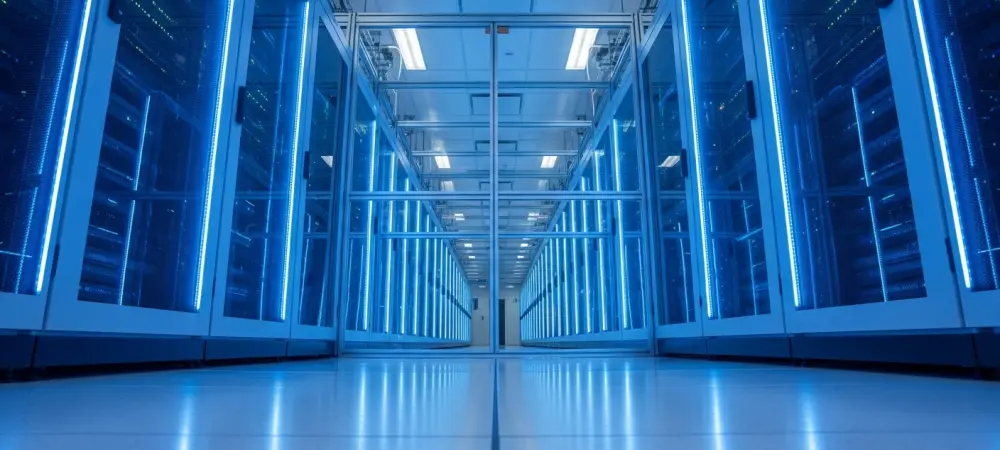
To combat this, engineers have perfected the “aisle containment” strategy. By physically isolating the hot and cold aisles with glass or plastic barriers, facilities create a high-pressure cold zone and a low-pressure hot zone. This pressure differential naturally pulls the cold air through the server chassis, maximizing the efficiency of every cubic foot of air moved. However, even with these optimizations, air cooling faces a physical ceiling. Because air has a low heat capacity compared to liquids, it requires massive volumes of movement to cool modern high-wattage chips, often leading to excessive noise and fan power consumption that can eat into a facility’s energy budget.
Advanced Liquid and Immersion Cooling Systems
The industry is rapidly pivoting toward liquid cooling as the only sustainable solution for extreme hardware densities. Direct-to-chip cooling utilizes a closed-loop system where a cold plate is mounted directly onto the CPU or GPU. A dielectric or water-based fluid circulates through this plate, absorbing heat far more efficiently than air ever could. This method is unique because it removes heat before it can even enter the room’s atmosphere, allowing data centers to operate with much smaller HVAC footprints. For the user, this means higher performance without the risk of thermal throttling, even during peak computational loads. Even more radical is the adoption of immersion cooling, where entire server blades are submerged in a tank of non-conductive dielectric fluid. In a single-phase system, the fluid circulates via pumps to a heat exchanger. In a two-phase system, the fluid actually boils upon contact with the components, turning into vapor that rises to a condensing coil, where it releases its heat and falls back into the bath. This phase-change process is arguably the most efficient thermal transfer mechanism available today, allowing for rack densities that would be physically impossible to cool with air. While the initial capital expenditure for immersion is high, the reduction in mechanical complexity and the elimination of server fans often result in a lower total cost of ownership over time.
Emerging Trends and Market Dynamics
The global cooling market is currently experiencing a period of explosive growth, driven by the shift toward ASHRAE Class A1 and A2 compliance. This standardization allows equipment to operate at slightly higher temperatures, which, paradoxically, makes cooling more efficient by reducing the “temperature delta” the system must overcome. Market projections indicate a steady double-digit growth rate through 2033, as cloud providers race to retrofit legacy facilities. This is not just a trend of “more cooling” but a trend of “smarter cooling,” where the infrastructure is expected to be as agile as the software it supports.
Furthermore, the rise of High-Performance Computing (HPC) has forced a convergence between mechanical engineering and IT procurement. Organizations no longer buy servers and cooling systems separately; they buy integrated stacks. This shift has given rise to the “modular” data center, where cooling units are pre-integrated into shipping-container-style pods. This approach allows for rapid scaling, enabling companies to deploy massive compute power in months rather than years. The market is also seeing a move away from chemical refrigerants toward natural coolants and water-based systems, reflecting a broader corporate push toward environmental responsibility and regulatory compliance.
Sector-Specific Applications and Real-World Deployment
The deployment of these technologies varies significantly depending on the industry. Cloud service providers, which manage vast arrays of general-purpose hardware, often stick to highly optimized air cooling with localized liquid loops for their AI-specific clusters. In contrast, AI research firms and cryptocurrency miners—who prioritize “hash rate” or “FLOPs per watt”—frequently jump straight to full immersion cooling. These organizations have realized that the ability to over-clock hardware without fear of melting the silicon is a major competitive advantage that justifies the infrastructure overhaul.
A unique challenge exists for legacy facilities that cannot easily be retrofitted with under-floor liquid piping. In these cases, Rear-Door Heat Exchangers (RDHx) have become the “hero” technology. These units replace the back door of a standard server rack with a liquid-filled radiator. As the server’s internal fans blow hot air out, the door absorbs the heat before it ever reaches the data center floor. This allows a facility built for low-density workloads to support modern AI hardware with minimal structural modification. It is a pragmatic solution that bridges the gap between the infrastructure of the past and the demands of the future.
Technical Constraints and Operational Challenges
Despite these advancements, the transition to high-efficiency cooling is fraught with technical hurdles. One of the primary constraints is the sheer weight of liquid cooling systems; a server rack filled with dielectric fluid or heavy water-cooled plates can weigh significantly more than its air-cooled counterpart, necessitating reinforced flooring in older buildings. Additionally, the risk of leaks—even when using non-conductive fluids—creates a psychological barrier for many traditional IT managers. Maintenance becomes more complex, as technicians must handle fluid levels, filters, and specialized seals that are not present in air-cooled environments. Regulatory pressure regarding carbon footprints and Water Usage Effectiveness (WUE) adds another layer of difficulty. Many evaporative cooling systems, while energy-efficient, consume millions of gallons of water, which is becoming a liability in drought-prone regions. To mitigate these issues, developers are focusing on “closed-loop” water systems and advanced sensor arrays. These sensors do more than just monitor temperature; they use acoustic signatures and vibration analysis to predict a fan or pump failure before it happens. By reducing “bypass air” and optimizing fluid flow in real-time, operators are slowly chipping away at the inherent inefficiencies of traditional HVAC design.
Future Horizons: Sustainability and Artificial Intelligence
The roadmap for cooling technology is increasingly defined by “free cooling” and the total elimination of mechanical chillers. Geothermal cooling, which taps into the constant temperature of the Earth’s crust, and “Kyoto wheels,” which use large thermal masses to exchange heat with the outside air, are becoming standard for new builds in temperate climates. These methods offer a path to a Power Usage Effectiveness (PUE) score near 1.0, meaning almost every watt of power entering the building goes toward computing rather than support systems. This is the “holy grail” of data center engineering.
Looking ahead, the integration of AI-driven thermal management will likely remove the human element from the cooling equation entirely. We are moving toward a future where neural networks analyze millions of data points from thousands of sensors to micro-adjust fan speeds and valve positions every second. Robotic monitoring probes, capable of navigating cramped aisles to identify “micro-hotspots” with infrared precision, will replace manual inspections. These breakthroughs will not only lower energy bills but will also extend the lifespan of the hardware itself by creating a perfectly stable, vibration-free thermal environment.
Summary of Technological Assessment
The transition from room-level air conditioning to component-level thermal regulation was a fundamental requirement for the survival of the modern digital era. It was observed that air-based systems, while refined, reached their physical limits when faced with the immense heat generated by modern AI processors. The subsequent rise of liquid and immersion cooling provided the necessary headroom for the next decade of silicon innovation. These technologies proved that cooling is no longer a passive background task but an active participant in the performance of the computing stack.
The verdict on this technological evolution was clear: the industry successfully traded simplicity for efficiency. While the new architectures introduced greater mechanical complexity and higher initial costs, the long-term gains in energy reduction and hardware reliability were undeniable. Strategic investments in “free cooling” and AI-driven management laid the groundwork for a more sustainable global infrastructure. Ultimately, the ability to balance the extreme power demands of the intelligence age with the urgent need for environmental stewardship became the defining achievement of this decade’s engineering efforts.