

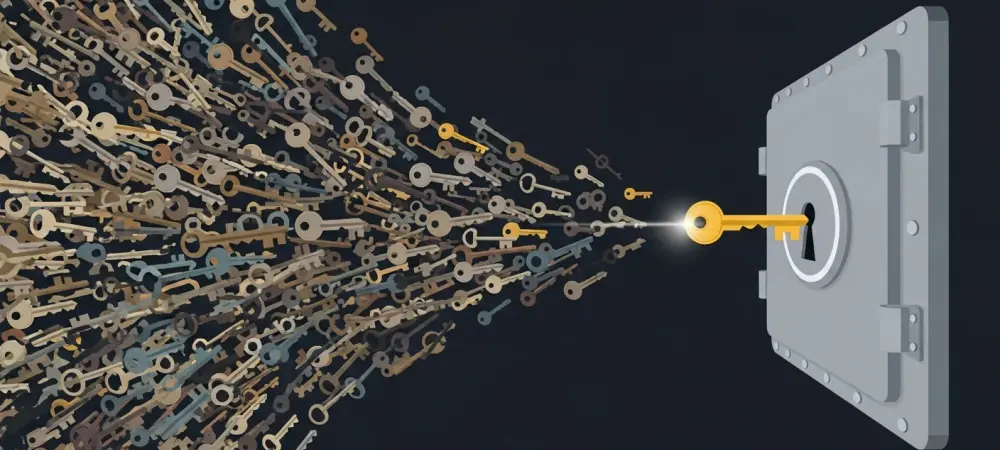
That login credential you created a decade ago for a long-forgotten online service might seem like harmless digital dust, but for a new breed of cybercriminal, it represents a golden key to modern-day vaults. The value of a single password may seem negligible, yet when aggregated from old data breaches, these credentials become powerful tools. A recent federal case highlights this danger, demonstrating how a handful of forgotten passwords fueled a sophisticated attack that resulted in a six-figure theft, proving that digital security is only as strong as its oldest link.
The Hidden Value of Your Forgotten Passwords
How much is a password you have not used in years really worth? For a trio of hackers, a collection of them was the key to a massive payout, proving that old data breaches have a long and dangerous shelf life. These seemingly obsolete credentials are not discarded but are instead collected, sorted, and sold on hidden corners of the internet, waiting to be repurposed for new attacks.
This stockpiling of personal data creates a persistent threat. While a breach from five years ago may feel like old news, the information stolen remains viable. Cybercriminals count on the public’s tendency to reuse passwords, turning a single compromised account from the past into a master key for accessing more sensitive platforms today, including financial and betting accounts.
The Ripple Effect of Old Breaches on New Crimes
The primary mechanism for these attacks is known as credential stuffing. This automated technique involves attackers using large lists of leaked usernames and passwords from past security failures to bombard the login pages of other websites. Since many people use the same email and password combination across multiple services, a single leak can grant criminals access to a wide array of a victim’s online accounts.
This vulnerability is exploited within a booming dark web economy, where troves of stolen credentials are sold as commodities. The common habit of password reuse across multiple platforms, from social media to financial institutions, places millions of users directly in the crosshairs. The convenience of a single, memorable password becomes a significant liability, enabling attackers to move laterally across an individual’s entire digital life.
Anatomy of a Digital Heist
A clear illustration of this threat unfolded in November 2022, when attackers used previously stolen credentials to successfully infiltrate over 60,000 accounts on a major fantasy sports and betting platform. The criminals did not need to crack the platform’s defenses directly; they simply walked in the front door using keys that users had unknowingly left in circulation from other, older breaches.
Once inside, the attackers employed a two-pronged monetization strategy. They directly drained nearly $600,000 from the accounts of approximately 1,600 victims, transferring funds out before the platform or users could react. Concurrently, they sold access to thousands of the other compromised accounts on illicit online shops, allowing other criminals to exploit them. The orchestrators behind this scheme included Nathan “Snoopy” Austad and his co-conspirators. Austad, a 21-year-old, played a pivotal role by operating one of the online shops selling the stolen account access and managing the laundering of the illicit proceeds.
The Digital Dragnet That Brought Cybercriminals to Justice
Investigators were able to unravel the scheme by meticulously following the money. The criminals used cryptocurrency to launder the stolen funds, but the digital trail ultimately led law enforcement directly to Austad. He was found to be in control of cryptocurrency accounts that had processed approximately $465,000 of the stolen money, providing a direct link between the virtual crime and the real-world perpetrator.
The successful prosecution underscores the serious real-world consequences of these digital crimes. Austad recently pleaded guilty to conspiracy to commit computer intrusion and now faces a maximum of five years in prison. His associate, Joseph Garrison, has already been sentenced to 18 months, sending a clear message that those who exploit common security weaknesses will be held accountable.
Four Steps to Bulletproof Your Digital Accounts
The first and most critical step is to conduct an audit of your digital footprint. It is essential to use a unique, complex password for every single online account, especially for any service tied to your finances. Resisting the convenience of password recycling is the primary defense against credential stuffing. To make this practical, embracing a secure password manager is key. These applications generate and store strong, unique passwords for every site, eliminating the need for users to remember dozens of complex credentials. Furthermore, activating multi-factor authentication (MFA) wherever possible adds a crucial layer of security, acting as a digital deadbolt that can stop a credential stuffing attack even if an attacker has the correct password. Finally, it is wise to proactively check your exposure. Free online services like “Have I Been Pwned” allow users to enter their email addresses and see if their credentials have appeared in known data breaches. Discovering that your information is circulating on the dark web is the first step toward securing your accounts before they can be exploited.
The case against Austad and his collaborators served as a stark reminder of the interconnectedness of digital security. The exploitation of old, forgotten data culminated in significant financial losses and demonstrated that proactive security habits are not merely advisable but essential in the modern digital landscape.