

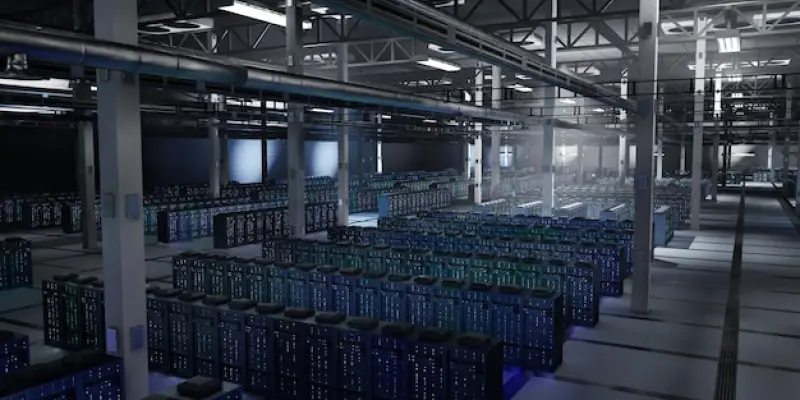
The dynamic evolution of artificial intelligence finds itself interwoven with the ambition of Elon Musk’s xAI project, bringing transformative potential to the forefront of technology. At the heart of this ambitious endeavor lies the Colossus supercomputer, which is poised to reshape the AI landscape with its unparalleled processing capabilities. In less than a year, Colossus has expanded its operating power from 200,000 Nvidia GPUs to an ambitious target of 1 million GPUs. This cutting-edge system aims to position itself as a formidable competitor against industry giants like Oracle Cloud Infrastructure, setting new standards in artificial intelligence training and computational prowess. The remarkable speed of development reflects not only technological innovation but also strategic infrastructural advancements, which are essential for maintaining its high-level performance and scalability. From its swift construction to its energy solutions, the Colossus supercomputer embodies the relentless drive to push AI capabilities beyond current confines.
Infrastructure Advancements and Energy Solutions
Swift Construction
Overcoming the complexities of building one of the world’s most advanced supercomputers necessitates agile responses and strategic planning in infrastructure. The Colossus supercomputer was rapidly constructed within 122 days in Memphis, Tennessee, signaling the incredible focus and coordination behind its development. Initiating its operations with 100,000 GPUs, Colossus doubled this computing power to reach 200,000 Nvidia GPUs within three months, showcasing an adaptive scaling process. This speed of expansion has established xAI as an innovative force in the AI field, foregrounding its readiness to embrace future enhancements and computational demands efficiently.
Energy Provision Challenges and Solutions
Powering such immense computational capacity presents distinctive challenges, illustrated by Colossus’s initial reliance on natural gas generators due to limited grid support. The concerns from local residents regarding this dependence highlighted the critical need for sustainable energy solutions in AI infrastructure. Transitioning to Memphis’s main power grid, Colossus now receives 150MW, supplemented by Tesla batteries, facilitating reliable and efficient operations. The anticipation of additional power provisions for Phase Two, expected by fall, underscores xAI’s commitment to sustainable growth. Plans for a new substation further illustrate proactive measures to meet future energy demands aligning with its expansive vision. Balancing technological advancement with practical energy considerations demonstrates xAI’s holistic approach to fostering AI innovations responsibly.
Technological Impact and Training Capabilities
Training Large Language Models
Beyond its infrastructure feats, the Colossus supercomputer is instrumental in fostering advancements in AI capabilities, particularly with large language models. Central to this effort is the training of xAI’s Grok tool, which is already available on Musk’s X social network, illustrating the practical implementation of sophisticated AI applications. Grok represents the possibilities enabled by extensive computational resources, allowing nuanced language understanding and generation that caters to complex user interactions and queries. By leveraging Colossus’s processing strengths, xAI emphasizes its commitment to bridging theoretical AI advancements with tangible outcomes for users worldwide.
Innovative AI Drive at xAI
The ambition encapsulated within xAI extends beyond mere technological achievements. It reflects a visionary approach aiming to “understand reality,” which positions itself firmly at the intersection of scientific discovery and technological progress. This motivation cultivates contributions to the AI field by exploring uncharted territories in machine learning and artificial intelligence, affirming its role as a leader in tech innovation. By continuously expanding the capabilities of its supercomputer, xAI seeks to define new benchmarks for AI functionality, propelling the industry forward with creativity and commitment to breaking existing limits. The synthesis of theoretical insights with practical applications underscores xAI’s ambitious narrative, driving an evolution across the AI sphere that aligns technological advancements with human-centric solutions.
Future Prospects and Concluding Reflections
The landscape of artificial intelligence is witnessing a rapid evolution, prominently influenced by Elon Musk’s xAI project, which holds the promise of transformative advancements in technology. Central to this groundbreaking endeavor is the Colossus supercomputer, a marvel poised to revolutionize the AI domain with its extraordinary processing power. In an impressive feat, Colossus has boosted its operational power from 200,000 Nvidia GPUs to an ambitious target of 1 million GPUs within a year. This state-of-the-art system aims to establish itself as a formidable rival to industry titans like Oracle Cloud Infrastructure, setting new benchmarks in AI training and computational proficiency. Its swift development is a testament not only to technological progress but also to strategic infrastructure enhancements crucial for maintaining top-tier performance and scalability. From its rapid assembly to its innovative energy solutions, the Colossus supercomputer exemplifies an unyielding drive to extend AI’s boundaries beyond existing limitations.