

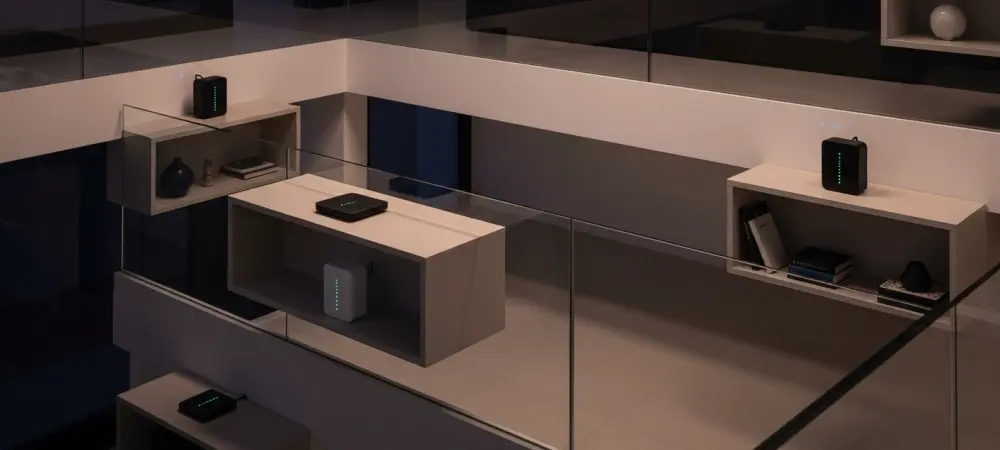
The rapid expansion of high-speed fiber-to-the-home infrastructure has left many modern households frustrated as their existing hardware fails to distribute multi-gigabit speeds effectively across multiple floors. Even with 10Gbps service plans becoming increasingly common in urban centers in 2026, the traditional router has remained a persistent bottleneck, often capped at older standards that cannot keep pace with the incoming data stream. This discrepancy creates a digital ceiling, where the potential of high-bandwidth applications like 8K streaming, real-time cloud computing, and low-latency virtual reality is never fully realized. To address this widening gap, D-Link introduced the AQUILA PRO AI M60, a sophisticated mesh system designed to bridge the divide between fast external fiber and internal wireless distribution. This launch signifies a critical shift in consumer networking, moving toward a robust infrastructure capable of supporting a hyper-connected ecosystem.
Technical Advancements: Navigating the Wi-Fi 7 Era
Multi-Link Operation: The End of Sequential Data Streams
One of the most transformative elements of this new mesh system is the implementation of Multi-Link Operation, a core feature of the Wi-Fi 7 standard that fundamentally changes how devices communicate. In previous generations, even advanced routers were limited to communicating with a device over a single frequency band at a time, forcing a choice between the range of 2.4GHz or the higher speeds of 5GHz and 6GHz. Multi-Link Operation eliminates this restriction by allowing compatible devices to transmit and receive data across multiple bands simultaneously, significantly increasing throughput and reducing interference. By aggregating these frequencies, the system ensures that data takes the most efficient path possible, which is vital in environments with high signal congestion. This leap in efficiency means that high-priority traffic is no longer delayed by background tasks, providing a more stable and responsive experience for everyone on the network.
Bandwidth Expansion: Utilizing the 320MHz Spectrum
The move to Wi-Fi 7 also introduces an unprecedented level of spectral efficiency through the use of 320MHz channels and 4K-QAM modulation techniques. By doubling the channel width from the 160MHz maximum found in Wi-Fi 6E, the AQUILA PRO AI system effectively creates a wider highway for data to travel, allowing for massive increases in raw speed. This expansion is paired with 4096-QAM, which enables the system to pack more data into every signal transmission compared to the 1024-QAM used in earlier iterations. The result is a theoretical speed boost that can reach up to 2.4 times faster than previous standards, making it possible to move gigabytes of data in seconds rather than minutes. For households that rely on large-scale data backups or professional creative work, these technical improvements represent more than just a minor upgrade; they provide the headroom necessary to handle the next decade of growth without requiring frequent hardware replacements.
Physical Infrastructure: Bridging the Wired and Wireless Gap
Port Evolution: The Necessity of 10GbE Connectivity
Physical connectivity remains the backbone of any high-performance network, and the inclusion of a 10GbE WAN port on this new mesh system marks a significant departure from the industry-standard 2.5G ports. While many manufacturers claim Wi-Fi 7 readiness, the lack of a true 10-gigabit input often renders the wireless speed gains moot, as the primary source of internet is throttled at the point of entry. By providing a dedicated 10GbE port, D-Link ensures that the full capacity of modern fiber-optic modems can be ingested and distributed throughout the mesh nodes without any loss in performance. Furthermore, the inclusion of high-speed LAN ports allows for a robust wired backhaul configuration, ensuring that the connection between mesh units remains rock-solid regardless of physical obstructions. This hardware-first approach ensures that the router functions as a true gateway, finally matching internal network speed to the speeds promised by modern ISPs.
Network Optimization: Looking Toward Seamless Integration
As the digital landscape continued to evolve throughout 2026, the necessity for intelligent network management became increasingly apparent for both casual and professional users. The integration of AI-driven optimization helped the AQUILA PRO AI system maintain peak performance by automatically shifting traffic to less crowded channels and prioritizing critical applications in real time. This proactive management reduced the need for manual troubleshooting and provided a level of reliability that earlier mesh systems struggled to achieve. For those looking to future-proof their homes, the decision to invest in 10GbE hardware served as a logical step toward eliminating systemic bottlenecks and maximizing the value of multi-gigabit internet subscriptions. The industry moved toward a standard where wireless performance matched the speed of fiber, ensuring that the home network was no longer the weakest link. Users who adopted these systems found that their infrastructure supported seamless connectivity.