

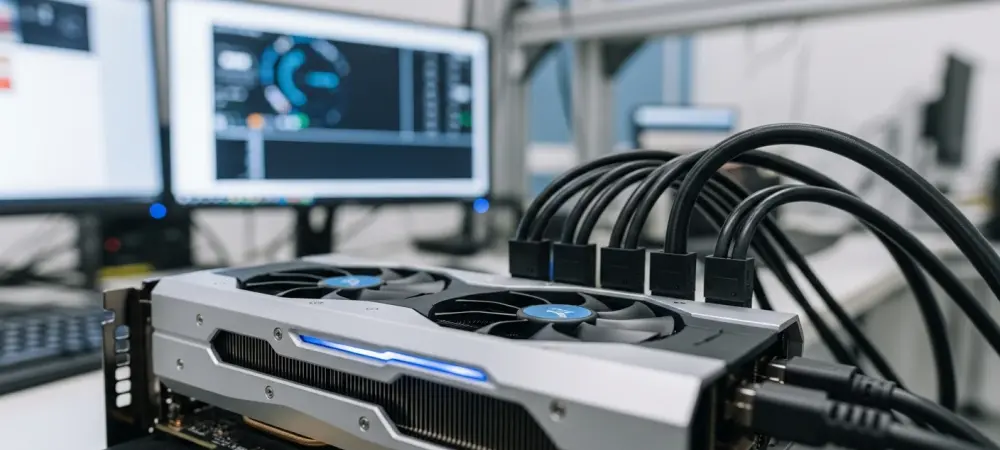
A software package smaller than the average desktop icon has emerged with a singular, audacious goal: to find the absolute computational breaking point of the most powerful graphics cards on the planet. This is not a sprawling open-world game or a complex production suite, but an 80-kilobyte benchmark named Radiance. Developed by former tech journalist Alan Dang, it poses a startling question: can a program that barely registers on a modern storage drive be designed to overwhelm multi-thousand-dollar hardware that doesn’t even exist yet? Radiance arrives not as entertainment, but as a computational gauntlet built to discover the true ceiling of GPU architecture.
The 80KB File That Brings Future GPUs to Their Knees
The core premise of Radiance defies conventional logic. In an age where applications are measured in gigabytes, this benchmark’s minuscule footprint is a key part of its punishing design. It serves as a forward-looking stress test that meticulously analyzes the raw FP32 compute performance and execution efficiency of a graphics processing unit. By its very nature, it deliberately sidesteps specialized hardware like the RT or AI cores that dominate marketing materials, focusing instead on the fundamental engine that powers every visual calculation.
Radiance was not created to simulate a gaming experience but to isolate a single, critical metric. It is a purpose-built tool designed to find the absolute breaking point where a GPU’s processing cores can no longer keep up with a purely mathematical workload. By stripping away other variables such as VRAM bandwidth and texture fetching, it provides an unfiltered look at the silicon’s raw number-crunching capability, offering a glimpse into the performance bottlenecks that will define the next generation of real-time rendering challenges.
Shifting the Goalposts Why We Need a New Breed of Benchmark
For years, GPU benchmarks have tested a cocktail of features. They measure a card’s ability to handle ray tracing, AI-driven upscaling, and high-speed memory access simultaneously. While useful for gamers, this approach can obscure a processor’s fundamental computational strength. A card might excel due to superior RT cores or faster VRAM, even if its core shader performance is less competitive. This makes it difficult to assess the raw architectural improvements from one generation to the next.
Radiance positions itself as a vital tool for the future by offering a different philosophy. It is engineered to measure one thing with ruthless precision: raw floating-point 32-bit (FP32) compute performance. This metric represents the foundational power of any GPU, underpinning every shader calculation, physics simulation, and rendering pass. By isolating this variable, Radiance provides a transparent measure of a GPU’s core horsepower, free from the influence of auxiliary hardware. This focus is directly connected to the broader industry trend toward increasingly complex computational demands in scientific simulation and advanced real-time graphics, where raw throughput is paramount.
Deconstructing the Crusher How Radiance Works
The benchmark’s incredible intensity stems from its core technology: raymarching. Unlike traditional rasterization, which renders scenes using polygons and textures, raymarching calculates light and surfaces through pure mathematics. It dispatches a compute shader for each pixel on the screen, which then “marches” a ray through a scene defined entirely by mathematical formulas. This method allows for the creation of complex, procedurally generated worlds with physically accurate global illumination and shadows without ever loading a single texture map or polygonal model.
To illustrate this, Radiance uses a simple “Breakout” game as its visual basis. Every object on screen—the paddle, the ball, and every single brick—is generated algorithmically by signed distance functions (SDFs). This compute-centric approach is amplified by the benchmark’s ingenious design. Its microscopic 80KB size ensures the entire test fits within a GPU’s L1 cache, the fastest memory available. This intentionally bypasses slower VRAM and the memory bus, creating a pure test of the GPU’s processing cores. The benchmark’s scalable challenge is divided into two presets: the default “RTX 5090” setting at 720p and the “Extreme” preset at 1080p, which adds a significantly higher debris count. This seemingly small increase in resolution and object complexity leads to an exponential surge in the computational load, pushing the GPU to its absolute limit.
The Meltdown Performance Figures and Developer Warnings
The performance data from a hypothetical RTX 5090 test case is striking and reveals the benchmark’s punishing nature. On the default 720p preset, the card demonstrates its next-generation competence, achieving a solid score of 2085 points with an average frame rate of 76.2 FPS. This figure suggests that even under a heavy, future-focused workload, the hardware maintains a smooth and playable experience, performing as expected for a flagship product.
However, the situation changes dramatically on the 1080p “Extreme” preset. While the initial average frame rate starts at a seemingly manageable 41.8 FPS, the performance collapses as the workload intensifies. Once the full debris system is activated, with thousands of mathematically generated particles filling the scene, the frame rate plummets to an unplayable 2-3 FPS. This dramatic drop showcases the benchmark’s ability to generate a computational load so immense that it can bring even the most powerful consumer hardware to a grinding halt. In light of this, the developer has issued a cautionary note, advising users to ensure their hardware is prepared for the extreme load by verifying cooling and power delivery.
Pushing Your Silicon to the Limit How to Run Radiance Safely
For hardware enthusiasts and reviewers eager to test the limits of their own systems, Radiance is publicly available for download. It offers a unique opportunity to gauge the raw computational throughput of current-generation hardware and see how it stacks up against this forward-looking challenge. However, given its intensity, running the benchmark requires preparation and a clear understanding of what is being measured.
Before launching the application, a practical safety checklist is strongly recommended. First, verify that the GPU’s cooling solution is clean and running optimally, as the test will push thermal output to its maximum. Second, double-check that all power cables, particularly sensitive 12VHPWR connectors, are fully and securely seated to prevent any power-related issues under extreme load. Finally, it is crucial to interpret the results correctly. The score produced by Radiance is a measure of pure computational throughput, not a direct comparison to gaming performance, offering a specialized insight into your hardware’s capabilities.
Ultimately, the arrival of Radiance served as a powerful reminder that raw computational demand could still outpace even the most advanced consumer hardware. It successfully refocused the performance conversation, shifting attention from a holistic mix of features back to the fundamental processing power of the GPU core itself. The 80KB file did not just test a hypothetical RTX 5090; it established a new high-water mark for what a true stress test could achieve, proving that the future of rendering performance would be defined by pure, unadulterated mathematical efficiency.