

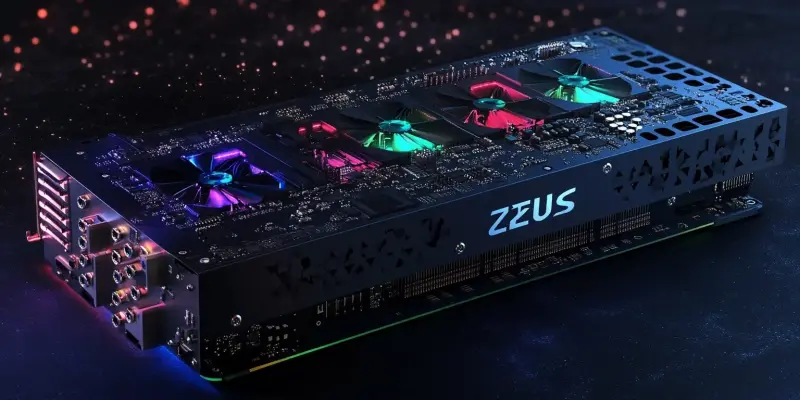
In the rapidly evolving field of high-performance computing (HPC), innovative solutions are continually being developed to meet the growing demand for faster and more efficient processing power. Recently, Bolt Graphics, a startup from Sunnyvale, California, has made headlines by announcing its groundbreaking Zeus GPU. The company claims that this new GPU surpasses existing solutions in rendering, high-performance computing, and gaming tasks, potentially revolutionizing the industry.
Unmatched Performance and Expandability
The Zeus GPU boasts “orders of magnitude” better performance than current alternatives, featuring an expandable memory capacity of up to 384 GB on a PCIe card or an impressive 2.25 TB per card in a 2U server. This cutting-edge technology can be scaled to 180 TB in a full rack of 2U servers, allowing for extensive data processing and storage capabilities. Furthermore, the Zeus GPU is the first to integrate high-speed 400 GbE and 800 GbE interfaces, which facilitate large-scale GPU connectivity. This innovation provides the infrastructure needed for multiple GPUs to work together seamlessly, leading to unprecedented computational power and efficiency.
Bolt Graphics illustrates the potential of their new GPU with some staggering performance improvements: the Zeus GPU is claimed to deliver up to 10 times better performance in rendering tasks, six times in FP64 HPC workloads, and an astonishing 300 times improvement in electromagnetic wave simulations. Such enhancements in simulation speed are vital for creating advanced technology products, such as CT scanners, radar sensors, and optical lenses, by speeding up time to market and improving overall quality.
Complementary Software and Industry Integration
In addition to the hardware advancements, Bolt Graphics introduces complementary software called Glowstick, a real-time path tracer that pairs with the Zeus GPU. A single Zeus PCIe card can achieve 4K path tracing at an impressive 120 frames per second, both for gaming and product design purposes. For the film industry, Bolt claims that 28 Zeus GPUs can match the path tracing performance of 280 legacy GPUs, demonstrating the immense computing power and efficiency this technology offers. Glowstick is included with the Zeus GPU at no additional cost and supports industry standards like MaterialX and OpenUSD, making it an appealing option for professionals across various sectors.
The Zeus GPU is set to make its debut at the upcoming Game Developers Conference in March 2024, where Bolt Graphics plans to demonstrate its capabilities firsthand. Development kits are expected to be available later this year, with mass production targeted for late 2026. Users interested in obtaining early access to this powerful new technology can sign up on Bolt’s website.
Impacts on the GPU Market
The Zeus GPU’s enhanced capabilities promise to deliver unprecedented speed and efficiency, addressing the intense requirements of the modern tech landscape. If Bolt Graphics’ claims hold true, the Zeus GPU could signify a pivotal shift in how computational tasks are managed, rendering significant advancements not only in HPC but across various technology sectors, setting a new benchmark for the future.