

Dominic Jainy is a seasoned IT professional whose expertise lies at the intersection of artificial intelligence, machine learning, and the complex architecture of mobile hardware. With a career dedicated to understanding how software can push the physical limits of consumer electronics, he offers a unique perspective on the rapidly evolving world of smartphone photography. In this discussion, we delve into the technical nuances of Samsung’s latest imaging breakthroughs, focusing on the potential migration of Galaxy S26 features to existing models and the broader implications of computational photography for the modern user.
Our conversation covers the intricate process of simulating professional lens effects through software and the engineering challenges of bringing these tools to telephoto sensors. We also examine how manufacturers balance user demand for updates with the hardware constraints of older processors, and look ahead to a future where mechanical camera components might make a surprising comeback in our pockets.
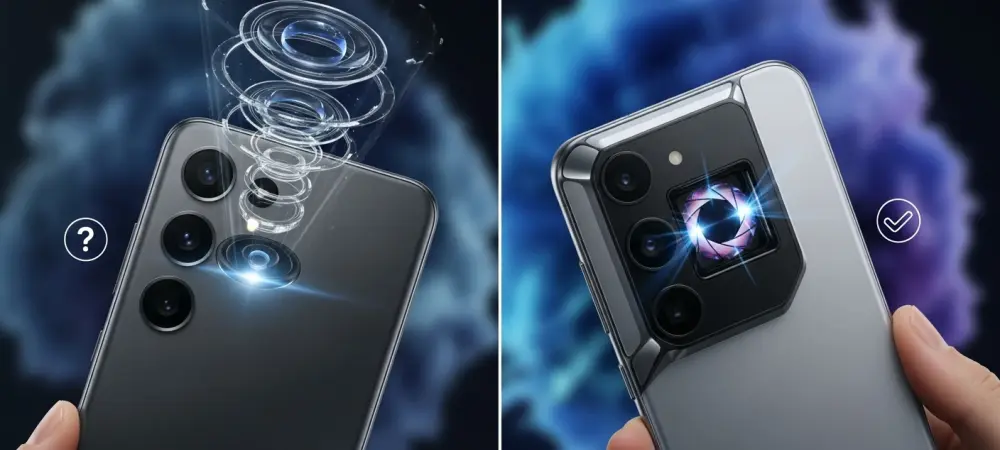
Virtual Aperture is currently limited to the main sensor on the Galaxy S25 series. What specific technical hurdles do engineers face when porting this software to telephoto lenses, and could you walk us through the step-by-step process of how this simulation enhances background blur in portrait photography?
Porting Virtual Aperture to a telephoto lens is a delicate balancing act because telephoto optics naturally have a narrower field of view and different depth characteristics than a 200MP main sensor. When an engineer moves this feature from the main camera of the Galaxy S25 Ultra to the zoom lens, they must recalibrate the AI algorithms to interpret distance data without the same light-gathering capabilities. The process begins with the Expert RAW app capturing a high-bitrate image, followed by the software generating a depth map to distinguish the subject from the background. By mathematically applying a Gaussian blur that mimics the bokeh of a wide lens, the device can turn a flat-looking portrait into something that feels professional and atmospheric. This simulation allows users to slide through different aperture values to find that sweet spot where the subject pops and the background melts away elegantly.
User requests often drive the decision to bring new flagship software features to older hardware via updates. How does this back-porting strategy impact a device’s long-term value, and what specific metrics do manufacturers look at when testing if an older processor can handle advanced image processing?
When Samsung listens to the internet community and decides to bring Galaxy S26 features to the S25 series, they are essentially protecting the consumer’s investment by extending the “newness” of the device. This strategy turns a $799 or $1,300 smartphone into a living platform rather than a static piece of hardware that depreciates the moment a newer model is released. Engineers look at heat dissipation and NPU cycles to ensure that the 12GB of RAM found in these models can sustain the heavy lifting required for real-time blur simulation. If a device like the S25 Ultra can process these complex image layers without a significant lag in the viewfinder, it proves the hardware’s longevity and builds brand loyalty among those who don’t want to upgrade every twelve months. It is a win for the user who gets flagship performance at a price point that might have dropped to as low as $443 on the secondary market.
Discussion is shifting toward the return of physically variable apertures, similar to those seen on the Galaxy S9. How does physical hardware compare to software-simulated bokeh in low-light environments, and what are the practical implications for the thickness and mechanical complexity of future smartphone designs?
The shift back toward physical hardware, which we haven’t seen since the Galaxy S9 and S10, represents a fundamental change in how we handle light in challenging environments. Software-simulated bokeh can sometimes struggle with fine details like stray hairs or transparent objects, whereas a mechanical aperture naturally controls the light hitting the sensor, providing a genuine blur that software can only hope to mimic. However, implementing a physically variable aperture, as rumored for the Galaxy S27 or iPhone 18 Pro, introduces significant engineering headaches regarding the internal layout of the phone. These moving parts require physical space, which could lead to a thicker camera bump or a trade-off in battery capacity to accommodate the mechanical blades. It’s a nostalgic return to form that promises superior low-light performance, but it challenges the modern obsession with razor-thin smartphone profiles.
What is your forecast for smartphone camera technology?
My forecast for the industry is that we are entering an era where the line between professional DSLRs and mobile devices will become almost indistinguishable for the average consumer. We will see a hybrid approach where high-end flagships, possibly starting with the Galaxy S27, combine massive sensors with mechanical apertures to capture raw optical data that was previously impossible on a phone. At the same time, the software side will continue to evolve, using generative AI to fill in the gaps where physics fails, such as perfectly reconstructing backgrounds in ultra-low-light shots. Eventually, the focus will shift from just taking a picture to creating a scene, where the hardware provides the canvas and the software provides the infinite possibilities of a professional studio. The future is one of immense flexibility, where your pocket device is no longer a compromise, but a primary tool for artistic expression.