

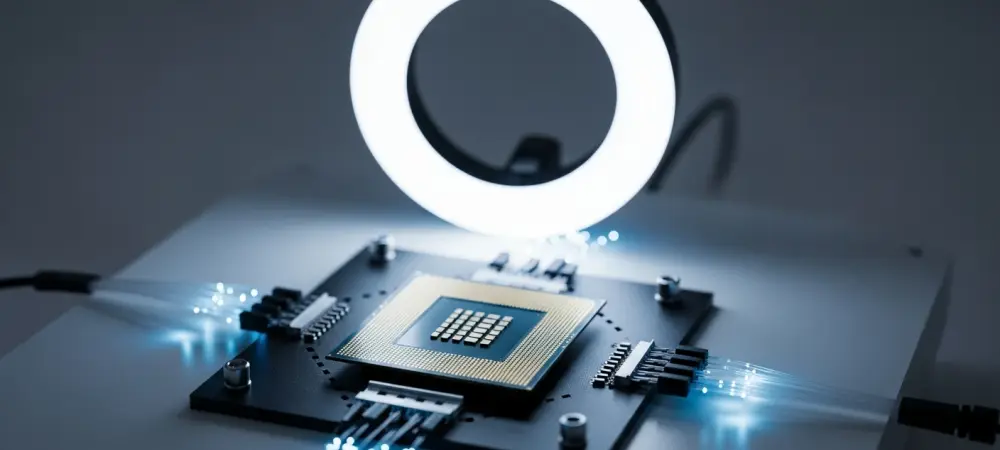
The dominant landscape of artificial intelligence infrastructure is currently undergoing a seismic shift as the industry moves away from the massive power requirements of legacy GPU architectures. While the market has long been held in a state of near-monopoly by traditional heavyweights, Tensordyne’s introduction of the Napier chip represents the first credible threat to this established order since the early proliferation of deep learning. Data centers globally are struggling with the cooling and power demands of current-generation Blackwell chips, leading to a desperate search for alternatives that prioritize architectural efficiency over raw transistor counts. The Napier chip claims to solve these issues by utilizing a radical new mathematical approach to tensor operations, potentially reducing power consumption by up to sixty percent while maintaining the throughput necessary for large language model training. This tension between established reliability and groundbreaking efficiency sets the stage for a transformative era where the definition of high-performance computing is being rewritten from the ground up by innovative startups.
Architectural Shifts: Beyond Traditional GPU Design
The engineering philosophy behind the Napier chip diverges significantly from the general-purpose nature of modern graphics processing units, opting instead for a specialized tensor-native design. By implementing hardware-level support for logarithmic number systems, Tensordyne managed to bypass the heavy computational overhead associated with floating-point arithmetic in standard neural network layers. This transition allows for much faster matrix multiplications, which are the fundamental building blocks of generative artificial intelligence models, without the heat generation that typically plagues high-density server racks. Furthermore, the chip integrates a novel high-bandwidth memory interface that eliminates the bottlenecks often found in multi-chip interconnects, ensuring that data flow remains consistent during peak utilization. As enterprises look toward the period between 2026 and 2028, the ability to pack more compute density into existing floor space without upgrading electrical grids has become the primary metric for success in the hardware sector.
While NVIDIA relies on the massive inertia of its CUDA software platform to maintain its market lead, the Napier chip presents a compelling case for specialized silicon that targets specific model architectures. The industry has seen a growing trend where developers are increasingly comfortable with abstraction layers like PyTorch and JAX, which can target diverse hardware backends without requiring deep manual optimization. This shift reduces the “software moat” that previously protected incumbent players, allowing Tensordyne to focus purely on the performance-to-watt advantages of their silicon. In rigorous testing environments, the Napier silicon has demonstrated an ability to handle inference tasks for trillion-parameter models with a fraction of the latency observed in conventional systems. This performance parity, coupled with a significantly lower total cost of ownership, suggests that the historical dominance of general-purpose GPUs is being challenged by highly tuned, application-specific integrated circuits designed specifically for the transformer era.
Strategic Integration: Future Directions in Hardware
To capitalize on these technological advancements, IT leaders must begin evaluating their hardware roadmaps with a focus on diversifying their vendor portfolios to mitigate supply chain risks. Implementing a multi-vendor strategy that includes emerging options like the Napier chip allows organizations to leverage competitive pricing while ensuring that their compute capacity is not tied to a single proprietary stack. It is advisable to conduct pilot programs targeting specific inference workloads where the Napier chip’s efficiency can be most easily quantified against existing benchmarks. Furthermore, investing in cross-platform development frameworks will ensure that internal engineering teams remain flexible and capable of porting models across different silicon architectures as the market evolves. Monitoring the energy-efficiency ratings of new deployments will also become critical as global regulations regarding data center power consumption continue to tighten. Taking these steps ensures that a company remains at the forefront of the AI revolution without being sidelined by the volatility of a single hardware supplier.
The arrival of the Napier chip signaled a fundamental shift in how the industry approached the challenges of scaling artificial intelligence infrastructure during a time of resource constraints. Early adopters found that the transition to specialized tensor-native silicon provided the necessary breathing room to scale their operations without exceeding their environmental or financial limits. The success of this architectural pivot demonstrated that the focus had moved from raw peak performance to a more nuanced understanding of efficiency and total system throughput. As more organizations integrated these chips into their production environments, the market responded by prioritizing modularity and open standards over the monolithic designs that characterized the previous decade. This period of rapid experimentation and diversification ultimately paved the way for a more resilient and sustainable technological landscape. The lessons learned during this transition provided a clear roadmap for future developments, ensuring that the next generation of hardware would be built on the principles of efficiency and accessibility rather than just brute force.