

The relentless demand for sophisticated artificial intelligence has finally outpaced the limitations of traditional infrastructure, forcing industry leaders to reconstruct their entire approach toward building the massive computational facilities required for the modern era. While the typical timeline for constructing a hyperscale data center often stretches toward the end of the decade, SpaceX’s Colossus 1 achieved operational status in a staggering 122 days. This was not a modest pilot project but the transformation of a defunct manufacturing plant into a high-density AI training cluster that rivals the largest facilities on Earth. The project represents a radical departure from industry norms, signaling a shift where the time to power is no longer measured in years, but in months. By the time Colossus 2 became the world’s first operational gigawatt-scale facility, the tech industry realized that the bottlenecks of the American energy grid were being bypassed by sheer industrial force and unprecedented capital deployment.
This velocity has redefined what it means to be a hyperscale operator. In Memphis, the conversion of the former Electrolux plant from a hollowed-out industrial shell into a 300-megawatt computing powerhouse happened at a pace that shocked veteran infrastructure planners. The facility was essentially built while the ink was still drying on the initial designs, proving that when the cost of delay is measured in billions of dollars of lost AI training time, the traditional rules of construction are discarded. Colossus 2 further expanded this footprint, pushing the site into the gigawatt range and effectively creating a private industrial ecosystem that operates on a scale previously reserved for national utilities. This sprint was not just about building walls and installing racks; it was about the coordinated mobilization of thousands of specialized contractors and the procurement of hardware at a global scale.
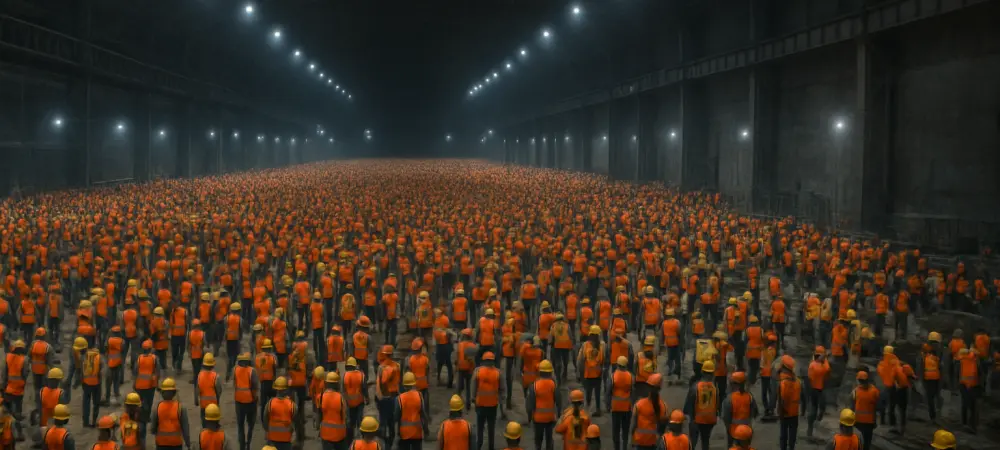
The massive scale of these projects has forced a broader conversation about the future of the American workforce in the industrial sector. To meet the 122-day deadline, the site required a constant presence of roughly 3,000 workers operating in around-the-clock shifts. This labor intensity suggests that the future of data center infrastructure is as much about human logistics as it is about digital innovation. As other companies look to replicate this success, they are finding that the primary hurdle is not just securing the chips or the power, but finding the sheer volume of skilled tradespeople capable of executing such a complex build in a condensed timeframe. This shift from a slow, methodical approach to a high-velocity industrial model has permanently altered the competitive landscape for artificial intelligence development.
A 122-Day Sprint to Gigawatt Scale
The transition from a derelict oven factory to a state-of-the-art training hub for frontier AI models serves as a case study in industrial agility. By the time most competitors have finished their environmental impact studies, SpaceX had already completed the initial wiring of 100,000 graphics processing units. This achievement was facilitated by an aggressive reuse of existing physical space, which allowed the team to bypass the groundwork phases that typically consume the first eighteen months of a project. Instead of pouring new concrete foundations and waiting for structural steel to arrive, the team worked within the existing bones of a facility that was already designed to handle heavy industrial loads. This decision saved months of time and provided an immediate shelter for the installation of high-density cooling systems and power distribution units.
As the project moved into its second phase, the focus shifted from mere capacity to total energy dominance. Colossus 2 was designed to be a gigawatt-scale facility from its inception, meaning it required enough power to support a small city. Achieving this required a total departure from the standard utility-dependent model. By integrating massive energy storage and on-site generation, the site became a self-sustaining island of compute. This expansion was not just a linear growth of the first facility; it was a comprehensive upgrade that introduced more efficient thermal management systems and a more resilient power architecture. The speed at which this transition occurred confirmed that the traditional multi-year construction cycle was a choice, rather than a physical necessity, for those with the resources to force a different outcome.
Furthermore, the operationalization of these facilities has attracted the attention of the largest players in the technology sector. Major entities such as Google and Anthropic have already moved to secure capacity within these clusters, recognizing that waiting for their own facilities to come online would put them at a severe disadvantage in the race for model supremacy. These partnerships have validated the SpaceX model, showing that the market values speed and availability over the aesthetic or traditional perfection of a purpose-built data center. The success of the sprint has created a new standard for neocloud providers, where the ability to bring massive clusters online in under six months is now the benchmark for being a serious contender in the high-stakes AI training market.
The Collision of AI Ambition and Infrastructure Stagnation
The emergence of frontier AI models has created an insatiable demand for compute, yet the physical reality of the U.S. power grid remains stuck in a bygone era. With the American Society of Civil Engineers labeling energy infrastructure with a D+ grade, the three-to-seven-year wait times for utility interconnections have become the primary threat to technological progress. The grid is currently plagued by a massive backlog of projects that are ready to go but cannot get the necessary permissions to plug in. For a company like SpaceX, which is trying to build the next generation of intelligence, these delays are unacceptable. The move into the data center sector via xAI is a direct response to this friction, highlighting a critical trend where leading in AI requires a company to essentially become its own utility provider.
Navigating a landscape of regulatory potholes and infrastructure hurdles has become a core competency for modern tech giants. The stagnation of the grid is not just a technical problem; it is a bureaucratic one. Permitting for a single high-voltage transmission line can take longer than the entire lifecycle of an AI model generation. By the time the utility is ready to provide power, the hardware inside the data center may already be obsolete. This mismatch between the speed of digital innovation and the glacial pace of physical infrastructure has created a vacuum that only the most well-capitalized and aggressive companies can fill. They are forced to bypass the traditional utility model, engaging in direct negotiations with power plants or building their own generation capacity behind the meter to maintain their competitive edge.
This infrastructure gap has profound implications for national competitiveness. As other nations move to streamline their energy permitting, the United States risks falling behind if it cannot find a way to modernize its grid at a pace that matches its software ambitions. The Colossus project serves as a loud warning to policymakers that the private sector is beginning to find ways to work around the public grid because the public grid is no longer reliable or fast enough to meet its needs. This “brute-force” approach to infrastructure is a temporary fix for a systemic problem, and while it allows a few elite companies to keep moving, it leaves smaller innovators and the broader economy struggling with a failing and congested energy system.
Strategic Blueprints of the Colossus Buildouts
The success of the Colossus initiative is rooted in a risk-heavy strategy that prioritizes immediate capacity over traditional architectural perfection. One of the most effective components of this strategy was the prioritization of the interconnect over the quality of the building shell. By repurposing an old Electrolux factory, the company inherited active substations and high-capacity gas mains that were already zoned for heavy industry. This allowed them to treat the facility as a secondary concern, focusing instead on the existing legal and physical links to the power grid that are nearly impossible to secure from scratch in a short timeframe. They realized that a functional, old building with a massive power pipe is infinitely more valuable than a beautiful new building that cannot get a utility connection for five years.
In addition to site selection, the project utilized a model of disaggregated permitting and parallel workflows to shave years off the schedule. Unlike standard projects that follow a sequential path, the construction team treated every component—cooling, power generation, and compute—as a separate track. By advancing these simultaneously, they could deploy their workforce to build while certain permits were still in the temporary or modification phase. This parallel construction model reduces the overall project duration by years, though it significantly increases the complexity of coordination and the initial capital risk. If a permit is denied late in the process, the company would have to undo months of work, but for SpaceX, the risk of being late was far greater than the risk of having to rebuild.
To finally bypass the grid queue, the project relied heavily on behind-the-meter generation. This involved purchasing a distressed power plant site and using private transmission lines to connect directly to the data center. By relying on a fleet of rented mobile turbines and truck-mounted generators, the Colossus facilities can operate independently of the public grid. This effectively creates a massive, private microgrid that functions outside traditional utility constraints. This strategy allowed them to bridge the gap until permanent, higher-capacity utility lines could be installed, ensuring that the GPUs were never sitting idle while waiting for the local power company to finish its upgrades.
Expert Perspectives on the Colossus Model
Industry analysts view the Colossus project as both a feat of engineering and a warning of resource scarcity. Independent satellite analysis from firms such as Epoch AI confirms that these facilities are fully operational, yet experts note that SpaceX’s success relied on brute-force procurement that may not be sustainable for the wider market. One of the most striking aspects of the buildout is the sheer volume of equipment consumed. Reports indicate that SpaceX rented roughly two-thirds of the total available mobile turbine fleet in the U.S. and one-quarter of the nation’s mobile cooling capacity. This first-mover advantage allowed them to bridge the gap until permanent power arrived, but it has effectively stripped the market of the tools other companies would need to replicate the feat.
While the speed is impressive, analysts have pointed out that it comes with a fragile legal foundation. To overcome domestic shortages of critical electrical components, SpaceX imported over 2,000 metric tons of three-phase transformers from international suppliers. However, new executive orders and tightening national security policies regarding foreign-made grid equipment suggest that this workaround may soon be closed off. Expert consensus suggests that while a blueprint for speed has been established, the regulatory risks could derail similar future projects if the government begins to crack down on the use of temporary power permits or non-domestic hardware in critical infrastructure. The legal and environmental scrutiny from local communities in Memphis and Southaven also highlights the growing friction between rapid industrialization and local quality-of-life concerns.
There is also the question of economic efficiency. While the revenue potential of an operational gigawatt cluster is astronomical, the cost of renting mobile turbines and importing equipment at short notice is equally high. Experts suggest that this model only makes sense for companies that are chasing the “frontier” of AI training, where the first-mover advantage is worth any price. For more traditional enterprise data centers, the “Colossus model” might be prohibitively expensive. Nevertheless, the project has proven that the primary bottleneck to AI progress is no longer the availability of chips or the complexity of the algorithms, but the sheer physical ability to move megawatts of power into a single location.
Strategies for Rapid Infrastructure Deployment
For enterprises looking to accelerate their own infrastructure, the Colossus project offers several practical frameworks that can be adapted to current market realities. A primary lesson is the implementation of microgrid resilience to manage the technical demands of AI training. These training runs involve massive, instantaneous spikes in power load that can destabilize local grids and cause