

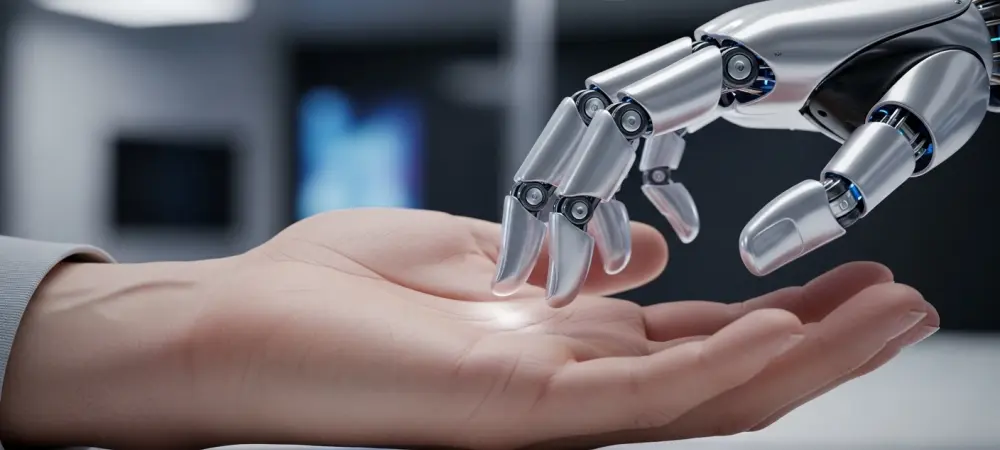
For all their computational power and visual acuity, modern robots often interact with the physical world with the subtlety of a toddler in mittens, a fundamental limitation that has long stymied their potential in complex, real-world tasks. This disparity between what a robot can see and what it can physically accomplish has kept automation confined to highly structured environments. The missing ingredient has always been a nuanced sense of touch, the very feedback mechanism that allows humans to handle objects with both strength and gentleness.
The ability to feel pressure, texture, and slippage is not merely a refinement; it is the final frontier for creating machines that can work alongside people, assemble delicate electronics, or even harvest fragile produce. While robotic vision has achieved near-human levels of perception, manipulation has remained stubbornly clumsy. Therefore, the development of advanced tactile sensing represents a critical leap toward building robots that are not just powerful, but also genuinely dexterous and adaptable.
The Decades-Long Quest for a Sensitive Grip
The history of robotics is littered with simple, rigid grippers designed for one purpose: to grasp and release objects with predictable shapes in a controlled setting. These early systems, foundational to industrial automation, operated with binary logic, lacking any capacity to adjust their force or understand the object they were holding. While effective for repetitive factory tasks, their inherent limitations made them unsuitable for any application requiring a delicate or responsive touch.
Engineers have long recognized this shortcoming, leading to decades of research aimed at replicating the human hand’s extraordinary sensitivity. The challenge, however, has proven immense. The human sense of touch is a complex symphony of feedback from thousands of nerve endings, detecting subtle changes in pressure, shape, and texture across a dynamic surface. Early attempts to create robotic equivalents were often too fragile, expensive, or computationally demanding for practical use, leaving a persistent gap between laboratory prototypes and commercially viable solutions.
XELA Robotics uSkin: A Leap Forward in Tactile Technology
The unveiling of the uSkin 3D tactile sensing platform by XELA Robotics at CES 2026 marked a pivotal moment in this long-standing quest. Developed as a spinout from Waseda University, the Japanese firm presented a technology designed not as a niche research tool but as a practical, integrable solution to finally give robots the sense of touch they have so desperately needed. uSkin aims to provide continuous, human-like feedback, transforming how machines interact with the physical world.
A Multi-Layered, Skin-Like Architecture
At the heart of uSkin’s innovation is an architecture that elegantly mimics biological skin. The sensor is constructed with a durable, protective outer layer that can withstand the rigors of industrial use, shielding the delicate components within. Beneath this lies a soft, deformable elastomer that conforms to the shape of any object it touches, much like human flesh.
This elastomer is bonded to a dense base layer embedded with sensors that measure its displacement. When the gripper makes contact with an object, the elastomer compresses and shifts, and the underlying sensors translate this physical deformation into rich, three-dimensional data. This multi-layered design allows the system to perceive complex interactions far beyond simple force, capturing the nuances of shape and texture.
Comprehensive 3D Force and Shape Detection
Unlike simpler sensors that measure pressure at a single point, uSkin captures three-axis displacement across its entire surface. This means it can detect not only how hard it is gripping but also the direction of the force—whether it is a direct press, a sheer, or a twist. This capability extends across all points of contact, including the fingertips, phalanges, and even the palm of a robotic hand.
This comprehensive data stream enables a robot to build a detailed “feel” for an object. It can perceive its contours, identify its orientation, and, most critically, detect the subtle micro-movements that signal a slip. By processing this high-fidelity feedback in real time, a robot can instinctively adjust its grip with precision, preventing drops or damage without human intervention.
A Practical and Adaptable Approach to Commercialization
What truly sets uSkin apart from previous laboratory-bound technologies is XELA Robotics’ pragmatic, hardware-agnostic strategy. Instead of developing a proprietary robotic hand, the company has engineered uSkin as a versatile component designed for straightforward integration into existing systems. This approach dramatically lowers the engineering barriers for companies seeking to upgrade their automation capabilities with advanced sensing.
This focus on adaptability positions uSkin as a key enabler for the growing field of “physical AI.” As artificial intelligence models become more adept at reasoning and problem-solving, they require more sophisticated physical hardware to execute their decisions in the real world. By providing a rich stream of tactile data, uSkin gives these AI systems the sensory input they need to learn, adapt, and perform complex physical tasks with greater autonomy and reliability.
uSkin in the Real World: Current Deployments and Partnerships
Demonstrating its market-readiness, uSkin is already being deployed in both academic research and commercial pilots. These early applications are proving its value in scenarios that were previously too challenging for automation, such as handling irregularly shaped components or sorting fragile goods.
The technology’s adaptability is further showcased by XELA’s growing list of collaborations. The company has successfully integrated uSkin with hardware from industry leaders like Wonik Robotics, Weiss Robotics, and Robotiq. A particularly notable partnership with Tesollo has resulted in its integration into the advanced DG-5F five-fingered anthropomorphic hand, demonstrating its potential for creating truly human-like robotic systems. Key target markets include manufacturing, logistics, and agriculture, where enhanced touch promises to reduce costly errors and minimize product damage.
Reflection and Broader Impacts
The introduction of a commercially viable, high-fidelity tactile sensor like uSkin signals a fundamental shift in the potential of automation. It moves robotics beyond mere programmed repetition and toward dynamic, responsive interaction with the unpredictable physical world.
Strengths and Challenges
The primary strengths of uSkin lie in its robust, bio-inspired design and its hardware-agnostic integration strategy, making advanced touch accessible to a wider market. However, challenges remain. The cost of such sophisticated sensors could be a barrier to widespread adoption, and scaling manufacturing to meet industrial demand will be a critical hurdle. Furthermore, the sheer volume of high-fidelity data generated by uSkin requires significant computational power for real-time processing, adding another layer of complexity for integrators.
The Future of Physical AI
Looking forward, the implications of human-like touch for robotics are profound. This technology could enable new applications in delicate assembly lines, advanced quality control where robots can “feel” for defects, and even assistive healthcare, where robots could provide personal care with a safe and gentle touch. The fusion of advanced tactile sensing with sophisticated AI promises a future where robots can perform a much wider range of tasks safely and effectively alongside humans.
Conclusion: The Dawn of the Dexterous Robot
This exploration highlighted the long-standing challenge of robotic dexterity and revealed how XELA Robotics’ uSkin technology presented a significant breakthrough. By successfully engineering a sensor that mimics the structure and function of human skin, the company has provided a tangible solution to the persistent gap between robotic perception and physical action.
The development of a practical, adaptable tactile sensor marked a crucial step toward a future where robots interact with the world with the same nuance and care as a human. This advancement did more than just improve a machine’s grip; it opened the door to a new era of automation, one defined not by brute force, but by intelligent and sensitive finesse.