

Despite decades of progress in workplace safety protocols and personal protective equipment, modern industrial facilities continue to grapple with a persistent paradox where human fallibility remains the greatest unaddressed vulnerability. This gap between safety policy and on-the-ground reality creates a costly and dangerous environment, challenging the very foundation of operational excellence. The core of this issue lies not in a lack of effort but in the inherent limitations of manual-first processes, which expose facilities to systemic risks that traditional safety measures are ill-equipped to handle.
This article explores the shift from a reactive safety posture to a proactive, integrated culture driven by automation. It examines how automated solutions, such as Automated Guided Vehicles (AGVs) and Automated Mobile Robots (AMRs), are not merely tools for productivity but foundational elements in engineering a safer, more resilient workplace. The discussion will navigate the systemic failures of manual operations, the evidence supporting a robotic revolution in safety, and a practical framework for designing a facility where safety is built-in, not bolted on.
Beyond the Hard Hat Why Is a 1.69 Billion Dollar Safety Problem Still Plaguing Modern Industry
The staggering annual cost of $1.69 billion in injury-related expenses for manufacturers serves as a stark reminder that conventional safety strategies are falling short. For years, the industry has relied on personal protective equipment, machine guarding, and procedural checklists as the primary lines of defense. While essential, these measures are fundamentally reactive; they are designed to mitigate the consequences of an incident rather than prevent its root cause. In today’s high-speed, high-throughput environments, this reactive approach is proving to be both financially unsustainable and inadequate for protecting the workforce.
The problem is systemic. A culture built around responding to accidents, rather than proactively eliminating their sources, perpetuates a cycle of risk. It places the burden of safety entirely on human vigilance, a variable that is easily compromised by the very nature of industrial work. This outdated paradigm fails to address the underlying operational vulnerabilities that give rise to accidents in the first place, leaving both workers and the bottom line exposed.
The Ticking Clock Exposing the Inherent Dangers of Manual First Operations
In high-throughput industrial environments, the pressure to meet demanding production targets creates a high-risk reality. Manual tasks, particularly those that are repetitive, physically demanding, or performed in close proximity to heavy machinery, are breeding grounds for incidents. The pace and complexity of these operations mean that a minor lapse in concentration or a moment of fatigue can have cascading and catastrophic consequences. The operational clock is always ticking, pushing the limits of human endurance and increasing the probability of error.
Consequently, industries must move beyond traditional safety measures and toward an integrated, proactive culture. This evolution requires a fundamental shift in mindset, viewing safety not as a set of rules to be followed but as an operational characteristic to be engineered. The goal is to design a work environment where the potential for human error is minimized through intelligent system design, creating a workplace where safe operation is the default, not the exception.
The Three Systemic Failures Automation Is Uniquely Positioned to Solve
A primary vulnerability in manual systems is the pervasiveness of human error. This is not an indictment of the workforce but an acknowledgment of the inevitable consequences of fatigue, stress, and repetition. Studies consistently show that manual tasks, from incorrect equipment assembly to inaccurate data entry, are a leading cause of operational disruptions. These mistakes create immediate safety hazards, result in costly rework, and undermine the reliability of the entire production chain.
Furthermore, many facilities suffer from the fragility of their data integrity. Outdated, paper-based systems are notoriously prone to error, but even disconnected digital systems create unseen vulnerabilities. Without robust integration and standardized communication protocols, facilities are exposed to data loss, security breaches, and malware. These threats can halt operations, trigger compliance failures, and create significant financial liabilities.
This lack of reliable, integrated data contributes to a third critical failure: the danger of lacking operational visibility. Without a real-time, comprehensive view of the entire facility, management cannot identify systemic issues like skill gaps, infrastructure bottlenecks, or recurring process failures. This forces the organization into a reactive, “run-to-fail” approach to maintenance and process management, where problems are only addressed after a breakdown. This strategy is not only inefficient but also dramatically increases the risk of equipment malfunctions that can lead to serious worker injuries.
The Evidence for a Robotic Revolution in Workplace Safety
The case for automation is powerfully supported by data. With human error accounting for as much as 80% of all unplanned downtime in industrial settings, the impact of manual processes on both safety and productivity is undeniable. Each instance of downtime represents not just a loss of output but a potential safety risk, often requiring manual intervention in a compromised or unstable environment. Robots, by design, execute tasks with precision and repeatability, directly addressing the root cause of this variability and creating a more predictable and controlled operational landscape. This evidence is fueling a new consensus: automation fundamentally shifts safety from a reactive measure to a foundational element of operational infrastructure. By deploying AMRs and AGVs to handle material transport, machine tending, and other high-risk tasks, facilities physically separate workers from hazardous zones. Moreover, these systems generate a constant stream of operational data, providing the visibility needed to anticipate maintenance needs, optimize workflows, and prevent incidents before they occur. In this model, safety is no longer a checklist but an outcome of a well-engineered system.
A Practical Guide to Designing a Safety First Automated Facility
The first step in this transformation is to assess existing workflows and transform reactive habits into proactive, systemic solutions. This involves mapping out current processes to identify high-risk manual tasks, data entry points prone to error, and areas with poor operational visibility. By pinpointing these vulnerabilities, managers can strategically target areas where automation will deliver the greatest impact on safety and efficiency. This analysis forms the blueprint for redesigning the work environment around preventative principles.
Next, it is crucial to leverage automation as a foundational safety infrastructure, not just a productivity tool. This means prioritizing the deployment of robots in tasks that pose the highest risk to human workers, such as lifting heavy objects, operating in confined spaces, or interacting with dangerous machinery. The objective is to create a collaborative environment where humans and robots work in synergy, with robots handling the strenuous, repetitive, and hazardous tasks, allowing human operators to focus on higher-value activities that require complex problem-solving and oversight.
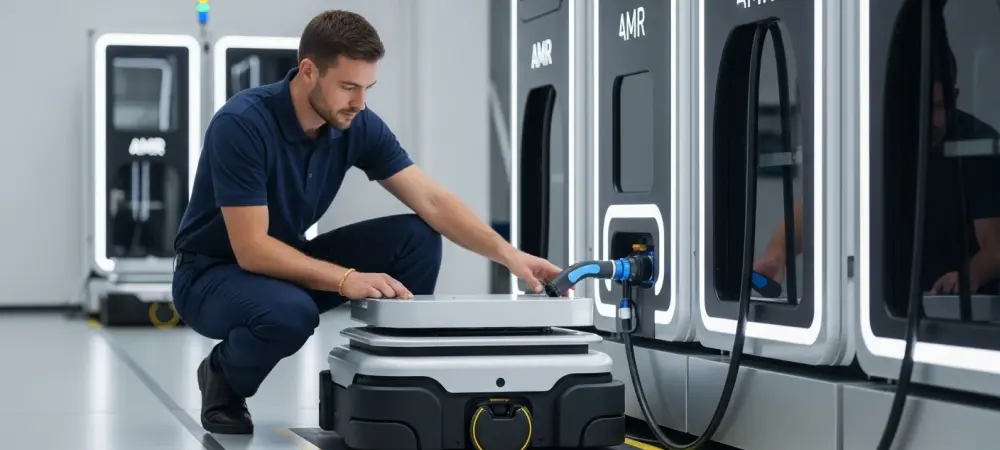
Finally, planning the backbone of a safe and efficient robot fleet is critical, and this hinges on a standardized, scalable charging architecture. As facilities increasingly adopt mixed fleets with vehicles from multiple manufacturers, interoperability becomes a major challenge. Divergent charging technologies and proprietary communication protocols can create operational silos and safety risks. Investing in open communication standards and a universal, adaptable charging infrastructure ensures that the entire robotic fleet operates as a cohesive, reliable, and secure system, future-proofing the facility for technological advancements.
Ultimately, the integration of robotics into the workplace represented a pivotal opportunity to re-engineer safety from the ground up. By moving beyond the limitations of manual-first operations and embracing a systemic, design-centric approach, organizations successfully built environments that were not only more productive but inherently safer. The evidence suggested that a well-planned automated facility, supported by robust infrastructure, did not just reduce accidents—it fostered a true culture of safety that protected its most valuable asset: its people.